

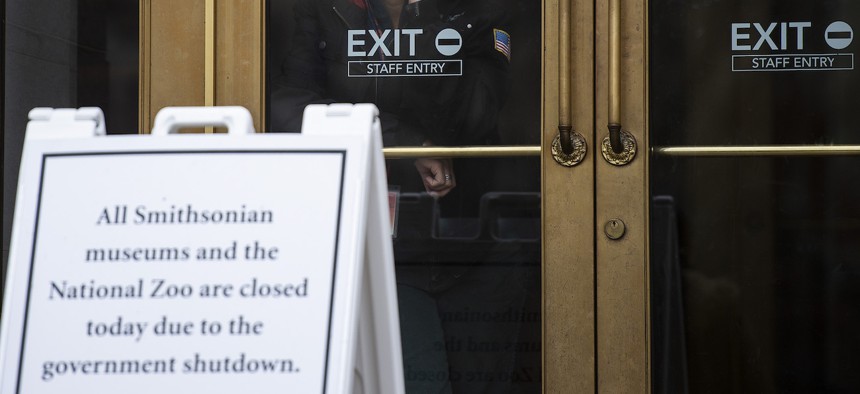
A closed Smithsonian museum in Washington, D.C. on Jan. 18, 2019. The government shutdown lasted 35 days. ANDREW CABALLERO-REYNOLDS / AFP / Getty Images




5 longest government shutdowns in U.S. history
The 2025 budget dispute is now the longest of the impasses that have left lasting impressions on the history of the federal government.

Updated Nov. 13 at 9:54 a.m.
Lasting nearly a month-and-a-half, the 2025 government shutdown marks the longest budget stalemate in U.S. history, at least until the next one.
Over nearly 50 years, Congress’ fiscal disputes have ranged from near misses, such as 2015’s Boehner sacrifice — where then-House Speaker John Boehner, R-Mo, resigned to ensure the passage of a stopgap bill and outmaneuver a faction of House Republicans threatening to oust him — to the 35-day partial government shutdown during the first Trump administration and now the 43-day full government shutdown of the second Trump term.
The shutdowns we’ve come to know today are defined by the 1980 Civiletti opinions, when then-Attorney General Benjamin Civiletti penned an interpretation of the Antideficiency Act that effectively crafted the rules of closing the federal government when appropriations lapse.
However, these fiscal gridlocks have deep history within the federal government, whether they resulted in federal agencies’ closure or not. Here’s a look at the five longest government shutdowns in U.S. history.
The 2025 shutdown
Duration: 43 days
Cause: With mere weeks left in fiscal 2025, House Republicans proposed and passed a "clean" continuing resolution to fund the federal government through Nov. 21, but Senate Democrats refused to advance the legislation without Congress first moving to address expiring Affordable Care Act plan subsidies to help temper escalating health insurance costs.
Resolution: Eight Democratic senators backed a Republican plan to fully fund the legislative branch, Veterans Affairs and Agriculture departments through fiscal 2026 and to fund the rest of the federal government through Jan. 30. The deal also guaranteed back pay for federal workers and unwound 4,000 reductions-in-force issued during the shutdown. Senate Majority Leader John Thune, R-S.D., as part of the deal, agreed to allow a vote on continuing Affordable Care Act subsidies. The House approved the measure three days later.
The 2018-2019 shutdown
Duration: 35 days
Cause: Though Congress has approved appropriations for some of the federal government, nine executive departments and several agencies stopped work on Dec. 22, 2018, after then-President Donald Trump said he wouldn’t sign a continuing resolution without $5.7 billion in federal funds to support construction of his proposed U.S.-Mexico border wall.
Resolution: Five weeks into the dispute, Trump agreed to a three-week CR without additional funding for the border wall. Trump would later sign a fiscal 2019 budget that reportedly included $1.375 billion for steel fencing on a portion of the border.
The 1995-1996 shutdown
Duration: 21 days
Cause: Preceded by a seven-day shutdown in November 1995, the three-week gridlock was a continuation of the dispute between then-President Bill Clinton and House members led by Speaker Newt Gingrich, R-Ga., over how to balance the federal budget and which spending estimates to use.
Resolution: Congress reached a compromised budget with the White House after negotiations to reopen the government in January.
The 1978 shutdown
Duration: 17 days
Cause: According to the Congressional Research Service, prior to the Civiletti opinions, the federal government continued to operate without full appropriation, though it “tended to curtail some operations in response to the funding gap.” In 1978, then-President Jimmy Carter vetoed certain appropriations bills funding a nuclear-powered aircraft carrier and other public works projects, according to Time magazine.
Resolution: Both provisions were later removed from the spending bills.
The 2013 shutdown
Duration: 16 days
Cause: The shutdown took effect over proposed delays and defunding of the Affordable Care Act in the GOP-led House-sponsored CRs, which were opposed by the Democrat-controlled Senate and the White House.
Resolution: House members ultimately passed a Senate-negotiated CR to fund the government through Jan. 15 without delaying or defunding the ACA.