

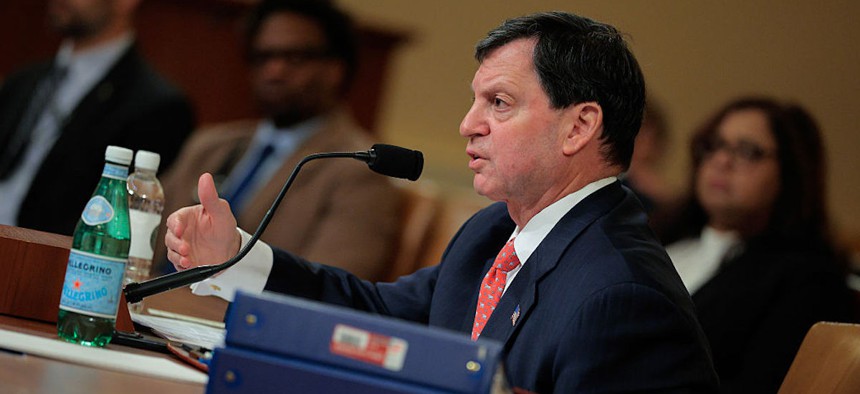
Internal Revenue Service Chief Executive Officer Frank Bisignano testifies before the House Ways and Means Committee in the Longworth House Office Building on Capitol Hill on March 04, 2026 in Washington, DC. The first CEO of the IRS in U.S. history, Bisignano simultaneously serves as the commissioner of the Social Security Administration. Chip Somodevilla/Getty Images





The IRS wants to shrink its workforce by nearly 4,000 — and use technology to make up the difference
“Without modernization, the IRS would be unable to sustain performance with a reduced headcount,” the budget document says.

The IRS has pushed out more than 28,000 employees since Trump’s inauguration. Now, it wants to lose another net 4,000 staff, according to new IRS budget documents.
The tax agency is banking on technology improvements to help it sustain performance at its lower headcount, it says in its fiscal year 2027 budget justification.
“Without modernization, the IRS would be unable to sustain performance with a reduced headcount,” the budget document says. The agency’s modernization budget “represents a prudent and necessary investment to sustain performance, enable future workforce efficiencies, and deliver enduring value to taxpayers and the Nation.”
The IRS estimates that staffing reductions of 4,875 employees will yield “significant savings” of over $777 million. The IRS budget doesn’t specify where or how these cuts would take place, and the IRS and Treasury Department did not respond to requests for comment. Overall, the administration has proposed a $1.4 billion reduction in IRS funding.
Even as the IRS says that it’s relying on technology to make up for a smaller staff size, its technology shop hasn’t been immune to staffing losses. The IRS has shed about 40% of its IT staff, according to Federal News Network, and 80% of its executives. The agency also reassigned 1,500 employees from its IT shop to the office of the chief operating officer last year.
AI “will be part of speeding up everything we’re doing,” Frank Bisignano, the IRS CEO, told lawmakers last month. “We are building an IRS that leverages advanced technology, empowers its workforce with better tools and delivers secure and easily accessible services.”
But Congress’ watchdog warned recently that staffing losses at the IRS have left skill gaps in AI areas that increase the risk that the agency’s AI efforts “will not succeed.”
The agency’s research, applied analytics and statistics unit — one of two main AI hubs at the IRS, helmed by the agency’s AI lead — lost 63 employees who supported the agency’s AI efforts as of May last year.
IT staff at the IRS have also been among those moved to work as tax examiners and contact representatives after the IRS failed to fully staff its divisions tasked with tax processing and customer service in the lead-up to the filing season.
The IRS is also proposing some hires in the new budget request.
The tax agency wants to hire 1,132 employees to “maintain customer service” to help implement the administration’s “One Big, Beautiful Bill” and staff its telephone line, according to the budget, which also previews a push for more online, self-service options for taxpayers so that they don’t have to rely on “assisted channels” in the first place.
This isn’t the first push to make up for staffing losses at the IRS since Trump took office. Last summer, the agency pivoted away from planned layoffs to hiring and reassignments to fill “mission critical skill sets.”
Danny Werfel, who served as IRS commissioner during the Biden administration, told Nextgov/FCW in a statement that “the most important next step is for the IRS to publish a detailed modernization plan that gives the public clear visibility into its technology priorities, timelines, and expected outcomes.”
“The plan should help make clear how, when, and at what budget, the IRS will make up for staffing reductions that may be impeding their stated objective to improve customer service, collections, and data security,” he continued.
That plan appears to be in flux as the IRS anticipates using up the last of its funding from the Inflation Reduction Act in fiscal 2028. Passed in 2022, the law originally gave the IRS almost $80 billion, although $54 billion of that has been rescinded by lawmakers. The IRS was using some of the funding for technology improvements, and now the IRS is re-evaluating its modernization plans as it anticipates the money running dry, the budget says.
Among the work that the IRS had been doing with IRA funding is trying to modernize some of its systems that date back to the 1960s. It appears that that effort is ongoing, as the IRS budget includes a push to modernize its mainframe tax processing systems that are built on over 15 million lines of COBOL, a legacy computer language that fewer programmers are now proficient in.
If you have a tip you'd like to share, Natalie Alms can be securely contacted at nalms.41 on Signal.
NEXT STORY: Cuts hit CISA, NIST and IRS in Trump’s FY27 budget