

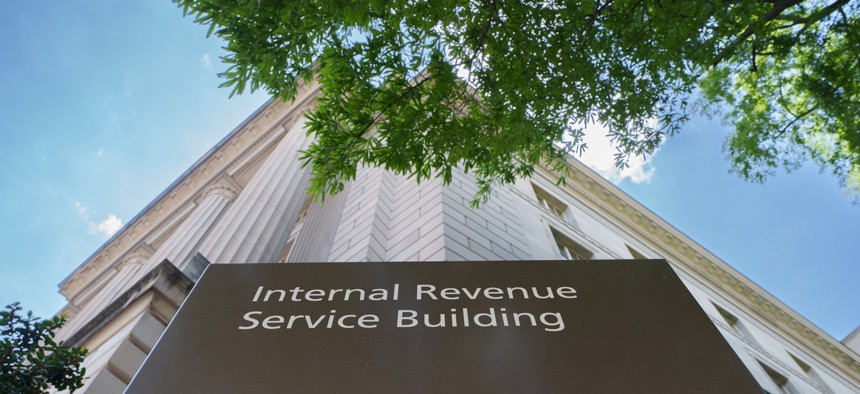
J. David Ake/Getty Images




IRS lacks transparent plans to leverage tech in the face of staffing cuts, GAO and employees say
Agency leaders are “shoving AI at us,” one IRS employee said, despite the fact that “they don’t have the right tools for us yet.”

The IRS is banking on using technology to do more with fewer employees. But staff inside the IRS say that how the agency will do that — considering that its own IT shop has lost personnel — is still unclear, and Congress’ watchdog says that the IRS still isn’t being transparent about its long-term tech plans.
The IRS continues to rely on some systems that date back to the 1960s. It’s been trying to modernize them for decades, and was using some of the money from the Inflation Reduction Act to do so under the Biden administration. Congress has since clawed back most of that funding, and the remainder is set to run out in fiscal year 2028.
A few months after President Donald Trump returned to the Oval Office, the IRS paused its modernization work to re-evaluate its strategy. IRS leadership said they wanted to rely more on generative artificial intelligence to convert legacy code into modern programming languages, and the agency set a goal to finish most of its tech modernization efforts within two years.
Over a year later, the IRS still hasn’t provided the Government Accountability Office with details on its new modernization plan, said David Hinchman, director of IT and cybersecurity at GAO, during a recent roundtable on the IRS.
“Recent changes to IRS' long-term plans have also cast uncertainty over what the agency's modernized end state will look like,” said Hinchman, explaining that the IRS has published “very little” on its new approach.
That’s despite the fact that technological progress is a lynchpin in the IRS’ bigger, overall strategy. After already pushing out over 28,000 employees since Trump took office, the tax agency is aiming to shed more staff and use technology to make up the difference, it said in its recent budget request.
“Without modernization, the IRS would be unable to sustain performance with a reduced headcount,” the budget request said.
Compounding the lack of transparency is a pause in strategic workforce planning, said Hinchman, which would help ensure that the IRS has the right workforce to get the job done.
The IRS didn’t respond to a request for comment.
The IRS hasn’t spared its IT shop from the workforce upheaval that has taken place over the last year. The IRS lost over 2,600 IT employees between January 25 and December 18 of last year, a 31% reduction, according to the National Taxpayer Advocate’s 2025 report.
The IRS also moved over 1,000 IT staff to the office of the chief operating officer last winter, and transferred some of those to jobs helping with filing season, along with human resources specialists.
Agency IT leadership recently told staff that the agency plans to hire 175 IT employees, a tech employee at the agency said.
Even so, IRS leadership isn’t sharing much information internally on the agency’s current plan for its technology, a second tech employee told Nextgov/FCW. Detailed IT strategic plans used to be available within the agency, they said. What’s now available is very abstract.
“It’s hilarious,” they said of the claim that the IRS can use tech to make up for fewer employees.
Using technology to do more with less might be possible in the long run, but “not right now,” the first IT employee told Nextgov/FCW. “We are so short-staffed.”
Despite the staffing shortages, the IRS is planning to capitalize on updates to the online accounts it offers for taxpayers to give Americans access to more self-service options.
The agency is also building a single interface for customer service representatives to allow them to see data about taxpayers that’s currently stored in disparate systems in one centralized place. The IRS thinks this will cut down on call times by speeding up the work of those manning the phone lines. The agency has been trying to build this system since the second Obama administration.
The IRS has also long been working to modernize its core system for individual tax account data, called the individual master file.
The tax agency did put its long-awaited new processing engine for the system into production last year, it said, but more work needs to be done. The effort is one of the most complex modernization efforts in the federal government, and the individual master file touches hundreds of other IRS applications.
“They are shoving AI at us and they think that with that, things can be converted super quickly,” the first employee said of efforts to modernize legacy systems. “But they don’t have the right tools for us yet.”
Frank Bisignano — the head of the Social Security Administration who is also helming a new chief executive officer role at the IRS — told senators earlier this month that data and AI are helping the tax agency with enforcement, even as it’s lost staff and is set to lose more under the Trump administration’s recent budget request.
But GAO reported recently that the agency is facing a skills shortage that could hamper its ability to roll out AI, including systems to prioritize audits.
Among the things that aren’t clear to Congress’ watchdog are how the IRS’ new plans relate to its old strategy to modernize, as well as how and if certain endeavors are continuing, said Hinchman. This isn’t the first time that watchdogs have dinged the IRS for a lack of IT planning.
Leadership under the new administration has altered at least some efforts started during the Biden years. The IRS launched an initiative to digitize paper with funding from the Inflation Reduction Act in 2023 by developing an in-house system. Last spring, leadership directed the IRS to stop working on the project, despite spending $61 million on it already, and shifted to a new approach using contractors, according to a watchdog report.
The IRS also shuttered the Direct File program, launched in 2024 to help certain eligible Americans file their taxes with the government online for free.
If you have a tip you'd like to share, Natalie Alms can be securely contacted at nalms.41 on Signal.
NEXT STORY: GSA No. 2 talks ‘million hours challenge,’ scaling agency AI efforts