

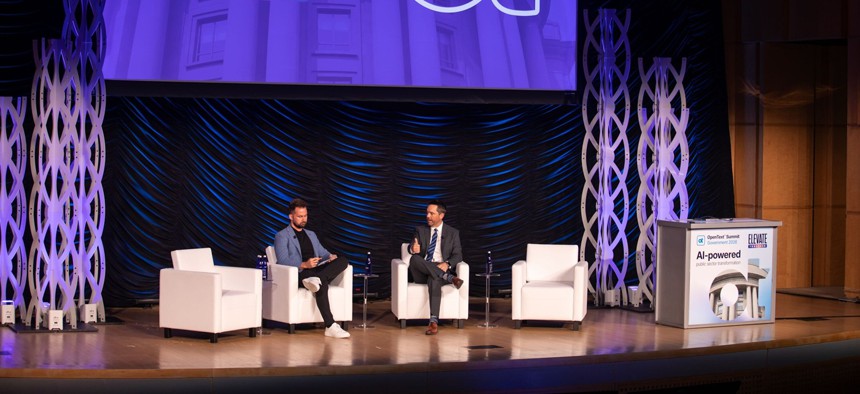
GSA Deputy Administrator Michael Lynch (R) speaks with Government Executive Editor-in-Chief Frank Konkel April 14 at the OpenText Government Summit in Washington, D.C. Courtesy: GSA




GSA No. 2 talks ‘million hours challenge,’ scaling agency AI efforts
GSA Deputy Administrator Michael Lynch last week offered a comprehensive look at the agency’s plans for key acquisition and shared services programs and new internal efforts aimed at automating work.

The General Services Administration is working to save and automate one million hours of workload across the agency as part of its Eliminate, Optimize and Automate — or EOA — playbook.
GSA Deputy Administrator Michael Lynch said the effort aims to use artificial intelligence and intelligent automation to handle “repetitive, manual workflows,” allowing its workforce to redirect their time toward serving customer agencies, improving procurement outcomes and pursuing other mission-critical services. Early into 2026, Lynch said the agency is almost halfway toward achieving its moonshot goal.
“We have about 400,000 hours that are currently identified of ways that we can — not replace people — but remove that non-high-value added time and replace it by putting people on more high-value opportunities within the agency,” Lynch said April 14 at the OpenText Government Summit in Washington, D.C. “And that really goes to address some of the workforce challenges we’ve had.”
Lynch added that GSA, like most agencies across government, lost headcount over the past year, but he asserted the leaner setup hasn’t slowed operations.
In 2025, the agency took on a centralized role in federal acquisition and led a massive overhaul of the process; became a key cog in the Trump administration’s AI Action Plan through the launch of USAI.gov; and negotiated more than two dozen deals with tech companies, saving partner agencies more than $1 billion on software through its OneGov program, according to Lynch.
Still, the agency is looking at more ways to drive innovation, foster collaboration and develop future leaders within its ranks — while tackling some of the agency’s toughest problems.
Called GSA Labs, the new program seeks a few dozen high-performing early-to-mid-career employees within the agency who will be placed into small, cross-functional teams with executive sponsorship to tackle those problems.
“We did a call to action for all of our senior leaders to say, ‘What are the problems that exist within automation technology, workflows and things that you want to dedicate resources to, that you just don't have the staff to do it?’” Lynch said. “And then we put out a call to our workforce to say, ‘Hey, if you’re kind of mid-career talent, would you be interested in doing a second job in addition to your day job — not a second pay job — but you know, be part of this program?’”
Lynch said the response was “amazing,” totaling more than 300 internal applicants who were narrowed to an initial cohort of 30 GSA staff to address five problem statements with a goal of “trying to create interoperable systems and processes."
He noted GSA Labs’ work is largely internal now, but “could be a scalable program in the future.”
“We have 30 individuals from GSA that are going to be almost our internal McKinsey consulting group that’s going to come in and help us solve these problems in partnership with leaders,” Lynch said. “And then the hope would be that further develops our workforce, develops great outcomes for our agency. And then where the program goes in year two and beyond is a bit up in the air.”
Maturation of OneGov
Far from a one-hit wonder, Lynch said to expect a maturation of GSA’s OneGov effort, which netted more than two dozen discounted deals for agencies from AI and tech software firms, including Google Public Sector, Adobe, Salesforce, Elastic, Oracle, Uber, IBM, Docusign, Microsoft, Amazon Web Services, OpenAI, Anthropic and Box.
Some of those were relatively short-term deals, and GSA is using feedback from industry and agencies to inform how that program evolves into “longer-term, scalable programs and engagements that are mutually beneficial for both the federal government as well as our industry partners.”
“Over the next six to nine months, you’ll see a lot more announcements around how those OneGov deals have matured,” Lynch said.
NEXT STORY: Agencies report over 3,000 AI use cases in 2025