

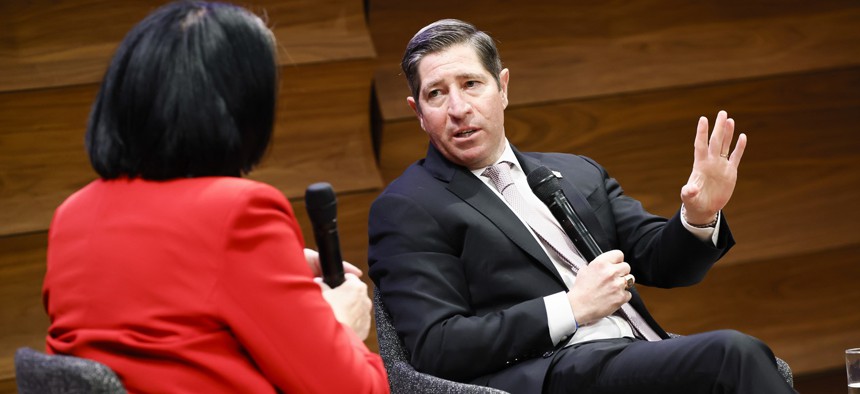
OPM Director Scott Kupor speaks onstage at the U.S. Tech Force Conversation at the Johns Hopkins University Bloomberg Center Theatre on January 14, 2026 in Washington, DC. Paul Morigi/Getty Images for Washington AI Network





Trump’s Tech Force hiring effort extends application deadline
Ethical questions remain about how managers from the approximately 30 industry partners involved in the program will work for the government without triggering conflicts of interest.

Trump 2.0 is extending the application deadline for its new U.S. Tech Force by over two weeks due to “tremendous interest,” the administration announced Thursday.
The goal is to bring in 1,000 young technologists for two-year terms of service across the federal government, although that number may increase, Scott Kupor, director of the Office of Personnel Management, said at a Wednesday event hosted by the Washington AI Network.
The hiring push comes after around 322,000 federal employees left the government between January and November 2025, including technologists.
It should be easier for workers to move between the government and private sector, Kupor said.
About 30 private sector companies like Uber, Microsoft and Anduril are collaborating with the Tech Force. They’ll provide employees as managers for the program, as well as offering training opportunities and participating in a job fair.
Those managers can remain connected to their private sector employers by taking a leave of absence while working for the government — a setup that raises a host of conflict-of-interest questions for some. Participants won't be required to divest from their stocks.
“I know the ethics lawyers hate me when I say this, but I think we can deal with the ethics issues. I'm not worried about that,” said Kupor. “To me, the bigger opportunity is, what's the upside of having that mix.”
“I want to demonstrate that, look, if you do great work in government and you ultimately decide you want to be in the private sector and not in government, then your skill set is transferable to the private sector,” he added.
So far, over 35,000 people have expressed interest in the Tech Force, according to Kupor, although it remains to be seen how many of those will submit full applications.
OPM is working with the NobleReach Foundation to recruit technologists for the program. The nonprofit started its own program to place talent within government agencies, including on the state and local side, in 2024.
NobleReach Foundation CEO Arun Gupta told Nextgov/FCW that there needs to be more infrastructure to connect top tech talent to the government.
Most big federal agencies will take on Tech Force fellows, said Kupor.
“I’m not worried about filling demand,” he said. “Our big challenge is supply… You talk to the IRS guys, they’re like, ‘Look, we’re going to completely modernize how, like the U.S. consumer deals with the IRS. If you can get me 1,000 people tomorrow, I'll take 1,000 people.’”
The IRS lost at least 2,000 technology employees, or about a quarter of its IT workforce, to the Trump administration’s deferred resignation program last year, jeopardizing the agency’s longstanding modernization goals.
Kupor said Thursday that increasing the number of younger people in the federal workforce is a major goal of the Tech Force.
But as the Trump administration sought to downsize the federal workforce last year, “you saw a disproportionate number of young, tech-savvy federal employees being shown the door,” Max Stier, president of the nonpartisan nonprofit Partnership for Public Service, told reporters Thursday.
The percentage of workers under the age of 30 went from 8.9% of the federal workforce to 7.9%, said Stier, who also emphasized the importance of the government clarifying exactly how potential new employees at the Tech Force will be able to maintain relationships with their prior employers.
Tech talent is “vital,” Stier acknowledged, but he said “some of what we’re seeing right now, frankly, is duplicating stuff that used to exist that no longer does.”
The government already has a technology fellowship program for early career technologists called U.S. Digital Corps, although the program didn’t announce a new cohort of fellows last year due to a government hiring freeze, a GSA spokesperson told Nextgov/FCW. The Digital Corps will partner with the Tech Force in sharing best practices and potentially on hiring, they said.
Other existing government tech teams were shuttered outright or saw an exodus of talent due to a mix of layoffs, resignations and retirements, as did many other teams across the federal government.
But some see potential in the new Tech Force model.
The Recoding America Fund, a philanthropic initiative focused on reforming government, has expressed support for the Tech Force, posting on social media that, “across multiple administrations, the federal government has experimented with different models to attract tech talent, and we’re glad to see another approach that we hope will lay the groundwork for continued expansion of top tech talent in the federal workforce.”
The fund is organized around the work of civic technologist Jennifer Pahlka, who helped found the U.S. Digital Service, which President Donald Trump reworked to house the controversial Department of Government Efficiency last year. Pahlka helped set up USDS during the Obama administration, and she’s since gained national attention for work on government reform and been an advocate for the center-left “Abundance” movement that calls for, among other things, cutting excess regulations.
Gupta said Wednesday that one benefit of bringing people into agencies is that it “humanizes” the work of the government.
“When you're on the outside, it just feels like something you can throw rocks at,” he said.
“I had very different views of what I thought things were until I got here,” Kupor concurred. “It’s easy to dehumanize things you don’t understand.”
By far, the Trump administration's highest-profile tech team has been DOGE, which has also done a wide array of non-tech work in the name of cutting costs and employees, up to and including effectively shuttering entire agencies.
One DOGE associate, Sahil Lavingia, was dismissed from DOGE in May last year, after he said in a media interview that he found the government to be more efficient than he expected.
Editor's note: This article has been updated to include a more precise number of federal employees that have left government.
If you have a tip you'd like to share, Natalie Alms can be securely contacted at nalms.41 on Signal.
NEXT STORY: Bill to improve government’s anti-fraud checks heads to Trump’s desk