


porcorex/Getty Images





Navigating the Pay.gov maze for federal retirement deposits
Don't let missing service credits or opaque OPM billing notices shrink your monthly annuity. Here is what you need to know before clicking submit.

Creditable Federal civilian and military service affects both retirement eligibility and the CSRS or FERS monthly annuity, which generally uses the employee’s high-3 average salary, the applicable formula and creditable service. Unpaid deposits and redeposits are treated differently by system, service type and date: some service is excluded, while some remains creditable with an annuity reduction. Employees should review their records early and ask their agency benefits office whether payment is required. The following examples show the difference a deposit can make when the service is not creditable without the payment.
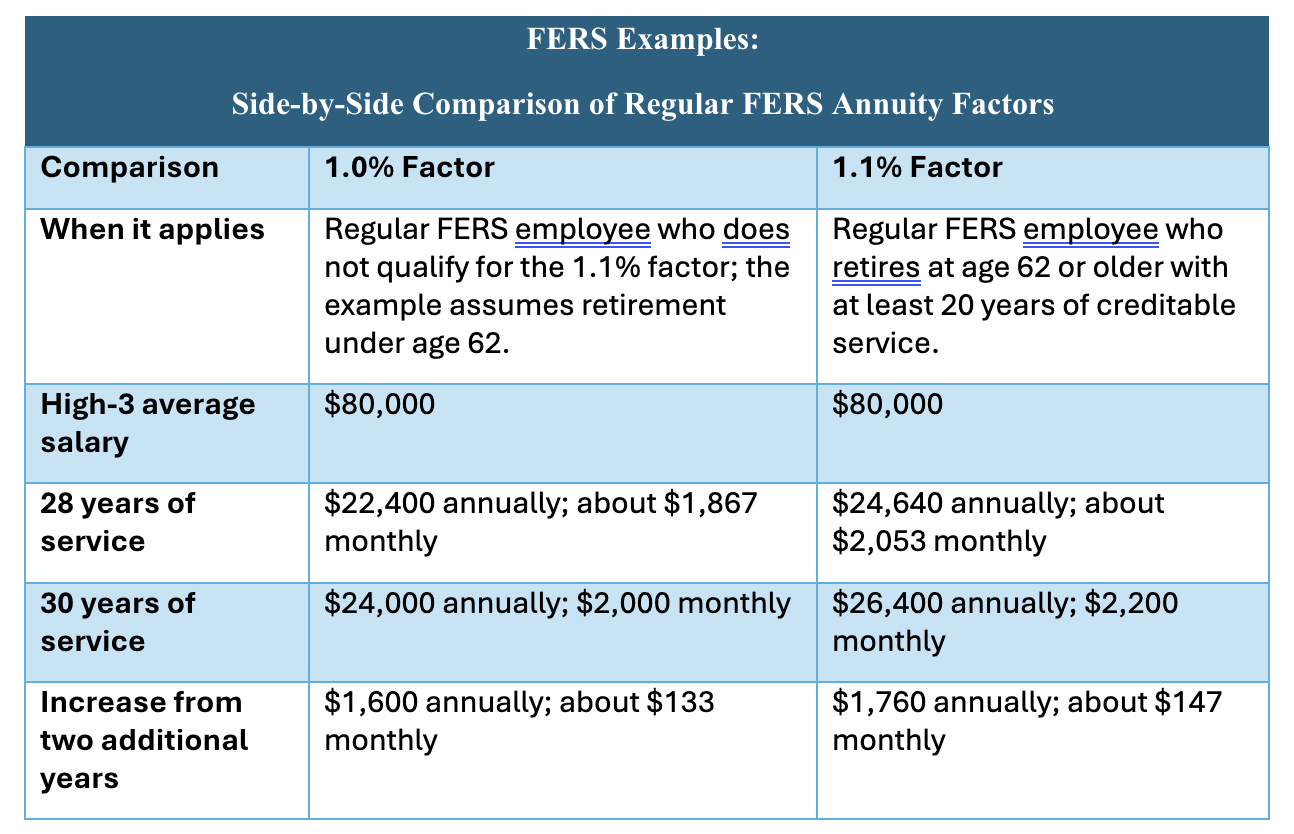
Assumptions and limitations: These examples use an $80,000 high-3, whole years and regular FERS rules. The 1.1% factor applies only at age 62 or older with at least 20 years. Amounts are gross estimates, rounded monthly and exclude special-category rules, partial months, survivor elections, taxes, insurance, court orders and other adjustments. Agency estimates are planning tools; OPM determines the final benefit.
Comparable CSRS example: For a regular CSRS employee with the same $80,000 high-3, the general formula is 1.5% for the first 5 years, 1.75% for the next 5 and 2% thereafter. At 28 years, the estimated annuity is $42,800 annually, or about $3,567 monthly. At 30 years, it is $46,000 annually, or about $3,833 monthly, about $267 more. The estimate excludes special-category rules, deductions, partial months and the CSRS maximum-annuity rule.
What you can pay through Pay.gov
Federal employees and retirees may owe OPM for service credit, insurance premiums or other benefit debts. Pay.gov, the Treasury Department’s secure payment service, eliminates mailing time, guides users through required information and provides an electronic submission record. OPM processing and account-posting times still apply.
A deposit pays for eligible service during which retirement deductions were not withheld; a redeposit repays retirement deductions that were previously withheld and later refunded. Employees should work through their agency benefits office and wait for OPM’s billing information. The active-employee Pay.gov form requires the seven-digit CSD number shown on the statement received from OPM (form RI 36-23).
Important FERS limitation: Civilian service that was not covered by FERS deductions performed on or after Jan. 1, 1989, is not creditable, and an employee cannot make a deposit to obtain credit for that service. Employees should ask their agency benefits office to determine service subject to a service credit deposit to be creditable for retirement eligibility and/or computation.
Annuitants use a separate service-credit form requiring a CSA or CSF claim number. Pay.gov also serves OPM retirees whose annuity cannot cover FEGLI premiums and provides forms for voluntary contributions and certain debts or underpaid benefits. Select the form that exactly matches the obligation.
If your CSRS or FERS annuity is too small to pay your health or life insurance premiums, you can pay your premiums directly to OPM. You shouldn't send any payment until OPM contacts you with instructions on how to pay your premiums to OPM.
Voluntary contributions for CSRS and CSRS Offset employees
Only employees currently covered by CSRS (including CSRS Offset) or separated employees whose application for retirement under CSRS is currently being processed by OPM are eligible to apply or make Voluntary Contributions. Applicants must first pay any required CSRS civilian-service deposit or redeposit, submit SF 2804 through their agency or directly to OPM with their retirement application, and wait for OPM to approve the application and establish the account. “After-tax” contributions are made in $25 multiples and cannot exceed 10 percent of aggregate basic pay for creditable civilian service.
After OPM approves the application and supplies a valid voluntary-contribution account number, employees may use the designated Pay.gov form. A retiring CSRS or CSRS Offset employee may continue making contributions while OPM finalizes the retirement claim, provided OPM continues to accept the payments; contributions must stop when the claim is finalized. Retain each submission confirmation and verify that OPM credited the payment. The account earns interest at rates prescribed by law. At retirement, the balance may purchase an additional CSRS annuity, including an optional survivor feature, or be refunded under applicable rules. The additional annuity does not receive cost-of-living adjustments; compare it with refund and permitted rollover options.
Military service deposits: Who can use Pay.gov
A military service deposit may provide retirement credit for eligible post-1956 active-duty service that ended under honorable conditions. CSRS, CSRS Offset and FERS employees should provide service and estimated-earnings records to their agency and servicing payroll provider. The deposit must be paid to the employing agency before separation, and interest can increase the cost after the initial two-year interest-free grace period for new hires.
Pay.gov is available only when the servicing payroll provider offers a military-deposit form and issues the required billing information. DFAS- and Interior Business Center-serviced employees may use their provider’s form when instructed. Do not choose a form simply because it appears in a search; it must match the payroll provider and notice.
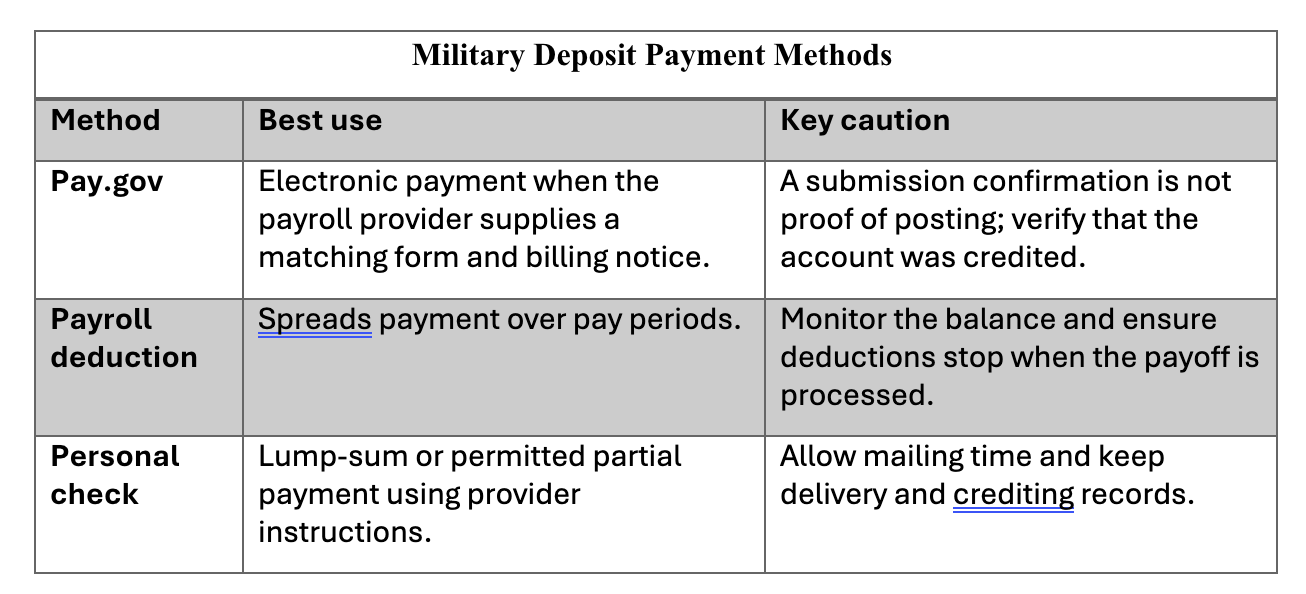
Most employees pay military deposits through their payroll deduction, permitted installments or personal check. Use only provider instructions, monitor the balance and retain records until receiving paid-in-full confirmation.
Peace Corps service credit deposits
Former Peace Corps volunteers and volunteer leaders may receive retirement credit for satisfactory full-time service; pre-enrollment training is excluded. Under FERS, the service is creditable only if the required deposit is paid. Under CSRS and the CSRS component of a FERS transfer annuity, the effect of nonpayment depends on the applicable service dates and deposit rules, so employees should request an individual determination from their agency benefits office — with all rules taken into consideration.
The deposit is based on the qualifying readjustment allowance or stipend, plus interest—not later Federal salary. Obtain Peace Corps certification and submit SF 2803 for CSRS or CSRS Offset, or SF 3108 for FERS, through the agency benefits office. Do not estimate or pay until the agency and OPM determine creditability and issue the amount due.
After OPM establishes the account, a current employee may use the active-employee Pay.gov form with the seven-digit CSD number on RI 36-23; annuitants use the separate form with a CSA or CSF claim number. Retain confirmation, verify posting, and obtain paid-in-full documentation.
Before you begin
Begin at OPM’s How to Make a Payment page and select the exact obligation. Have the OPM notice, account or claim number, amount, identifying information and payment details ready. Accepted bank or card options vary by form.
Why the online process is more efficient
Pay.gov eliminates postage and delivery uncertainty, prompts for required information, allows review before submission, and creates immediate confirmation. It does not eliminate OPM processing time, so users must verify that the payment posts to the correct account.
Protect your information and follow up
Use a trusted device and private network, confirm the .gov address, and never email bank or claim data. Avoid duplicate payments while posting is pending. If rejected or returned, verify the information and contact the office named on the OPM notice before retrying.
Pay.gov makes retirement and insurance payments easier to submit and document. Start with OPM’s official payment page, choose the exact form, use the identifiers on OPM correspondence, review the entry, save confirmation and verify posting.