

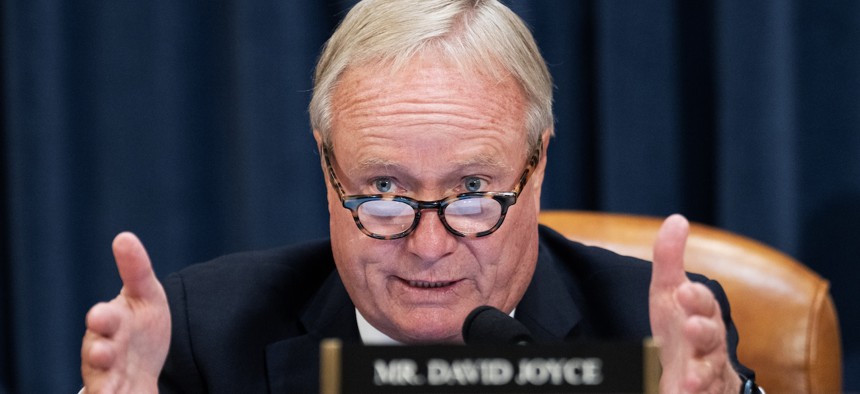
But Rep. David Joyce, R-Ohio, chairman of the panel’s financial services and general government subcommittee, said his caucus would not step on the president’s toes in his efforts to reshape the federal workforce, including on issues of compensation. Tom Williams/CQ-Roll Call, Inc via Getty Images




House GOP on Trump’s 2027 pay freeze: ‘That’s politics’
Republicans on the House Appropriations Committee last week beat back multiple attempts to increase federal workers’ pay next year and restore their workplace rights.

Republican appropriators in the House last week thwarted efforts by their Democratic colleagues to override President Trump’s apparent plan to freeze civilian federal employees’ pay next year and restore civil service and workplace protections currently on the chopping block.
The House Appropriations Committee voted along party lines to advance its draft of the fiscal 2027 Financial Services and General Government spending bill last week, the culmination of a marathon markup hearing that spanned multiple days. That legislation is traditionally the vehicle by which lawmakers move to overrule a president’s pay raise plans for the following year.
Earlier this month, President Trump released his budget blueprint for fiscal 2027, but the document was silent on civilian federal compensation. An Office of Management and Budget spokesperson told Government Executive that the plan envisions a pay freeze next year, while military personnel would get raises between 5 and 7% next year, depending on their rank. Last year, Trump’s so-called “skinny budget” was similarly silent on federal pay, but the president ultimately implemented a 1% across-the-board increase for most feds, with supplementary increases for feds in some law enforcement positions.
Rep. Steny Hoyer, D-Md., urged lawmakers to support a 3.1% raise for feds, a figure he said was aimed at approximating the cost-of-living adjustment federal retirees and Social Security beneficiaries would likely see next year. Democrats earlier this year put forth a plan to provide a 4.1% average pay raise to federal civilian workers, split between a 3.1% across-the-board increase and a 1% average increase in locality pay.
“[This raise would be] a recognition of the extraordinary service that they perform on a regular basis for the American people, and very importantly, in carrying out the duties that we have assigned them through legislation,” Hoyer said. “[This] enmity toward government ought not be enmity toward federal employees. We ought not to devalue them.”
But Rep. David Joyce, R-Ohio, chairman of the panel’s financial services and general government subcommittee, said his caucus would not step on the president’s toes in his efforts to reshape the federal workforce, including on issues of compensation.
“Just as President Biden increased the workforce by 6%, this administration has made streamlining the workforce and reducing spending two of its main goals,” he said. “Presidents often use alternative pay plans when setting pay increases, and this president has chosen to increase law enforcement [salaries] at a higher rate than office workers, which is his prerogative. That’s the reality of politics, and that’s exactly why we have elections every four years.”
The amendment failed by a 28-32 vote.
Hoyer also proposed an amendment that would have barred federal agencies from using fiscal 2027 funding to implement a pair of new job categories—Schedule Policy/Career and Schedule G. The first, formerly known as Schedule F, threatens to strip at least 50,000 career federal workers in “policy-related” positions of their civil service protections, making them at-will employees, while Schedule G creates a new avenue to hire more political appointees into government.
“What they want to do is, which the [1883] Pendleton Act was designed to avoid, is the politicization of the civil service,” Hoyer said. “The pride of our country has been that we have a non-hack civil service, a civil service composed of people who carry out their duties faithfully, and if they don’t, they ought to be fired. But what they should not be is turned into 50,000 additional political appointees, by either administration, Democrat or Republican.”
Joyce again declined to mount a policy defense but nonetheless opposed the measure. Republicans defeated the amendment by a 27-33 vote.
“While I certainly appreciate his various positions regarding some of the administration’s changes to the federal workforce, they fall within his prerogative,” he said. “The previous president made workforce changes as well, and these prerogatives only reinforce that elections have consequences.”
Rep. Glenn Ivey, D-Md., offered another amendment, this time blocking federal funds from being used to terminate collective bargaining agreements pursuant to the president’s pair of executive orders stripping two-thirds of the federal workforce of their union rights on national security grounds. The proposal mirrored a bill that the House approved on a bipartisan basis last December, following a successful discharge petition, but has stalled in the Senate.
“I represent a district where we have tens of thousands of federal government employees, many of whom were impacted by that EO, and these people are hardworking patriotic Americans, dedicated to serving the United States,” he said. “Many of them are veterans, who elected to continue to serve the public by becoming federal employees after they left military service and I think it’s important to treat all of these people fairly.”
But Republicans again opposed the measure, on the grounds that the issue falls under another committee’s purview. The amendment failed by a 29-31 vote, with Rep. Nick Lolota, R-N.Y., a sponsor of last year’s bill, joining Democrats in support.
If you have a tip that can contribute to our reporting, Erich Wagner can be securely contacted at ewagner.47 on Signal.
NEXT STORY: They did everything right and still haven’t been paid