

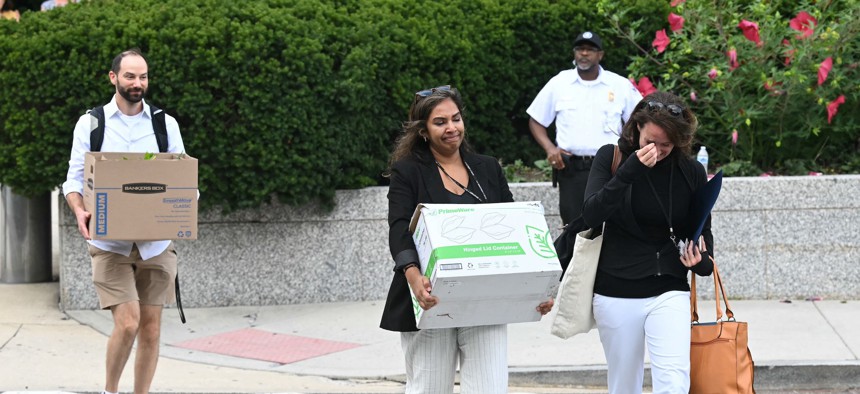
Fired State Department workers carry their belongings as they leave the building in Washington, D.C, on July 11, 2025. A new survey found that 87% of former civil servants who were laid off or removed answered "yes" or "maybe" when asked if they'd consider returning to federal service. SAUL LOEB / AFP / Getty Images




‘Exit survey’ of former feds finds fears of civil service politicization under Trump — and many willing to return to their agencies
While the Office of Personnel Management has argued that most of the 2025 federal workforce separations were voluntary, academic researchers countered that many of the departing civil servants reported they felt forced into resigning.

The civil service has lost a net of nearly 300,000 employees since the start of President Donald Trump’s second term, according to federal workforce data, as his administration seeks to downsize agency worker headcounts through firings, layoffs and separation incentives.
Because agencies generally did not conduct exit surveys for workers who were pushed out or otherwise left the federal service, a research collaborative of colleges and universities focused on studying the government workforce sought to fill that gap.
“No one asked the departed, at scale and with a carefully designed and vetted instrument, what happened to them and why they left,” wrote public administration professors Gary Hollibaugh and William Resh of the Accountability and Reform Research Consortium in an October report. “So, we asked.”
ARRC surveyed more than 2,000 former career civil servants from 55 agencies who left government on or after Nov. 5, 2024, gleaning new insights into why these individuals separated, what their experiences were like and whether they’d return to federal service.
Politicization was the top answer that respondents gave for why they separated, with nearly half of them including it as one of their primary three reasons.
“For comparison, compensation and career advancement — two conventional retention levers — landed near the bottom,” Hollibaugh and Resh wrote.
The researchers disaggregated the survey results based on the former feds’ political ideology and found that several groups (“slightly liberal,” “moderates,” “slightly conservative” and “other”) all reported similar levels of politicization based on a five-point scale.
“The differences are smaller than a simple partisan-grievance account might predict, and every group averages at or above the scale midpoint,” they wrote.
Researchers also asked respondents to report how coerced they felt into leaving on a 0 to 1 scale, with the average answer for those who were laid off being 0.75 compared with those who retired as planned being 0.17.
The Office of Personnel Management has emphasized that the majority of the 2025 federal workforce separations were voluntary as a result of the deferred resignation program, under which participants generally received several months of full pay and benefits in exchange for leaving federal service.
But Hollibaugh and Resh noted that the average coercion score for survey participants who separated under the DRP was 0.50, which is closer to the layoff average than the planned retirement one.
“The typical [DRP] account collected in our survey describes an offer accepted out of fear of an alternative — layoff, removal or reassignment — that the respondent found unacceptable,” they wrote. “In short, an exit that looks voluntary in administrative records can still be experienced by the employee as a highly constrained choice.”
Additionally, the ARRC survey reported that 87% of respondents who were laid off or removed said “yes” or “maybe” when asked if they’d consider returning to federal service, with “alignment with mission” and a “changed political environment” being the top reasons that would motivate them to return.
“For policymakers who seek to rebuild federal capacity, these results identify a potentially receptive pool of former employees, though they do not establish that restoration is the only or preferred policy objective or how long those people may be willing to wait,” the researchers wrote.
The ARRC was convened by the Volcker Alliance, a public service-focused nonprofit. The researchers stressed that the sample in the survey is nonrandom and that they relied on respondents’ “retrospective self-report.”
Hollibaugh and Resh also found that nearly half of respondents had not found work at the time they were surveyed. This aligns with other recent polls of former feds.
A group of ex-civil servants earlier this year surveyed more than 300 new and recently promoted feds who were fired en masse by the Trump administration before they completed their probationary period, and the most common response to a question about their job search was “still unemployed.”
And a former foreign service officer who is now pursuing a graduate degree conducted a survey of nearly 3,800 staffers for the U.S. Agency for International Development, which the Trump administration shuttered, or a partner organization. Only 40% of respondents to that poll, which was conducted in the spring, reported that they’ve found full-time employment.
If you have a tip that can contribute to our reporting, Sean Michael Newhouse can be reached securely at seanthenewsboy.45 on Signal.
NEXT STORY: The census shows what government does well — and what political interference could break, author argues