

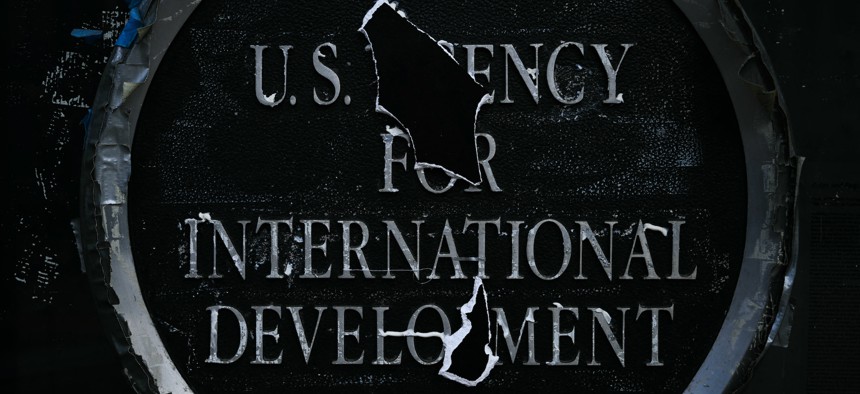
Remnants of signage for the U.S. Agency for International Development in Washington, D.C, on December 29, 2025. The Trump administration shuttered the agency last year. BRENDAN SMIALOWSKI / Getty Images




Survey shows the toll of USAID’s closure on former employees and their families
Nearly half of survey respondents who were foreign service officers reported that their households experienced dual job loss as a result of the layoffs.

Jaime Oberlander was a foreign service officer for the U.S. Agency for International Development stationed in Ethiopia last year when administration officials folded USAID into the State Department, resulting in nearly all USAID employees losing their jobs. She said the layoffs hit employees serving overseas—and their families—particularly hard.
“You're being forced to make this huge international move with not a lot of information, changing guidance, not a lot of the resources needed for that level of move when you have to set up housing, set up schooling, set up these things all again,” she said.
For example, Oberlander questioned if her family would lose their housing, which had been paid for by the government, and knew it could take months for their belongings to be shipped back to the U.S. She recalled that a colleague’s son was a senior in high school preparing for final exams, only to face the prospect of not being able to finish the school year at all.
Now a graduate student at the University of Michigan School of Social Work with plans to become a therapist, Oberlander decided to study the impacts of the foreign aid agency’s closure on employees and their families. She conducted a survey of nearly 3,800 former foreign aid staffers who worked for USAID or a partner organization, finding that most are still struggling financially and have experienced adverse effects to their mental health.
“Ultimately, I do hope and want and believe it will be a story of resilience, but the community isn't there yet,” she said.
Only 40% of respondents to the survey, which was conducted between March 27 and April 26, reported that they’ve found full-time employment. Of those, 66% said they were making less than their previous salary.
“Former aid sector employees face structural barriers to re-employment: careers built around specialized graduate degrees, mastery of U.S. foreign assistance regulations and overseas networks do not translate easily to a stagnant labor market,” Oberlander wrote in a report on the survey results.
Additionally, 48% of survey participants that were foreign service officers experienced dual job loss. One respondent whose husband also worked for USAID said that they and their two children “found ourselves living temporarily from house to house as we tried to chart a new path. The extreme level of uncertainty caused tremendous stress such that I lost over 15 lbs and my husband suffered from depression and insomnia.”
Based on the survey results, Oberlander also found that younger workers are more likely to have found employment than their older counterparts and that former aid staffers who are Black have the lowest levels of full-time employment of any group.
And 81% of participants said they experienced stress-related physical symptoms, such as headaches, panic attacks or the worsening of an existing condition.
Oberlander’s findings correlate with other recent studies of Trump’s effort to downsize federal agencies. A winter survey of more than 300 fired agency probationary employees found that, of those who found new jobs, 68% reported that their salaries are “lower” or “significantly lower.” And 95% said they’ve experienced “new mental health symptoms that had negative impacts on personal wellbeing” since being terminated.
The former foreign service officer said she plans to conduct similar surveys in the future to examine the long-term consequences of shuttering USAID.
But she also emphasized that former aid workers are not just distressed about losing their jobs; they also worry about the effectiveness of foreign assistance moving forward. A 2025 peer-reviewed study found that cuts to foreign aid under Trump could lead to more than 14 million additional deaths around the world by 2030.
“It's recognizing that people are suffering and people are dying because we can't do our job,” Oberlander said.
If you have a tip that can contribute to our reporting, Sean Michael Newhouse can be reached securely at seanthenewsboy.45 on Signal.
NEXT STORY: Why treating everything as 'URGENT!' makes government less effective