

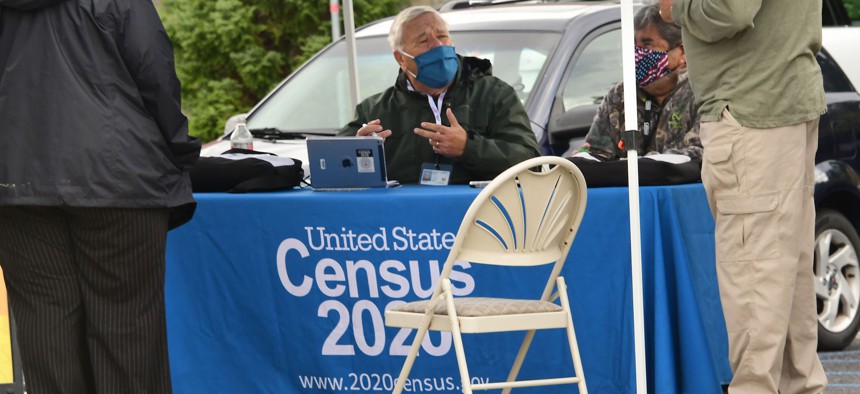
Census Bureau employees hold an event in Albany, N.Y., on Oct. 2, 2020, to get people to complete their census forms. The COVID-19 pandemic significantly impacted 2020 census operations. Lori Van Buren / Albany Times Union / Getty Images



The census shows what government does well — and what political interference could break, author argues
A university researcher who embedded in the Census Bureau ahead of the 2020 national headcount warns in a new book that President Donald Trump’s federal workforce reforms, paired with decades of “Jenga politics,” could put the next census at risk.

With four years to go until the next decennial headcount of the U.S., the Census Bureau is facing several challenges. The agency has lost about 17% of its workforce since 2024, according to federal workforce data, and the Trump administration is seeking to nix questions about race and ethnicity, and exclude undocumented migrants from the population totals that determine political representation..
danah boyd, a Cornell professor who has lowercased her first and last name since childhood, was embedded in the Census Bureau around the 2020 census when civil servants managed to count the country despite facing new debates around privacy, Trump’s failed attempt in his first term to add a citizenship question and, notably, the COVID-19 pandemic.
Based on that experience, as well as interviews with hundreds of Census employees, boyd wrote a book titled: “Data Are Made, Not Found: A Story of Politics, Power and the Civil Servants Who Saved the U.S. Census.”
In an interview with Government Executive, boyd explains how society treats civil servants and teenagers similarly, why the results of the upcoming midterm elections will significantly shape operations for the 2030 census and what needs to be done to strengthen America’s Jenga-like democratic system.
Editor’s note: The following interview has been edited for clarity and length.
Q. You have had a range of experiences in the tech industry, in nonprofits and in academia, yet you write that, while at the Census Bureau, “I have never witnessed such systematized coordination, such in-depth planning or such an intentional dedication to resilience.” How surprised are people when you tell them this?
A. They don't believe me, including civil servants. One of the stories that I tell in the book is of a technical worker at the Bureau who was walking me through all of the different systems, and I was just awestruck by how thoughtful she was about her systems and about how much redundancy and resilience was baked into them. I explained this to her, and she was like, "You've been in industry, you've seen real products launch. There's no way that what we do is better." And I was like, "You are out of your mind. What you're doing is really phenomenal!" Fast forward, she is one of the people who was forced out by the Department of Government Efficiency, and she is now working in the tech industry. I regularly get text messages from her being like, "I know you said it was insane, but it's truly insane in industry."
I think part of it is to recognize that civil servants are building systems that will be resilient to anything. They need to count everybody once, only once and in the right location. Because of this, they're building systems that will work on outdated operating systems, old phones that nobody thinks about, that will be able to withstand all sorts of strange configurations, like having a phone work when there's no cell tower nearby. All of that is part of their plan.
If you talk to people in industry, they shrug and they're like, "Eh, that's not our top priority. We are not really interested in making certain we serve those people.” But for the government, they're going to serve everybody, and that is such a different orientation.
Q. You write that political appointees during Trump’s first term pressured Census employees to implement Schedule F in a way that “bordered on harassment.” In his second term, Trump has implemented Schedule F as Schedule Policy/Career, removing civil service protections from about 8,000 federal jobs. What fears would you have about an increased number of political appointees at the Census Bureau?
A. Article One, Section Two of the Constitution gives Congress the ability to conduct a census. Congress has subsequently given certain authorities over to the executive branch, including to operationalize the census, but a census is not meant to be a partisan activity. A census is meant to be something that serves the public as a whole and guarantees that we have the data necessary to allocate representatives to the states and implement different kinds of laws, including federal funding formulas and anti-discrimination laws.
Until the first Trump administration, it was quite uncommon for the executive branch to get involved at all. There were very few political appointees, and they were primarily the director, the person in charge of communication and intergovernmental agency liaisons. They were not involved in the micromanagement of the methodology or the ways of actually operationalizing the census. The assumption was that the civil servants and their professional expertise would drive how the census would be operationalized. Of course, they still reported to Congress. So the Census Bureau would make changes, it would provide those to Congress and Congress has the authority to come back and be like, “No, no, no, do it differently.” But generally, Congress stayed out of it.
This is all different, and this is different on many different fronts. This is different in terms of the number of people that are politically appointed. This is different in terms of the detailed level of micromanagement of the procedures themselves. We are currently watching this unfold. On Sept. 10, the current administration issued a Federal Register notice that basically was a change of how the residence rules were to be operationalized for the 2030 census. It is a mind-boggling change from the previous decades. To give you a flavor, the Census Bureau used to make these really tiny micro edits to the residence rules, followed by thousands of pages of research and documentation. And everybody would shrug their shoulders and move on.
This Federal Register notice has a very clear partisan-oriented opening, which is very peculiar. There are a ton of radical changes that raise questions about constitutionality, that undermine congressional authority around how to do the work, that make it impossible to implement certain laws, that are operationally nearly impossible to implement, that lack clarity and there is no research provided. There are no details of why these changes are to be done, and the civil servants have been told that they are not to speak to anybody publicly until the comment period is over. That is mind-boggling. This goes against every norm and process of the modern Census Bureau, and so it is not just the introduction of more political appointees or converting people into this new schedule. It's also a complete disruption of norms and processes.
Q. It sounds like you're still talking with Census employees, even though this book is finished.
A. Absolutely. I'm talking both with former civil servants and current civil servants. Let's be clear: the people that are inside the federal government, inside the civil service, are working hard on behalf of the American public, and they are committed to the mission. They are dedicated. They do the work regardless of who is attacking them. They have worked for Republicans and Democrats throughout their career. They believe it is their responsibility to serve the public, and so this is heartbreaking for them.
They want to be able to take their expertise, their experience and bring it to bear. They don't like being silenced. They almost constitutionally desire overexplaining everything. They're like, “We want to give you the research and the details and the technical information.” Sometimes, of course, that's a little too much. But this is where the fact that they are being pushed to do things that they can't defend from a scientific and technical place is confounding to them.
Q. You cover an incident during the 2020 census when officials decided to use an agency-produced system to enable individuals to self-respond online for the census instead of a tool developed by a contractor because the government-created product performed better during testing. What would you say this incident shows about the state of technology in the federal government?
A. The Census Bureau has a long history of producing some of the most important technologies out there. Let us not forget that in 1880, when the Census was struggling to tabulate its data, it called on somebody to come help. The person who ended up helping is a man named Herman Hollerith. He took the technology he created for the census and converted it into a business that we know as IBM. We can keep counting over and over again the number of technologies that the Census Bureau has innovated and enabled not just for the government but for the private sector as well.
The challenge that the Census Bureau has faced, like many federal agencies, is decades of pressure to outsource everything. Both Republicans and Democrats have forced them to outsource, including mission-critical components, even though they're supposed to be able to have mission-critical technologies built in-house. But it's hard to pull off the justification to build in-house because there's all sorts of Kafkaesque restrictions that make that very difficult.
When it came to the self-response technology, under the Obama administration at the time, it became clear that they would need to outsource. So they did the public call. Of course, the contractor is very slick, very capable of selling a system. But there's all sorts of broken incentives for being able to make sure that this system could work with evolving technologies. It was supposed to work on an iPhone. The iPhone kept changing. It had to work on the web. Well, internet technologies kept changing. The Bureau tried to write the best contractor requirements document they could imagine, but there are limits.
As deadlines were coming closer, the civil servants who had created the pilot technology said, "Hey, what if the contractor can't deliver?” So they decided to take what was originally the prototype, turn it into the backup system and they even went to then Commerce Secretary Wilbur Ross — by this point the first Trump administration was in power — and said, "We're going to have this backup system." Ross supported them and said like, "Yeah, this is mission-critical. Have that backup system."
But then the way that that information became part of the public dialogue was a complete mess and involved a journalist’s narrative that this was a wasteful act by civil servants who couldn't manage a contractor. It ended up in hearings. It ended up in this whole big spectacle, when actually what the Census Bureau was doing was making certain that their systems were resilient by making them redundant, and we don't appreciate that thoughtfulness. When you have mission-critical systems, redundancy is a very good strategy. So the civil servants not only are capable of producing the technology themselves, but they're also capable of seeing that having backups is a critical part of making sure that the mission-critical work of the census can continue.
Q. You bring up that political actors on both the left and right have recently accused the Census Bureau of being biased against them. You also note that distrust in the census is hardly new, as George Washington and Thomas Jefferson were apparently “skeptical” about the results of the first census. How can government leaders rebuild trust in the census?
A. The irony of the 2020 census is that by every statistical measure and scientific evaluation, these data are better than all censuses produced in the 19th and 20th century. We can quibble about what happened in 2000 and 2010 because there's a lot of metrics by which those censuses are better than 2020. But let's put a big old asterisk around 2020, and call the pandemic the biggest disruption to the 2020 census.
What is it about these data — that are really, really good by most measures — that people believe are terrible? That's where this issue of trust comes in because the Census Bureau has become politicized and because our distrust in government is an extension of our distrust in whoever the administration is. So the civil servants are constantly battered by everybody, and they often joke that the only thing that the Republicans and Democrats agree on is that civil servants are terrible people, which is painful. Dark humor is part of being in the government these days.
But trust is not just about the partisan actors. Trust is also about the ecosystem of stakeholders. In the case of the census, this includes, for example, data users, and we've seen a loss of trust in the data user community as well as the political actors. Why? Some people will tell you it's the change in processes about differential privacy or the modernization of the confidentiality procedures, but I actually think that it's something much more basic. Up until about a decade ago, we saw the Census Bureau had all these mechanisms by which they were in constant conversation with external stakeholders. They went to conferences.
There were formal processes, like the federal advisory committees, but most of the really important work was actually done over stale cookies and really bad coffee. That kind of relational work allowed people to ask questions like, “This choice that you made about how you measured that thing, I don't think I agree with it.” Then the Census employee can say, “Ah, this is why, and here's how we did our set of trade-offs.” And then the data user can reply, “Oh, that's interesting,” and back and forth.
We saw a loss in the ability to maintain those external relations. It began decades ago, but it became more acute through austerity budgeting under Obama, more acute under the first Trump administration, even more acute during the COVID-19 pandemic and even more acute under the Biden administration where it was a combination of the pandemic and austerity budgeting and now, of course, it's impossible. If you don't know a civil servant, if you don't know the people that are making these data, it's easy to demonize them or treat them as some sort of other.
I think that that loss of social fabric around our civic institutions is costing us at the Census Bureau and beyond. Because that's how we trust systems. If you want a parallel, I grew up in a place where many people I went to high school with, many people in my community, were in the military. We had a trust of the military because you knew the people. Then I went to college, where no one knew anybody in the military, and they distrusted the military. It's this reminder that the closer you are to how the systems work, the more you trust it completely with its imperfections. The Census Bureau is imperfect; all government agencies are imperfect. But that doesn't mean that these census workers are not working their tushes off to make certain that we get the best data possible because they absolutely are.
Q. Given the challenges that you've highlighted, do you think it's possible for the Census Bureau to rebuild trust with the left, the right and other stakeholders ahead of the 2030 census?
A. I think it is possible to rebuild trust, but ahead of the 2030 census, I am not sure. We are going to elect a new Congress next week. Regardless of who wins, that Congress will have some of the most important decisions to be made about the census. Those decisions are primarily made in years that end in seven and eight. That is really critical because if Congress takes back its authority, which it has every right to do, it can do many things to help guard against whatever is happening. If it continues to close its eyes and pretend like they can deal with this later, it's going to be very, very difficult.
The way to really rebuild the system is for Republicans and Democrats in the new Congress that will seat in January 2027 to recognize the importance of protecting this institution and to do it together. Of course, that is not an easy ask in this particular political climate. But is it possible? Yes. Do I have every confidence in it? No. Can I be hopeful? Yes.
I also want to be clear for anybody who thinks about census timelines, by the time we are in January 2029, the forms have been printed. Things are rolling, so this is not something where Congress can close its eyes and hope that the next Congress deals with it. This is really about the present, and I think it's very difficult right now for both our representatives and our senators to understand the significance of their distancing from this.
We've had history where things have gone wrong, and people have stepped back in. One of the most notable stories here is the 1920s, where things were so dysfunctional in 1921 that we did not reapportion Congress, even though we were supposed to. The Senate got very frustrated with this, and in 1929 came in and was like, "We are going to pass a law. We are going to make this happen, so that we do not roll into a never-ending constitutional crisis." So again, it's possible to rebuild trust, but to really do the work is going to require Congress at this stage.
Q. You write that this book is “my invitation to the public to step up to protect our administrative state before it is too late.” It reminded me of the speech that Rep. Mike Johnson, R-La., gave after he was re-elected speaker in which he said “We are going…to roll back the totalitarian fourth branch of government known as the administrative state." If you had the opportunity, what would you say to Speaker Johnson to convince him that the “administrative state” should be protected?
A. I'm not sure that I can persuade Johnson, but I'll say that one of the things that fascinated me working inside and witnessing the federal government was to realize how many of the people who do the work on behalf of the American people are naturalized citizens. When I asked naturalized citizens why they chose to work for the federal government, over and over again I heard the same story: “I come from a country where — insert authoritarianism, insert corruption, insert abuses of power and egregious things" — all the things that we as a country, the United States, has stood in opposition to for our entire history. We have worked so hard to ensure that we would have a robust and resilient democratic republic. These civil servants who are naturalized citizens understand that a democracy is not just about elected officials and the laws but also the actual operationalization of those laws.
Congress passes all sorts of laws, but to execute them requires an administrative state, and those are the people who are making certain that the laws passed by Congress actually play out to help the American people. We might disagree on what those laws are, and many of us do. But it is important that we have the ability to actually make those things possible. One of the egregious parts of the present day is that when we don't like laws, we have reached the point of making it impossible to implement them. Don Moynihan and Pamela Herd called this “policymaking by other means.” I think it's really important to recognize how destructive that is to a truly checks-and-balance-oriented democracy that we have architected.
I understand the posturing that people like to do when they want to demonize the administrative state. But even people who do that performatively want the administrative function to work when it is the laws they passed. They just don't want it to work with the laws that they don't agree with, and that is what has made this whole thing toxic. It's also just easy to pick on civil servants because they can't speak up and speak back. As somebody who has studied youth for a long time, I feel like I'm watching the same dynamic of “We can lambast and mock teenagers” because they don't get a voice. Why is this?
Q. Is there a question I didn’t ask that you wished I had?
A. One of the arguments that I make in the book is around Jenga politics. I use Jenga as a metaphor intentionally. It’s the wooden game where we take out pieces of a tower, and we make it weaker, and then we put the the piece on top, and make the whole thing even wobblier, and we go back and forth, and one person will end up getting blamed for making the tower fall but we all lose. We all contributed to the loss of it. I use this metaphor to talk about where we are at right now in our approach to our systems because we have been pulling out pieces of our democracy in critical ways over and over again.
We are all ready to blame whoever makes the system fall, but we all have to take responsibility to actually protect that system. It starts with understanding how that system works. The civil servants are trying to keep it from falling over, and I commend them. But they can't do it alone, and so it's really imperative both that our politicians understand how weak and wobbly things are, but also that our public does.
It's not just about whichever elected official is in power that we don't like. It is actually something that we've contributed to collectively, and we can only repair it collectively. It's a matter of calling out to people and saying, “We can all play a role in repairing this. We can all work to make the trust in these systems more functional,” but it starts with us paying attention. Often, we don't pay enough attention as a public, but a democracy requires an informed citizenry. My plea to everybody is to really think about how we can be more collectively informed and protect these systems before it's too late.
If you have a tip that can contribute to our reporting, Sean Michael Newhouse can be reached securely at seanthenewsboy.45 on Signal.
NEXT STORY: Mediation agency finalizes rule allowing denial of arbitrator requests