

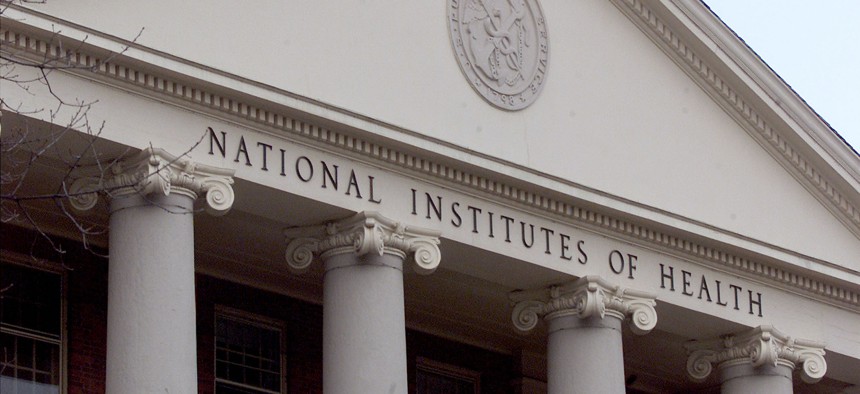
A building on the National Institutes of Health's campus in Bethesda, Md. A group of agency employees critical of the Trump administration signed the "Bethesda Declaration" in 2025 and recently issued an update. Mark Wilson / Getty Images





A year after sounding the alarm, NIH dissenters say political influence is entrenched at research agency
The Trump administration has cut staff and grants at the National Institutes of Health, and employees warn further overhauls appear to be likely.

Last year, a group of National Institutes of Health employees compiled their objections to the workforce and research funding policy changes that the Trump administration was making at the agency into the “Bethesda Declaration,” which mirrored other civil servant-led documents that were released around the same time at the EPA and Federal Emergency Management Agency.
On Tuesday, 74 current and former NIH staffers, 39 of whom are named, published a one-year update to the “Bethesda Declaration,” arguing that the administration’s overhauls have led to increased political influence at the world’s largest public funder of biomedical research.
“The chaos of 2025 has been replaced with coordinated, systematic, institutionalized destruction in 2026,” they wrote.
NIH has shed more than 4,400 staffers, or about one-fifth of its workforce, since the start of 2025, according to federal employee data. The declaration signers also said that directorships at 14 of NIH’s 27 institutes are unfilled.
They expressed concerns that Schedule Policy/Career, a recently implemented directive to make it easier to fire 10,000 career federal employees in “policy-related” positions, would further hurt staffing. Specifically, the signers contended that frontline NIH workers involved in “regular scientific administrative work,” rather than policymaking, are set to be converted to the new job classification.
The NIH employees also criticized certain appointments at the agency, including Kristine Blanche — an integrative medicine practitioner and the wife of acting Attorney General Todd Blanche — at an NIH advisory council and Kyle Walsh — a neuroepidemiologist and friend of Vice President JD Vance — as head of the National Institute of Environmental Health Sciences.
“Positions of authority and accountability at NIH are increasingly filled by people who lack the technical knowledge or integrity to make sound decisions about the future of health research in the United States,” they wrote.
Additionally, the Partnership for Public Service nonprofit recently reported that the Trump administration has installed six political appointees at NIH as of March 2026. The historical average number of such officials at the agency between 2009 and 2024 is 0.7.
While NIH has reinstated thousands of research grants that it terminated in 2025, often because of a court order, the letter signers emphasized that more than 1,000 grants have not been restored, according to a tracker website. They further argued that the sudden nature of the cancelations hurt not just the researchers but also, in many cases, the study participants.
“Terminated studies, including clinical trials, were initially allowed no time or funding to ethically close out, safely disenroll participants or follow through on commitments to participants,” they wrote. “After months of harm, NIH finally changed policy to allow terminated studies to request costs to support an orderly study closeout. However, the damage caused by abrupt trial discontinuation and disruption was entirely foreseen by NIH staff and should never have occurred.”
The NIH employees also slammed a change to the agency’s grant review process requiring a certification that funded research does not include certain words associated with diversity, which has held up some grant disbursements and forced scientists to rewrite proposals.
“NIH leadership has justified these acts by establishing the ill-defined concept of ‘Gold Standard Science’ and then claiming that any research project that doesn’t align with the administration’s political priorities does not meet the standard,” the letter signers wrote.
Other issues flagged in the new “Bethesda Declaration” include:
- A proposed rule from the Office of Management and Budget that would overhaul the federal grantmaking process, including by requiring political appointees to approve awards to ensure they advance the president’s priorities.
- A 24% reduction in the number of NIH grants issued in fiscal 2025 compared with the average of the previous 10 years.
- A policy that all purchasing orders more than $15,000 must go through a “lengthy, centralized process that takes so long it effectively functions as an arbitrary limit on essential laboratory tools and resources.”
A spokesperson for the Health and Human Services Department said in a statement to Government Executive that agency Director Jay Bhattacharya has made “scientific integrity, open inquiry and academic freedom central priorities at NIH during the Trump administration” and met last year with the “Bethesda Declaration” organizers.
“Director Bhattacharya is committed to transparency, open inquiry and constructive debate and remains open to continuing direct conversations with the authors of the Bethesda Declaration to discuss their concerns firsthand,” the spokesperson said. “While disagreement is a healthy part of science, he believes the most productive path forward is through direct engagement and dialogue.”
The letter signers also noted that trust in NIH has decreased; a survey by the Annenberg Public Policy Center at the University of Pennsylvania found that 62% of respondents in February said they have confidence in the agency compared with 75% who reported the same two years ago.
If you have a tip that can contribute to our reporting, Sean Michael Newhouse can be reached securely at seanthenewsboy.45 on Signal.
NEXT STORY: NDA proposal for feds draws scrutiny on Capitol Hill