

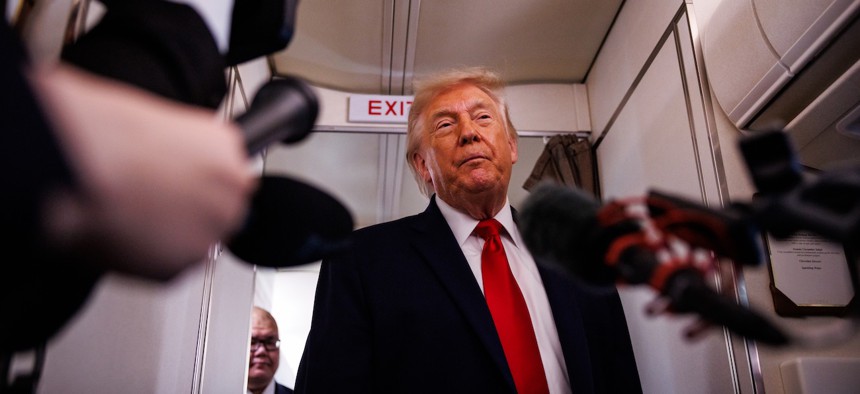
President Trump speaks with reporters while aboard Air Force One on June 5, 2026 en route to Chippewa Falls, Wis. Schedule Policy/Career is formerly known as Schedule F, and makes it easier to fire federal employees in “policy-related” jobs. Samuel Corum/Getty Images




Trump’s edict making 8,000 feds at-will employees draws swift outcry
Agencies have just one week to reclassify thousands of federal workers in purportedly policy-related roles into the new Schedule Policy/Career, stripping them of most civil service protections.

Organizations representing federal workers and good government advocates were quick to decry President Trump’s move this week to formally strip around 8,000 federal workers of their civil service protections, making them at-will employees, though the exact contours of the initiative’s scope remain unclear.
Wednesday’s executive order implements Schedule Policy/Career, a new job category within the excepted service -- formerly known as Schedule F -- designed for career employees in “policy-related” positions who lack the removal protections in Title 5 of the U.S. Code and of the right to appeal adverse personnel actions. Under Office of Personnel Management regulations that took effect in March, whistleblower complaints from Schedule Policy/Career employees would no longer go to the U.S. Office of Special Counsel, instead being referred internally to the employing agency’s general counsel for review.
The edict tasks agencies with reclassifying the roughly 8,000 federal workers into Schedule Policy/Career within seven days -- by June 10 -- as well as set up a separate bonus pool for those workers to recognize “outstanding work.” And OPM is expected to propose new regulations setting up a new governmentwide presidential award program for the job category.
Has the return of Schedule Policy/Career affected you or your work? Reach out to Erich Wagner at ewagner@govexec.com or ewagner.47 on Signal to share your story.
A 200-page appendix accompanying the executive order lists the various positions slated for conversion, subdivided by agency and subcomponent and accompanied by position codes used on an internal basis. As such, the veracity of administration officials’ claims regarding the precise number of impacted employees, or that 97% of them occupy GS-15 or Senior Leader pay grades, remains murky.
The State Department told employees in an email Thursday that Trump placed 100 positions into Schedule Policy/Career with Wednesday’s order but did not specify how many employees would be affected.
“Employees encumbering these crucially important positions will be notified by the Bureau of Human Resources within seven work days,” the email stated. “These changes will allow the department to reward high performance and ensure that we are well equipped to promptly and effectively address poor performance and misconduct. These roles remain career positions and will continue to be filled through merit-based hiring procedures.”
The nonprofit Protect Democracy on Thursday solicited federal employees whose jobs appear in the executive order’s appendix to provide information about their position and duties to better ascertain its scope.
A Defense Department employee, who declined to be named for fear of retaliation, told Government Executive that while they were not personally set for reclassification into Schedule Policy/Career, each of their supervisors are. None of them influence policy, they said.
“First line supervisors are responsible for the oversight of their employees’ projects and the successful execution of those,” the employee said. “They hire and evaluate their direct reports annually and handle execution of disciplinary actions as needed. They have ZERO authority to establish policy. All of that is dictated down to them from their senior leadership.”
Federal employee unions have filed multiple lawsuits challenging the legality of Schedule Policy/Career, filed last year but effectively held dormant until the policy was set for implementation. In statements Thursday, their leaders vowed to block it in court.
“The administration continues to focus on trying to strip federal workers of the rights that Congress gave them instead of letting them do the jobs that the American people count on them to do,” said National Treasury Employees Union National President Doreen Greenwald. “Now that the administration has officially ordered the transfer of an untold number of employees to Schedule Policy/Career—so that they are, in the administration's view, easier to fire—the litigation surrounding this initiative will resume. NTEU looks forward to aggressively pursuing that litigation and fighting to ensure the American people have their government services delivered by federal employees who were hired based on merit and skill, not partisan affiliation.”
“The practical implications of this action are clear,” said Everett Kelley, national president of the American Federation of Government Employees. “Workers who once felt comfortable reporting waste, fraud, abuse and mismanagement at their place of employment because they were protected from retaliation will now be afraid for their jobs if they speak out. That is a disservice to them and to the millions of Americans who rely on the federal government every day.”
And while it appears those legal challenges are set to finally kick off, Stephanie Rapp-Tully, partner at federal employment law firm Tully Rinckey, PLLC, while some may try to challenge their reclassification before the Merit Systems Protection Board, it could take some time before individual employees can file litigation of their own.
“For an individual to bring an action, they have to have suffered a harm,” she said. “You could be reclassified as Schedule F and maintain your employment, never face an adverse action and retire as planned. That could be your trajectory—you don’t know. It’s not until they pursue an adverse action that someone has suffered a damage.”
A perhaps overlooked change for Schedule Policy/Career employees is the inability to respond to a proposed adverse personnel action before it takes effect.
“Agencies are not required to provide advanced notice or ally for a written reply on any disciplinary or adverse actions,” Rapp-Tully said. “[They’re] also not entitled to see the evidence against them, which is a huge component . . . and they couldn’t appeal agency decisions to the MSPB. It’s the true definition of at-will.”
NextGov/FCW reporter David DiMolfetta contributed to this report.
If you have a tip that can contribute to our reporting, Erich Wagner can be securely contacted at ewagner.47 on Signal.
NEXT STORY: Lawsuit claims DOJ is retaliating against employees with disabilities who request telework