

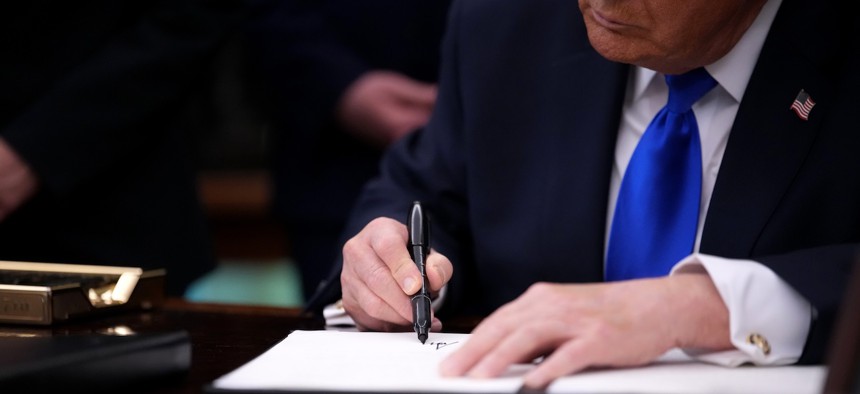
Trump signing an executive order on April 30, 2026. Schedule F was first proposed via executive order in October 2020 and was rescinded during the Biden administration. Andrew Harnik/Getty Images




Trump signs order moving thousands of federal employees into Schedule F
Roughly 8,000 career federal employees were stripped of their civil service protections Wednesday, making them effectively at-will employees.

President Trump on Wednesday signed an executive order formally converting nearly 10,000 career federal workers into Schedule Policy/Career, making them effectively at-will employees.
The edict marks the culmination of a years-long push to make it easier to fire federal employees in “policy-related” jobs by removing them from the federal government’s competitive service and placing them in a new job category, initially called Schedule F and now referred to as Schedule Policy/Career. Employees placed into the new schedule would no longer be able to challenge adverse personnel actions before the Merit Systems Protection Board, and whistleblower complaints filed by Schedule F employees would be investigated by their own agency, rather than the Office of Special Counsel.
A senior administration official told reporters Wednesday that, contrary to the administration’s prior estimates that 50,000 feds would be converted to the new job category, just 8,000 jobs are targeted in Wednesday’s executive order. An OPM spokesperson said Trump chose to instead focus on "the most senior level career policy officials."
The official said the vast majority -- around 97% -- of those impacted are either GS-15s or senior leaders (SL). Jobs targeted for conversion include agency office and division heads; C-suite posts like chief information officers; regional officers and their deputies and chiefs of staff; program managers; those who help write federal regulations and attorneys involved in crafting agency or internal policies, as well as advisors, senior HR officials and grantmaking posts.
Schedule F was first proposed via executive order in October 2020, but following Trump’s electoral defeat the following month, officials failed to implement the measure prior to former President Biden’s inauguration. Biden rescinded the edict, and in 2024 the Office of Personnel Management issued new regulations to make it more difficult for a future president to revive the idea.
Though early in Trump’s second term, officials suggested the president could simply “nullify” regulations, OPM ultimately followed the notice-and-comment process to propose new regulations to unwind the Biden-era protections and implement the newly-renamed Schedule Policy/Career. OPM’s final rule implementing the new job category took effect in March.
The policy remains the subject of multiple lawsuits by federal employee unions, who have accused the administration of violating the Constitution, the 1978 Civil Service Reform Act and the Administrative Procedures Act. And good government groups have warned that at-will employment of public employees on the state level have produced mixed results in terms of productivity, while increasing reports of political and personal favoritism in the workplace.
Scott Kupor and another official said Wednesday that contrary to opponents’ warnings that the measure would give rise to a new spoils system in federal employment, there won’t be political litmus tests for employees in Schedule Policy/Career and the traditional hiring process for competitive service positions will be retained in the new job category. Unmentioned, however, was OPM’s decision last year to institute new politicized essay questions as part of the federal hiring process.
“In order to effect the president’s policy priorities, we need people in these senior positions willing and capable of carrying out those directives,” Kupor said. “All this does is basically say: it doesn’t matter what your political views are–and you can have any political views–but if you allow them to interfere in your willingness to carry out lawful orders and directives, this is a mechanism for you to be removed, effectively at-will . . . There are zero loyalty tests in this.”
Has the return of Schedule Policy/Career affected you or your work? Reach out to Erich Wagner at ewagner@govexec.com or ewagner.47 on Signal to share your story.
NEXT STORY: Federal oversight faces ‘structural conflict’ as political appointees enter IG offices