

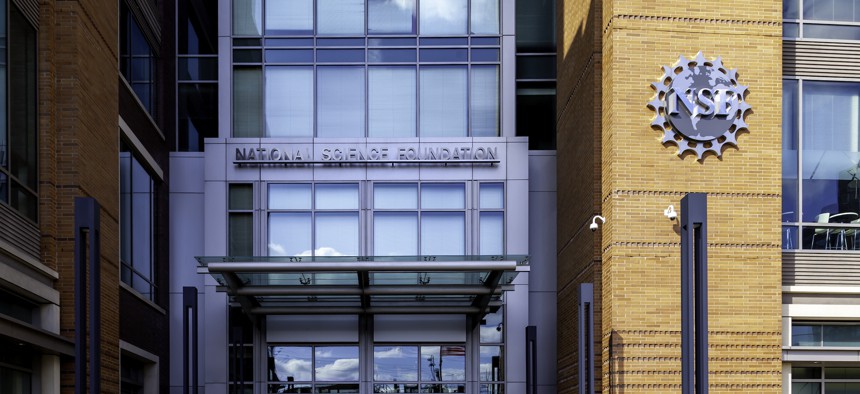
Entrance to the National Science Foundation in Alexandria, Va., on Feb. 29, 2020. The agency is in the process of relocating to a different nearby building. JHVEPhoto / Getty Images



NSF is using its HQ move to revoke telework for workers with disabilities, employees say
Most of the science agency’s workforce is currently teleworking, as they are being relocated to a new office building that is close to the former headquarters.

The National Science Foundation is reviewing employees’ reasonable accommodations, as the agency relocates its headquarters to a nearby building. But several employees allege that officials are using the move to revoke telework flexibility for workers with disabilities.
While President Donald Trump ended work from home for most of the federal workforce at the start of his second term, his administration exempted employees with disabilities who telework under a reasonable accommodation. Officials are legally required to provide reasonable accommodations (e.g. accessible technology) to better enable a worker to perform their job, unless doing so would result in an “undue hardship” for the agency.
Nevertheless, employees at several agencies — including now NSF — have contended that the Trump administration is blocking civil servants with disabilities from receiving telework reasonable accommodations.
“There are people with cancer, people who cannot walk and people with major disabilities, and [officials] are telling them that telework will not be an option,” said an NSF employee who preferred to be unnamed due to fears of retaliation.
In employee testimonials provided by American Federation of Government Employees Local 3403, which represents federal research staffers, NSF workers said the officials reviewing reasonable accommodations are offering unclear guidance and pushing alternative accommodations that don’t meet their needs.
One worker said that the experience “created an environment where I no longer felt psychologically safe advocating for my medical needs” due to fears of retaliation or having to leave their job if a reasonable accommodation isn’t granted, while another said their stress level has gone “through the roof” and that they’ve “developed additional symptoms related to [their] disabilities as well as a new physical condition as a result.”
Likewise, a different NSF employee, who said they’ve previously renewed their reasonable accommodation without issue, wrote in a testimonial that the agency HR’s response to emails has been “incredibly delayed,” but workers are required to fulfill requests for additional information with “fast turn arounds.”
Agency employees are particularly perplexed by the apparent crackdown on telework, as most of them are currently working from home due to the headquarters move. The Housing and Urban Development Department began transferring its workforce to NSF’s former headquarters in Alexandria, Va., this spring.
NSF is in the process of moving to a building that is close to its old headquarters, and the agency employee said the expectation is that workers will start working from that office in a staggered schedule over the summer.
An NSF spokesperson said in a statement to Government Executive that the agency “prioritizes the health and safety of its staff and remains committed to fulfilling all legal obligations under the Rehabilitation Act. Exercising due diligence, NSF continues to implement the reasonable accommodation process and assess the new workplace environment while most of its staff are teleworking during the transition to its new headquarters.”
The agency did not address a question about the schedule of the relocation.
The NSF employee said that the scrutiny of reasonable accommodations is worsening morale at the agency, which has also been impacted by the Trump’s administration’s staff reductions and changes to the grantmaking process.
NSF’s workforce went from around 1,700 employees in 2024 to just under 1,150 in 2026, according to federal workforce data. And the Office of Management and Budget recently proposed overhauling the federal grantmaking process, including by requiring political appointees to approve awards to ensure they advance the president’s priorities.
“[These are] the foremost scientists and administrators in the country, who for decades have ensured that not a penny of taxpayer money is wasted, and [they’re] now being collapsed and attacked by a bunch of folks who have no scientific training,” the NSF employee said.
If you have a tip that can contribute to our reporting, Sean Michael Newhouse can be reached securely at seanthenewsboy.45 on Signal.
NEXT STORY: In rare move, full appeals court agrees to hear case challenging Trump’s ‘Article II’ firings