

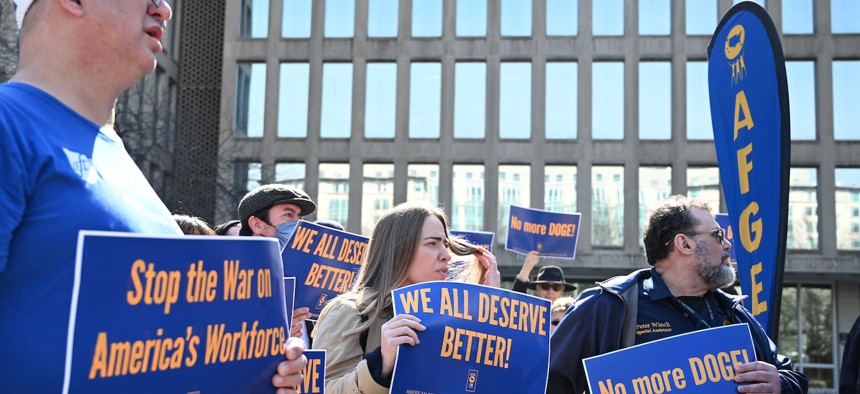
Protesters hold signs in solidarity with the American Federation of Government Employees of District 14 at a rally in support of federal workers at the Office of Personnel Management in Washington, D.C., March 4, 2025. AFGE warned that the NDA could also infringe on labor officials’ and members’ rights and duties under federal sector labor law. ALEX WROBLEWSKI/AFP via Getty Images




Lawmakers, unions and civil society groups urge withdrawal of governmentwide NDA plan
The Office of Personnel Management received more than 30,000 comments on its plan to require federal workers sign nondisclosure agreements, which critics said would violate the First Amendment and chill whistleblowers.

Federal employee groups, lawmakers and good government organizations in recent days have announced their formal opposition to the Trump administration’s plan to require federal workers sign non-disclosure agreements, arguing the measure would violate employees’ First Amendment rights and chill whistleblower activity.
The Office of Personnel Management first announced its plan in May, issuing a notice in the Federal Register and soliciting public feedback. In its one-month comment period, the initiative has attracted more than 30,000 comments, the bulk of which appear to oppose it.
OPM has argued that leaks of information, primarily to the press, have been disruptive to executive branch operations, citing Government Executive reporting on internal criticism of a then-planned regulatory proposal to overhaul federal performance management.
“Unauthorized disclosures of confidential government information disrupt agency operations and erode public trust,” OPM wrote. “In recent months, unauthorized disclosures have included internal government materials not intended for public release such as pre-decisional documents and interagency comments exchanged during internal coordination processes . . . Such disclosures risk chilling candid interagency feedback, disrupting orderly decision-making and weakening trust within and among federal agencies.”
But in a series of filings before the comment period closed over the weekend, federal stakeholders excoriated the draft NDA as an effort to intimidate federal workers into silence rather than report instances of waste, fraud or abuse. The National Active and Retired Federal Employees Association took issue with OPM Director Scott Kupor’s comparisons to NDAs in the private sector.
“The federal workforce is not a private-sector workforce accountable to private owners or shareholders,” wrote NARFE National President William Shackelford. “Career employees swear an oath to the Constitution, serve the public, and often carry statutory duties to report wrongdoing, provide information to Congress, cooperate with inspectors general, participate in grievance and labor processes, and adhere to professional and evidentiary standards. Layering a broad new NDA on top of these existing obligations risks shifting the culture of public service away from accountability and toward secrecy.”
The American Federation of Government Employees, the nation’s largest union representing federal workers, said the administration’s arguments fail to explain why the myriad existing rules governing the disclosure of confidential government information are insufficient or how this new measure would alleviate those purported deficiencies.
“OPM claims that the proposed NDA does not impose any additional legal obligations on federal employees, and is instead merely an attempt to promote consistency across government and to inform employees of their obligations regarding confidential information,” the union wrote. “But if this were genuinely the case, there would be no need for the proposed NDA at all. It would be unnecessary because federal employees are already routinely informed of their obligations regarding confidential information. In truth, the Proposed NDA goes far beyond existing legal requirements and seems plainly designed to intimidate federal employees and chill their lawful and legally protected speech, including speech about personnel matters and matters of public concern that is a vital part of the Unions’ work.”
The union warned that the NDA could also infringe on labor officials’ and members’ rights and duties under federal sector labor law.
“The First Amendment problems of the proposed NDA are manifold: it is an unconstitutional prior restraint on speech; it is unconstitutionally overbroad; it violates constitutional principles prohibiting vagueness and viewpoint discrimination; it conditions a public benefit based on a waiver of a constitutional right; and it restricts members’ right to associate for expressive purposes,” AFGE wrote. “For example, by broadly restraining the content of the communications made between the unions and their members—and also communications made between the union’s members in connection with their union—on matters relating to those members’ conditions of employment, the proposed NDA impedes one of the unions’ core functions and infringes on their and their members’ associational rights.”
Lawmakers of both parties were also critical of OPM’s proposal. A group of 44 House Democrats called the measure an effort to “hide this administration’s waste, fraud, abuse and corruption from the American people,” while Sen. Chuck Grassley, R-Iowa, warned that the NDA plan’s current protections for whistleblowers are insufficient.
“The OPM draft nondisclosure agreement form includes a partial anti-gag provision, but it is not the exact same as the version required by existing law,” he wrote. “While the form does provide that the nondisclosure agreement does not prohibit an employee from making a whistleblower disclosure to Congress and inspectors general, it fails to include the Office of Special Counsel. Accordingly, OPM must immediately update the draft nondisclosure agreement form to include disclosures to the Office of Special Counsel.”
If you have a tip that can contribute to our reporting, Erich Wagner can be securely contacted at ewagner.47 on Signal.
NEXT STORY: Bill would limit federal relocations to states with abortion restrictions