

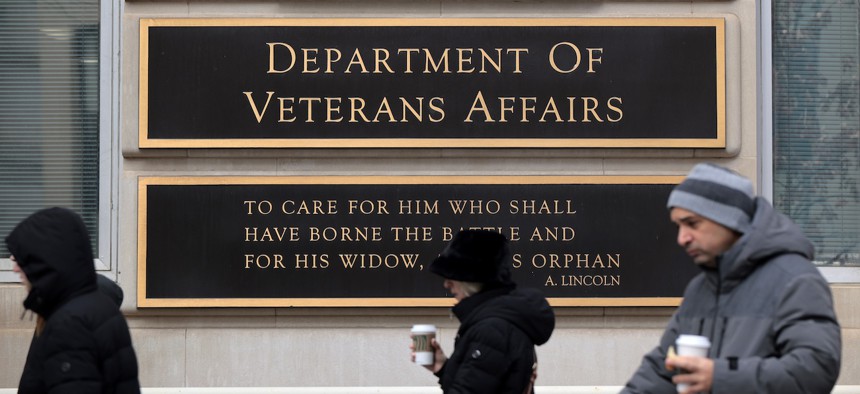
The VA fought to stay the injunction and enforcement order in this case. Chip Somodevilla/Getty Images




Appeals court upholds order reinstating VA’s union contracts
A unanimous three-judge panel found that only a district judge’s requirement that the Veterans Affairs Department “comply” with its collective bargaining agreements should be put on hold while litigation proceeds.

A federal appeals court last weekend upheld a March ruling that restored collective bargaining rights to Veterans Affairs Department, though not a later requirement that the department “comply” with its contracts with the American Federation of Government Employees.
U.S. District Judge Melissa DuBose previously found that VA Secretary Doug Collins violated the First Amendment and the Administrative Procedures Act last year when he terminated the department’s collective bargaining agreements with AFGE in connection with President Trump’s executive order banning unions from most federal agencies under the auspices of national security.
The VA appealed that decision, along with a second order enforcing the initial ruling after management asserted that it could reinstate the contract but ignore all its provisions and then sought to terminate the CBA a second time to “moot out” the court case, and requested a stay from the U.S. Court of Appeals for the First Circuit.
The three-judge panel, comprised of Biden, Obama and Trump appointees, unanimously denied VA’s request to pause enforcement of the initial injunction but found that the courts could not force management to abide by the contract “in both form and substance.” Writing for the court, Chief Judge David Barron determined the VA’s claim that its union contracts were rendered “inoperable” by Trump’s executive order was faulty, as judged by its own five-month delay in terminating the contract after the edict’s signing in March 2025.
“Indeed, we note, the record shows that the defendants chose to keep the CBA in place, seemingly as if it remained binding on them, for months after the president issued the EO, even though they were not subject during those months to any court order to do so,” Barron wrote. “It may be that there is some reason why it was more workable to keep the CBA in place as a binding agreement at that time than it is now. But, if so, the defendants do not contend that the CBA has since become any more unworkable than it was when they chose to keep it in place during that period.”
However, the panel did agree with VA officials, who argued that the April district court ruling to enforce the injunction “greatly expanded” the scope of DuBose’s initial decision, creating a mechanism “utterly foreign” to labor relations lawsuits.
“The question here concerns whether, even after the CBA has been reinstated as a binding agreement pursuant to a preliminary injunction, the district court may then modify that injunction as a means of enforcing it by ordering specific performance in each instance in which it finds that there has been a breach of one of the CBA’s terms providing for ‘grievance and arbitration’ procedures,” Barron wrote. “After all, such an individual breach would not in and of itself suffice to show that the CBA had not been reinstated as a binding agreement and need not itself result from the defendant having in that instance ‘acted outside their scope of authority.’”
As the VA fought to stay the injunction and enforcement order in this case, it separately and successfully lobbied the Federal Mediation and Conciliation Service, a federal agency that facilitates arbitrated grievance proceedings across government, to cease processing arbitrator requests in connection with VA grievances, instead placing those cases in abeyance until the conclusion of the broader litigation.
In a statement Monday, MJ Burke, president of AFGE’s National VA Council, applauded the ruling.
“For nearly two months, the VA has tried every which way to get around complying with the preliminary injunction ordering them to restore union rights to more than 320,000 nurses, housekeepers, social workers, cemetery caretakers, claims processors, and so many others who are represented by AFGE/NVAC and show up every day to serve veterans,” she said. “Every VA public servant who cares for a veteran depends on a workplace where they can do their job without fear of retaliation for exercising their rights.”
If you have a tip that can contribute to our reporting, Erich Wagner can be securely contacted at ewagner.47 on Signal.
NEXT STORY: Nuclear waste oversight at risk as staffing vacancies mount, watchdog warns