

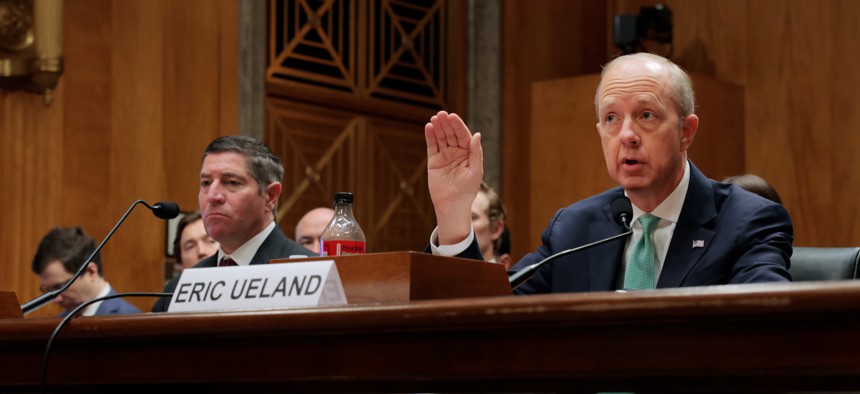
OMB Deputy Director for Management Eric Ueland, right, speaks alongside OPM Director Scott Kupor during a hearing with the Senate Committee on Homeland Security and Governmental Affairs on Capitol Hill on April 3, 2025. Ueland said Thursday that federal employees' ability to make change will be "significantly enhanced in an at-will organization". Anna Moneymaker / Getty Images





Continuing to shed federal workers remains ‘priority number one,’ White House official says
OMB deputy suggests that making it easier to fire feds will ‘liberate’ them to do their jobs better.

The Trump administration will continue working to shrink the size of the federal workforce after already shedding more than 300,000 employees, a White House official said on Thursday, who suggested a leaner civil service will be more effective as a result of its reduced stability.
Continuing to reduce the size of the federal government and its workforce remains “priority number one,” Office of Management and Budget Deputy Director for Management Eric Ueland said at a government efficiency conference in Washington, adding it would contribute to the goal of tackling waste, fraud and abuse. He pledged that individual agencies would ensure consistent and transparent communication on their plans, so employees would at least have a clear roadmap of what is to come even if they disagree with the destination.
“At the end of the day, if they walk away, even if they disagree with that goal, even if they disagree with that reorganization, even if they disagree with the potentiality that there may no longer be an opportunity for them to serve inside the federal government,” Ueland said, “that we have been very clear and we have communicated responsibly and expansively with them, so that they at least appreciate and understand where it is that we're going and what it is we're trying to do.”
Scott Kupor, the Office of Personnel Management Director who also spoke at the panel, said his agency is not giving agencies any specific targets for workforce reduction.
“Certainly the goal that we have given to agencies is not ‘you must hit X percent headcount reduction over this period of time,’” Kupor said.
He added the needs of government will continue to grow, but agencies must find ways to add to their portfolios without adding staff.
“We also have been very clear to people that, look, it can't be the case that every time we do something, the answer is we've got to come back to Congress and ask for additional appropriations,” Kupor said. “We ought to be able to do more with at least the resources we have.”
He later added: “We've got to get out of this idea that we just add people and that's the magic solution to every problem.”
He and other administration officials at the event extolled the possibilities of using artificial intelligence to reduce headcount without impacting government services. Ueland also noted the administration is hard at work on slashing the number of procurement, human resources and other systems to simplify agency operations.
Ueland acknowledged the disruption federal workers will continue to face going forward through ongoing agency reorganizations and initiatives such as Schedule Policy/Career, which will convert tens of thousands of civil servants into at-will employees who serve at an administration’s whims.
“The liberty to step forward on your own behalf, to assess the responsibilities placed upon you, to figure out and work in partnership under the direction of your leadership, to effectuate goals and bring about change can be significantly enhanced in an at-will organization,” Ueland said.
He implored federal workers to take advantage of the situation in which they now find themselves.
“It’s a real empowerment,” the OMB official said. “Think about what you can really do when you are liberated from some of the stultifying rules and difficult processes that previously have held you back.”
Kupor suggested there are areas of need within government to add staff, particularly those just starting their careers. Prior to Kupor’s confirmation, OPM attempted to push out tens of thousands of early-career employees by ordering federal agencies to fire staff still in their probationary periods. After various court injunctions, agencies ultimately shed around 7,000 of them.
“We're doing a horrible job of bringing new people into the system,” Kupor said. “So along with that comes new skills. And so one of the things we're doing is we've got to have programs that help us get better at early career recruitment.”
The OPM director added that while he “can't guarantee people permanent employment,” he would attempt to sell the government as an attractive employer going forward.
“I want people to come here because they feel like they can actually do something different, and the government can help them build their career,” Kupor said. “That's the story that we got to go talk to people about and we got to deliver on that.”
Share your news tips with us: Eric Katz: ekatz@govexec.com, Signal: erickatz.28
NEXT STORY: After shedding 25,000 employees, IRS chief says his agency now has perfect staffing level