

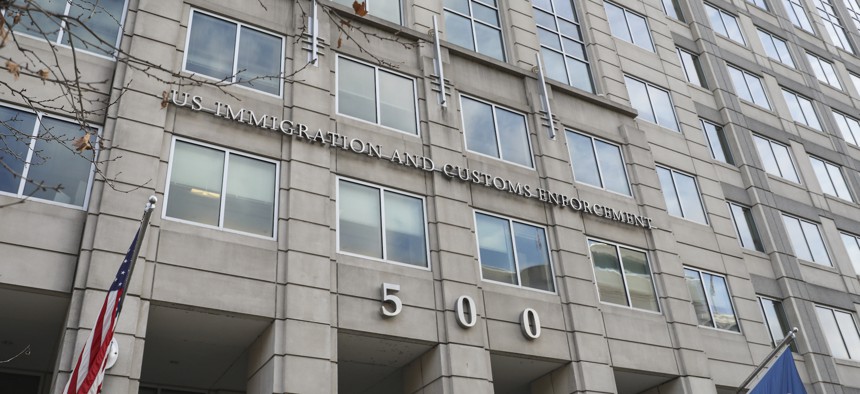
Immigration and Customs Enforcement is establishing a board to advise on granting reasonable accommodations for telework and remote work. Anadolu / Getty Images





ICE is scrutinizing work from home permissions for its employees with disabilities, continuing trend across government
The immigration enforcement agency said there was a “dramatic surge” in telework and remote work reasonable accommodation requests after President Donald Trump ended work from home flexibility for federal employees.

Immigration and Customs Enforcement is reviewing any reasonable accommodation that its employees have that permit telework or remote work to ensure they are in compliance with guidance that was sent to the agency’s workforce on Jan. 26 characterizing work from home as an “option of last resort.”
In doing so, ICE becomes the latest agency to more strictly scrutinize telework and remote work reasonable accommodations since President Donald Trump largely eliminated work from home flexibility for federal personnel at the start of his second term. Officials are required to provide reasonable accommodations to enable employees with disabilities to better perform in a role, unless the accommodation would result in an “undue hardship” for the agency.
According to the guidance, which was signed by Todd M. Lyons, the senior official performing the duties of ICE director, all existing telework and remote work reasonable accommodations will convert to an interim status until a review is complete. Interim accommodations, according to the document, are not supposed to exceed 10 business days, “except in extraordinary circumstances.”
“Some employees have had telework through an accommodation for years,” said Michael Fallings, a managing partner at Tully Rinckey law firm who specializes in federal employment law. “This really puts fear in those employees’ minds of ‘Am I going to still be able to work for this agency? Because I need an accommodation to do so.’”
ICE is also requiring employees with pending reasonable accommodation requests to resubmit them for review pursuant to the new process.
“That is something that really stands out because that can obviously cause people concern, having to reinitiate things that were already pending for, perhaps, months,” Fallings said.
And the agency is creating a board, whose members will be appointed by the assistant director of ICE’s Office of Civil Rights Compliance, that will meet every two weeks and serve as the final adjudicator for reasonable accommodation requests.
The immigration enforcement agency said in the policy document that these actions are necessary because there was a “dramatic surge” in telework and remote work reasonable accommodation requests after Trump in January 2025 ended work from home for the federal workforce. That presidential directive, however, exempted civil servants who telework or remote work because of a reasonable accommodation.
Still, Government Executive has previously reported that feds with disabilities have been ordered to in-person work. Several agencies last year also put restrictions on reasonable accommodations.
Over the summer, the Veterans Affairs Department, as part of an effort to “maximize” in-person work, began requiring a member of the senior executive service to approve a reasonable accommodation request for more than eight weeks of telework or remote work and ordered an annual review of reasonable accommodations that don’t have an end date. Likewise, the Health and Human Services Department in the fall mandated that all telework and remote work requests must be signed off by an assistant secretary instead of a supervisor.
ICE did not immediately respond to a request for comment.
Immigration enforcement agencies, including ICE, have attracted scrutiny in recent weeks following the January killings by federal agents of two individuals in Minneapolis who were protesting the Trump administration’s deportation operations.
Share your news tips with us: Sean Michael Newhouse: snewhouse@govexec.com, Signal: seanthenewsboy.45
NEXT STORY: Employees begin furloughs as lawmakers hope to end shutdown Tuesday