

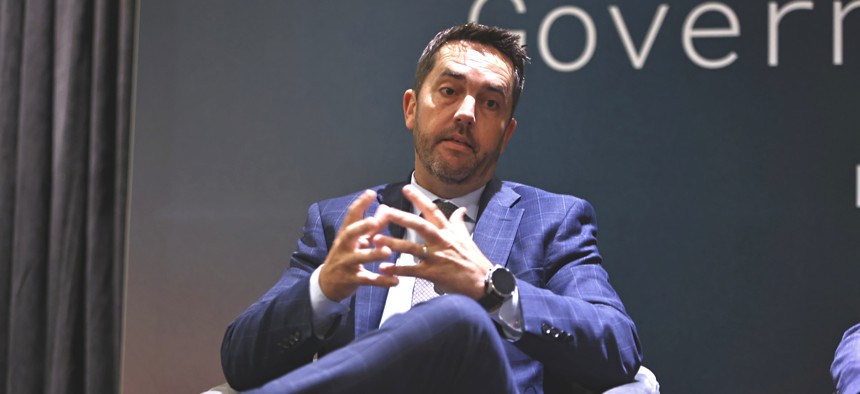
GSA Deputy Administrator Mike Lynch speaks at GovExec’s Government Efficiency Summit on July 16, 2026. Zaid Hamid/Nextgov/FCW



GSA is losing a key digital modernization leader
Michael Lynch joined the General Services Administration in January 2025 as a senior advisor and later became the agency’s deputy administrator.

Updated at 1:14 p.m. ET
Mike Lynch, deputy administrator for the General Services Administration, will be leaving his role and returning to the private sector, according to an email sent to staff Wednesday morning by GSA Administrator Ed Forst.
“Mike has been a part of the Administration since January 20, 2025, and I want to thank him for his service to the agency and the American people,” Forst wrote in the email. “During this time, Mike has led initiatives to advance our strategic priorities, strengthen oversight of internal operations, and support effective delivery of our mission. Mike has also helped accelerate GSA’s efforts to increase technology adoption across the agency and the federal government, supporting our customers, workforce and efforts to streamline how we operate.”
“Deputy Administrator Lynch has been a great partner, and has served GSA with distinction," a GSA spokesperson said. "Throughout his tenure, he has made valuable contributions to the agency. We appreciate his leadership, his commitment to GSA’s mission, and his service to the American people. We wish him all the best in his future endeavors.”
Lynch’s departure date is unclear.
Lynch, in an email to staff sent later Wednesday morning, said he was proud of his time in the Trump administration, grateful to Forst “for his leadership, trust and partnership” and described his 20-month tenure in public service as “incredibly rewarding.” He added the decision was “the right one for me and my family.”
“When I arrived at GSA in January 2025, one of my priorities was to help modernize how government operates — leveraging emerging technology, reducing duplication, and improving delivery for the American people. Over the past 20 months, we have made meaningful progress and built a strong foundation for this work to continue,” he wrote.
Prior to his government service, Lynch was the chief executive officer at UK-based medical technology firm Zedsen, and after joining GSA, he quickly became the public face of the agency’s increased role in AI and technology adoption and driving efficiencies across the federal government.
Lynch championed GSA’s OneGov program, through which GSA negotiated substantial discounts on AI and other software on behalf of the entire federal government, with accumulated savings to agencies now exceeding $1.7 billion. Several of those discounts have been extended in recent weeks, including deals with Google, OpenAI and Anthropic.
Meanwhile, more than two dozen agencies are using GSA’s USAi platform to access commercial AI models produced by frontier AI firms.
Within GSA, Lynch led the execution against two core efforts that are now making a dent in challenges faced by other agencies. In early 2026, the agency launched a “million hours challenge” to save and automate one million hours of workload across the agency. The agency is pacing to exceed that goal by year’s end, according to multiple GSA officials. Insights and lessons learned in attempting to accomplish the feat later served as the backbone for its Eliminate, Optimize and Automate, or EOA Playbook. GSA released the playbook publicly to all agencies in June to serve as a step-by-step guide to cut, automate and streamline work.
Lynch, who said the Trump administration “has looked to GSA to lead” on approaches to make government more efficient and responsive, evangelized the agency’s internal efforts through a governmentwide Emerging Technology Showcase attended in-person and online by thousands of federal employees on July 30.
“That's really a core to GSA's mission and a convening function that we've heard: a lot of demand and interest throughout government to expand what we were doing internally and offer it up more broadly,” Lynch said during GovExec’s Government Efficiency Summit on July 16.
Behind the public-facing tech efforts, Lynch was known as a steady hand for GSA’s workforce, which — like many agencies — faced force reduction in 2025. Lynch helped launch GSA Labs, a program designed to identify high-performers in the early-to-mid career level and place them into small teams with executive sponsorship to tackle the agency’s toughest problems.
“Mike was the guy working with the [GSA chief human capital officer] to make this make sense,” one senior GSA official told Nextgov/FCW. “He’s been trying to keep things steady for employees. He’s the one heading up all the GSA labs, and made them a positive for employees. He really cared about [workplace] culture and performance management.”
Lynch’s departing email acknowledged pride in GSA Labs, the EOA Playbook and Million Hour Challenge, expanding OneGov agreements and launching USAi, but also called out the agency’s key resource: it’s people.
“I have also appreciated the opportunity to visit GSA employees across the country,” Lynch said. “Those visits reinforced that GSA’s greatest strength is its people and their commitment to serving our agencies and the American public. It’s been an honor to serve alongside you.”