

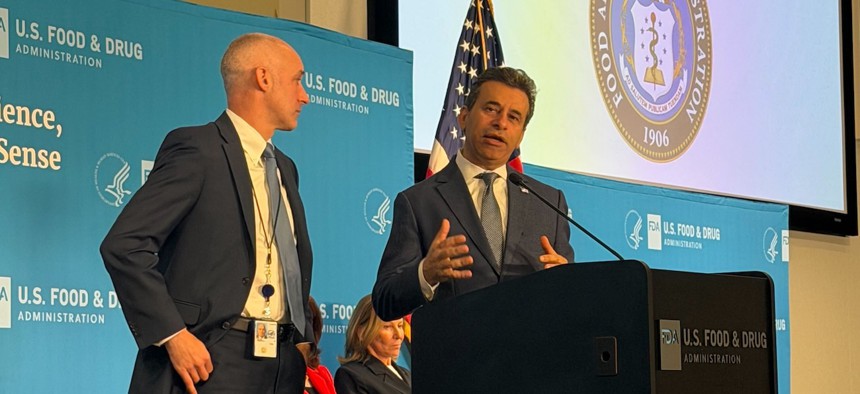
FDA Commissioner Marty Makary (right) speaking Tuesday at the agency's headquarters in Silver Spring, Md., alongside chief artificial intelligence officer Jeremy Walsh. Frank Konkel/Government Executive




FDA to pilot real-time clinical drug trials through cloud and AI
The first-of-its-kind pilot could lead to speedier regulatory approval of medical drugs and devices and potentially reduce “20, 30, 40% of overall clinical trial time,” according to FDA Chief Artificial Intelligence Officer Jeremy Walsh.

Through a new pilot program announced this week, the Food and Drug Administration will use artificial intelligence and cloud computing to monitor clinical trial data in real time, an effort that could ultimately shave years off the approval timelines for new drugs, devices and medications.
FDA commissioner Marty Makary announced “the first ever real-time clinical trial” Tuesday at a press conference held at FDA’s headquarters in Silver Spring, Md. “Today is a milestone day for us to challenge the assumption that it takes 10 to 12 years for a new drug to come to market.”
Makary said about 45% of the time between when a company conducts a Phase 1 clinical trial and submits its applications—which can sometimes be millions of pages long—to the FDA is “dead time,” where investigators and staff are doing “paperwork and other tasks, many of which are tedious.”
The pilot allows the agency to have “a direct data feed from a clinical trial, where the FDA will see what is happening, in the cloud, with the predefined clinical endpoints and any other signals investigators and regulators decide are valuable,” Makary said. “When a patient develops a fever, or a tumor shrinks, FDA regulators can see in the cloud, in real-time, exactly what is happening.”
FDA Chief Artificial Intelligence Officer Jeremy Walsh, who Makary credited as a driving force behind the pilot, said the idea for real-time drug trials manifested last summer through a confluence of the right personnel, emerging technologies and leadership’s drive to modernize the review process, which had not changed much since the 1960s.
Walsh told reporters that “while there is an opportunity to shave off” as much as 40% of the clinical trial time, the agency won’t be cutting corners on safety.
“The goal here is to sort of get to a regulatory decision in a faster timeline, without compromising any safety,” Walsh said. “The goal here is to raise the bar for what can be done. We are reimagining what information we need and when we need it in order to make a decision.”
So far, two clinical trials conducted by pharma companies AstraZeneca and Amgen will pilot the new system.
“The ultimate goal is to move data as quickly as possible across this ecosystem to accelerate our ability to bring new therapies to patients to make a meaningful difference in their lives,” said Amy McKee, oncology senior vice president at AstraZeneca.
In conjunction with the announcement, the FDA released a request for information for the public and industry to solicit input regarding how AI-enabled technologies “can improve efficiency, speed and quality of decision-making in early phase clinical trials.” Responses are due May 29 and could shape an expansion of the pilot this summer.
FDA’s broader tech modernization effort
During the press conference, Makary highlighted several major modernization efforts undertaken by FDA’s IT and AI team, a brain-trust that includes Walsh, acting chief information officer Sridhar Mantha, acting deputy CIO Sanjay Sahoo and acting associate director of business operations Gregory Jackson.
“Thanks to the moderation efforts by our entire IT and AI team here at FDA, we have been able to get away from the fiefdom culture where every center has to have their own license agreement for the same software and their own system,” Makary said. “We have done a massive consolidation.”
Over the past year, FDA consolidated 40 separate application intake systems into a single system, further consolidated its three data monitoring systems and seven adverse event reporting systems each to single systems, and systematically reduced the duplication of various software licenses across the agency’s multiple centers.These consolidation efforts—performed without additional staff or resources after significant staff downsizing in early 2025—“is going to save us at least $120 million a year,” said Makary, noting that money would be reinvested in the scientific community, new technologies and rehiring as many as 3,000 new scientists.
“That added reserve in our resources will support our bold reform agenda,” Makary said.
The agency has also taken massive steps in adopting generative AI.
Walsh, speaking last week at Google Cloud Next in Las Vegas, said in early 2025, about 1% of the agency’s workforce regularly used generative AI in their jobs. Today, the agency has a generative AI adoption rate of more than 80%, with some individual centers exceeding 90%. One of its most popular tools is Elsa, a large language model-powered tool that assists employees with reading, writing and summarizing reports.
FDA makes use of both Google’s Gemini and Anthropic’s Claude models.
“We have deployed enterprise AI across the entire agency, giving our highly skilled, highly-educated workforce access to all these tools,” said Walsh, adding that AI is helping FDA achieve its mission faster. “One of the great things about working with companies like Google in this is the speed at which we can get access to the models where our data sits. When new models are released, we can get access to the model in a week. For us, we need to make sure we have access to the latest capabilities and tools.”
Walsh said in early pilots, AI has already dramatically reduced timelines for data- and documentation-intensive regulatory duties FDA regularly performs, in some cases reducing administrative tasks from 10 days down to 20 minutes.