

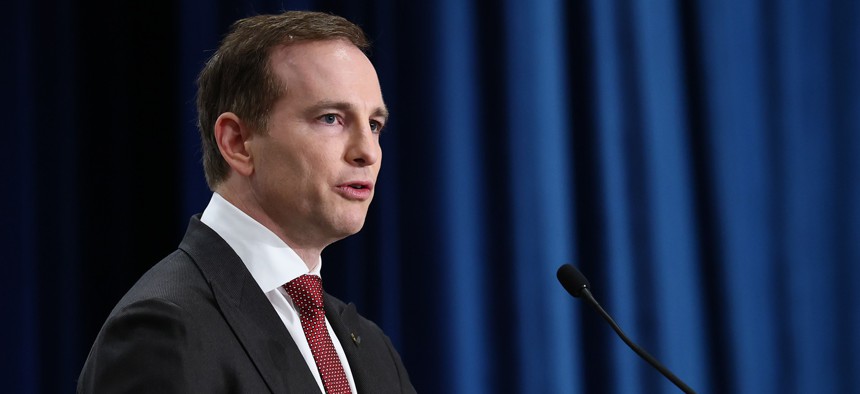
U.S. Chief Design Officer Joe Gebbia speaks during an event to "Celebrate the Implementation of the Dietary Guidelines for Americans" at the Health and Human Services Headquarters on February 11, 2026 in Washington, DC. Michael M. Santiago / Getty Images





New White House design team aims for ‘delightful’ websites — changing design ethos in the process
Trump’s chief design officer says that his work shouldn’t be controversial, but his team’s track record has raised questions about who their websites are for, who they leave out and whether the White House can garner trust based on sleek design alone.

Joe Gebbia wants to make the government’s websites better, more useful and more beautiful. They should be “delightful,” the billionaire Airbnb co-founder said recently on a podcast.
Gebbia is the government’s first-ever chief design officer, a position created by President Donald Trump within the White House last summer. Previously an associate of Trump’s Department of Government Efficiency, Gebbia’s oft-repeated goal is to make the government on par with an Apple store.
He’s aiming big: Gebbia’s team is working to reshape the government's main web design standards and use artificial intelligence to roll them out across the government.
“Everybody can agree — it doesn’t matter who you voted for — that they would love government websites to be better designed, have great usability and load faster,” Gebbia has said. “It’s the least controversial thing you could be working on.”
The creation
Gebbia joined the Trump administration early in 2025 to modernize the government's antiquated retirement system, which still relies on limestone mines in Pennsylvania to store paper records.
Since then, the Office of Personnel Management has deployed a new portal to digitize the front-end of the retirement process with an online application, an effort that had been years in the making.
Gebbia says he was only expecting to work for the government for six months, but got requests from heads of agencies to redesign their websites. Inspired by a Nixon-era initiative to improve government design, he pitched a Trump version of the effort to the president, and last summer, the National Design Studio was born via executive order.
“Our American [sic] by Design initiative will fully transform our most dated federal systems and services, providing Americans the richest, most beautiful and most user-friendly government experience in the entire world,” Trump said at the recent launch of the TrumpRx platform, which lists discounted cash prices for prescription drugs and was designed by the National Design Studio.
The executive order creating Gebbia’s role instructs agencies to work with his team to show results in improving their websites and physical spaces by July 4.
Like DOGE, the executive order setting up the team also set up a three-year temporary organization, which could take on unpaid volunteers, though it’s unclear if they have done so.
The White House did not clarify that or who bears the administrator title laid out in the executive order. Gebbia is the studio’s chief design officer, but the executive order also describes an administrator for the group that reports to the White House chief of staff and helms the temporary organization.
They also didn’t offer more information on a National Design Studio “advisory council” that Gebbia recently referenced on a podcast. Entrepreneur Scott Belsky, a partner at entertainment company A24 who previously worked at Adobe, is chairing that council, Gebbia said.
The work
Undoubtedly, some government websites could use an upgrade: nearly half of federal websites aren’t accessible, many aren’t mobile friendly and some just look like they’re from another era.
So far, Gebbia’s team has launched just over ten websites, most focused on Trump White House priorities, like the administration’s Genesis AI research initiative, or its Make America Healthy Again nutrition website, realfood.gov.
On Thursday, they launched Freedom.gov, reportedly meant to counter censorship by enabling people in Europe and elsewhere to see content banned by their governments, including alleged hate speech and terrorist propaganda.
So far, the websites from the White House team do look different from many other government websites.
On the TrumpRx website, a gilded America spins on a white globe halfway down the page. At the bottom of the page, a golden eagle clutches a golden scroll that reads ‘TrumpRx,’ flourishes that echo the gold accents the president has been adding to the Oval Office.
.png)
Some onlookers have praised the look of the new websites created by Gebbia’s organization, and others have lauded the milestone of design getting a seat at the White House. Others on social media have criticized Gebbia’s suitability to lead design work for his reposting of takes like “mass migration kills culture” on X and other posts that promote conspiracy theories.
As for how the websites work, many of the National Design Studio launches have had accessibility issues, although it appears that the team has at times made fixes after launching websites.
The MAHA nutrition website acknowledges that explicitly with a note on the website that says that “this content is undergoing a Section 508 review,” referring to the law mandating government websites be accessible.
Earlier this month, a user on X called out accessibility issues on TrumpRx. The same day, Edward Coristine — who proudly bears the moniker “Big Balls” and gained notoriety working for DOGE — responded, showing fixes to the website.
“This shouldn't have slipped through” and “won't again,” posted another team member, Caelin Sutch, who previously worked in the start-up space.
While a few of Gebbia’s websites still show errors when put through automated accessibility testing, others show hardly any.
When asked about the accessibility issues, an administration official told Nextgov/FCW that the team adheres to standard accessibility processes, and “when things aren’t working, they fix them very quickly.”
“The National Design Studio, under the leadership of Joe Gebbia, is doing outstanding work modernizing federal digital and physical services, improving both usability and design across platforms like the Trump Rx, Eat Real Food, and Trump Accounts websites,” they said in a statement. “President Trump has consistently prioritized innovation and efficiency, and he will continue to ensure federal services deliver results and meet the needs of the American people.”
Ethan Marcotte, who worked on the 18F team that was dismantled by the Trump administration, has also pointed out that the large size of the websites could make them difficult to download for people with limited data or without broadband.
The history
Gebbia and his team have a tab on their website that places themselves in a lineage of government design, but that timeline stops in the 1970s.
That leaves out the work bringing the government into the digital age, said Ashleigh Axios, who worked as a creative director and digital strategist in the Obama administration before helping to found Coforma, a government-focused digital consultancy, and more recently, a public innovation consultancy called Public Servants.
Like Gebbia, she’s an alumna of the Rhode Island School of Design. She overlapped with Gebbia during her time there and on an alumni board after.
She noted that the National Design Studio follows the recent dismantling of some government teams that worked on design and the pushing out of thousands of civil servants, including designers.
“When you torch a landscape, you can stand in the middle of it and stand alone,” said Axios. “It doesn’t mean that there was nothing that came before you.”
Matt Lira, who worked in the first Trump administration’s Office of American Innovation, called Gebbia the “dream candidate to lead this initiative," the type of Silicon Valley expert that administrations past have wanted to bring into government, at an industry event last year.
Asked about the fact that this follows the pushing out of many designers, Lira, who is now the executive director of nonprofit Invest America, noted that those decisions weren’t Gebbia’s call. He also praised Gebbia’s work modernizing retirement, saying that he studied what had been tried in the past.
“He very methodically met with senior career officials, external stakeholders [and] the vendors,” he said. “It was done with a tone of respect.”
Gebbia’s White House team should be judged on whether their services work and if people trust and believe in the government, said Lira.
To some former government designers like Axios, it’s clear that different values undergird Gebbia’s websites than government websites before him.
Government designers have traditionally focused on clarity, continuity and reassurance, said Rachael Dietkus, who worked in the U.S. Digital Service, now DOGE, as a design expert, and in the U.S. Digital Corps as a design supervisor. She’s also a licensed clinical social worker, which informs her design work.
People often come to the government in a moment of stress, after experiencing a disaster or losing a job, so the goal has historically been to build websites that are easy to understand and easily recognizable as government entities — it’s a focus on usability rather than aesthetics — said Dietkus.
She added that those at NDS seem to be asking how they can make websites more individualized, not recognizable as government websites.
“Are they even aware of the audience that their websites are intending to serve?” she questioned.
The National Design Studio website has three lines of scrolling photos and short videos of the team, the ceiling of a government building, water bottles and more. There’s a photo of Gebbia with Elon Musk.
“There’s an animated GIF of Joe Gebbia throwing a punch at the camera. What is that about, in [relation] to governance and serving the American people?” asked Axios. “I don’t know what that has to do with me as a taxpayer that’s funding this team.”
The goals
The NDS look may be coming to more websites soon.
Gebbia says that he wants to fix all of the government’s 27,000 websites, which include 7,000 to 8,000 dot-gov domains, pointing to the website of the Social Security Administration and Medicare as fruitful targets for upgrades — though the SSA website was updated last year.
“In the next three years, how do we touch every digital surface of the United States government?” Gebbia said of his goal on the recent podcast.
This could have a major impact on how Americans experience their government. The top nine websites get 160 million visits monthly, Gebbia said.
The U.S. Web Design System is a likely conduit for him to get this done. It was designed by two digital teams in the government — 18F and U.S. Digital Service — that have since been either completely shuttered or transformed into DOGE, respectively.
The executive order creating Gebbia’s team instructed it to work with the General Services Administration, which houses the guidelines, to update this design system.
It also instructed government agencies to make sure they’re in compliance with the standards, as directed by Congress in law. Getting agencies to use the standards has been a struggle: only 30% of government websites used them as of mid-2023.
If Gebbia’s team is successful, they could help implement these policies that’ve been in the works for years, like USWDS and the 21st Century IDEA Act, the law that requires agencies to use the design system, said Lira. The design studio adds a new type of capacity to the design and service delivery space that could help make progress with expertise, convening authority and political will.
“Hopefully it’s a net balance positive” against the loss of capacity that happened across the government last year, he said, noting that the space did need to be “revitalized” in order to scale across the ecosystem.
“We're building what will be the most used / implemented design system ever created that will be used by hundreds of millions of Americans,” NDS employee Sutch posted on Twitter late last year. His colleague — 2024 college graduate and software engineer Ahman Sandid — posted on X that they’re going to “create a framework and standard to succeed” USWDS.
“Head of engineering propaganda,” reads Sandid’s bio on X.
Gregory Barbaccia, the federal chief information officer, said on a recent panel that design studio is experimenting with using AI to do “complete website redesigns” using “NDS guidelines.”
Using AI to make changes at scale could work theoretically, although it would require careful monitoring of results for quality, said one former 18F employee, who requested anonymity for fear of retribution.
How AI will work in redoing websites more complex than the websites created by the design studio so far is an open question, though — as is the fact that making changes at scale in government often requires overcoming nontechnical hurdles, like who owns a website and who can tell them to do what with it.
“The thing about government web sites is that once you have seen one of them, you've seen one of them,” said Mikey Dickerson, who was the first administrator of the U.S. Digital Service, which is now DOGE.
“It's not only a different tech stack every time, it's a different staff employed by a different contractor and a different one person who has the password,” he said. “And no one has seen that one person for six months.”
Some of the design studio’s apparent AI work has run into issues already. The TrumpRx website previously showed a child with six toes running towards an American flag without any stars on it.
Still, there’s a chance the design group takes on even bigger priorities moving forward.
Barbaccia previously told Nextgov/FCW that he’s working with the design studio on a single, “digital front door” for the government, so that citizens don’t have to give the government the same information over and over at different agencies.
The questions
Some questions about how the design studio operates remain unanswered.
For one, the team appears to be using Google-based emails — not the existing White House email system.
Unlike other White House emails that go through the Defense Department, the design studio emails are getting delivered directly to Google, said David Nesting, who previously served as the deputy CIO at OPM and also did stints at the federal Office of the Chief Information Officer and U.S. Digital Service before it was DOGE.
The White House has traditionally been scrutinized for how it preserves presidential and federal records, and in response to past court cases, took great pains to ensure all emails and documents were automatically captured by a records management system, he said.
"It's not really possible for us to tell from the outside how or whether the team is preserving records — the design studio could've set up its own automatic records capture system, too — but the intent to operate independently does raise questions,” said Nesting.
The White House didn’t respond to a request for clarification.
The team also briefly had a store section on its website, where users could sign up to get notified when a $47 limited edition MAHA poster became available. A $400 “collector’s edition” with autographs from Secretary of Health and Human Services Robert Kennedy and Agriculture Secretary Brooke Rollins was also advertised.
Gebbia himself promoted the store, which has since disappeared. When asked where the profits would be going, a White House spokesperson told Nextgov/FCW that the posters were never “actually for sale,” as there was never a “purchase button.”
The design studio has also been criticized for using Elon Musk’s chatbot, Grok, on its nutrition website, which previously called out Musk’s product by name. That name drop was removed after Nextgov/FCW asked the White House for comment.
As of last Wednesday, the National Design Studio website included photos of company logos and links to their websites on its main page in its carousel of pictures.
That included links to the websites of X, Cloudflare, Figma, Made Thought and Code & Theory, without explanation as to why those links and photos of those companies’ logos were there.
They disappeared after Nextgov/FCW emailed the White House for comment.
.png)
“The National Design Studio is rapidly removing corporate logos because it is illegal for any governmental official to use public office for personal enrichment, including the enrichment of any specific private business or corporation,” said Craig Holman, a lobbyist at Public Citizen, a nonprofit advocacy group.
It “reeks of both corruption and incompetence,” said Emily Peterson-Cassin, a policy director at Demand Progress, an advocacy group.
Speaking of X, the team includes a few former team members of Musk’s DOGE beyond just Gebbia and Coristine. Kaitlyn Koller, who bears the title of “director of operations” for the White House team on her LinkedIn, also formerly worked at DOGE, as did Yat Choi, who helped Gebbia with OPM’s retirement modernization.
Gebbia’s team also includes Greg Hogan, the former CIO at OPM, as well as newcomers to government, including Nate Brown, Jaylee Adams, Tyler Kim, Braden Steffanik and Tai Groot, the White House confirmed. More may be coming, as the team is hiring.
The ethos
Gebbia called the administration’s MAHA website that houses new government nutrition guidelines, realfood.gov, a “modern, minimalist experience” at a recent administration event.
“Clean lines, playful illustrations, intuitive flow inspired by the best consumer brands. Because if we're asking families to choose real food every day, the guidance should feel welcoming, trustworthy and beautiful, not bureaucratic,” he said. “We're making healthy choices clearer, more accessible and even joyful.”
Designing in a government context is fundamentally different from designing for a business. The latter is more focused on differentiation, shareholder growth and customer loyalty, said Axios.
“In government, the responsibility is broader and more complex,” said Axios.
“Public institutions don’t need to feel like consumer brands to be effective,” she said. “They need to be clear, consistent, transparent, and grounded in evidence. They are meant to serve, not sell.”
A website on health, for example, should be measured by looking at if it's evidence-based, if it reduces confusion and helps the public make decisions, she said.
Gebbia has said that his work — “clear, crisp design” on par with consumer brands — can help build trust in the government.
To Axios, trust in government institutions doesn’t happen in a vacuum.
“The public doesn’t experience government in silos,” she said. “People don’t separate a nutrition website from immigration policy, law enforcement practices, healthcare access, or economic conditions.”
If you have a tip you'd like to share, Natalie Alms can be securely contacted at nalms.41 on Signal.
NEXT STORY: Targeted AI adoption can drive change, current and former officials say