

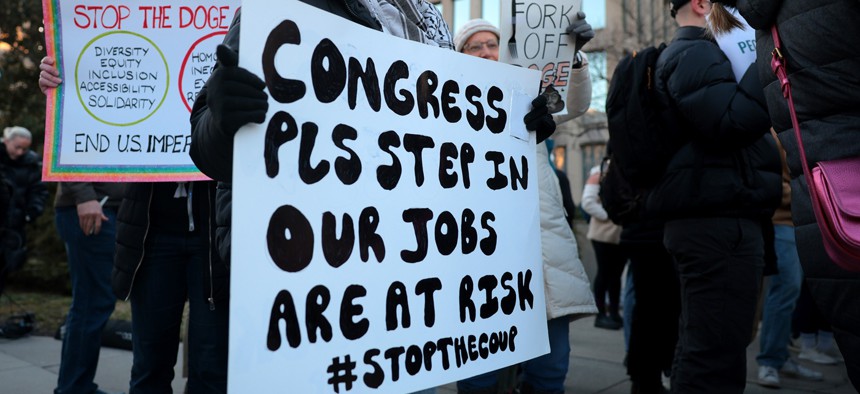
Federal workers and supporters hold signs as they demonstrate against the Department of Government Efficiency outside of the Office of Personnel Management headquarters on February 7, 2025 in Washington, DC. Kayla Bartkowski/Getty Images




Agencies lost around 20,000 tech workers last year — and now the Trump admin is hiring
All six departments and agencies that lost the most IT talent currently have open job listings for such roles.

Over 19,500 technology, data and telecommunications employees left their jobs with the federal government last year after President Donald Trump took office and began a crusade to shrink the government’s workforce, according to newly released government data.
Now, it appears that the administration is trying to make up for the losses.
All six departments and agencies with the biggest losses of IT management employees — the departments of Defense, Treasury, Agriculture, Veterans Affairs and Homeland Security, as well as the General Services Administration — currently have IT jobs listed on the government’s hiring website, USAJobs.
The Trump administration is also looking to hire 1,000 new early career technologists through its new U.S. Tech Force, which it launched late last year.
“Anything even tangentially related to tech — there’s a spot for you,” the administration’s chief information officer, Greg Barbaccia, recently told potential applicants.
In total, 352,285 federal employees left their posts between Jan. 20 and Dec. 31, 2025, according to data released by the Office of Personnel Management on Wednesday.
Among the government’s IT management, computer science, computer engineering, data science and telecommunications jobs, 19,519 employees left the government between Jan. 20 and Dec. 31, 2025, representing about 5.5% of all those that departed last year. With limited hiring, the net loss of tech employees was 17,228.
Asked by Nextgov/FCW during a January interview if it was a mistake for so many tech employees to leave the government, Barbaccia said, “there was quite a bit of disruption, obviously.”
“Disruption is not intrinsically a bad thing,” he said. “It remains to be seen. We haven't seen major system disruptions across the board.”
The loss of technology employees has stalled the overhaul of a key public health system that tracks diseases like tuberculosis, slowed the modernization of key tax systems at the IRS and put a government health benefits program for the U.S. Postal Service at risk of operational failure. Experts have also raised concerns about the government’s cyber defense in light of workforce losses.
The vast majority of the technology employees that left the government last year were not laid off, which forced only about 450 workers out of their jobs.
Many others retired, resigned or opted to take the administration’s deferred resignation offer, which the Department of Government Efficiency and Office of Personnel Management first extended via an email last January that warned, “we cannot give you full assurance regarding the certainty of your position.”
The Trump administration has emphasized that the majority of the government’s workforce losses in 2025 weren’t due to layoffs. But many of the former feds that left disagree with the characterization that their departures were voluntary, saying that they quit their posts because of toxic work environments or because they were threatened with layoffs if they didn’t accept the offer. Some of the administration’s layoff plans were also stalled by courts.
It remains to be seen how successful the government will be in recruiting new talent to take the place of feds who left the government.
Nextgov/FCW previously asked the head of the Office of Personnel Management Scott Kupor if the headlines about government layoffs and turmoil in 2025 had hurt the government’s recruitment pitch.
“The answer is unequivocally no,” he said.
“That’s not a surprising outcome, unfortunately, for those who have been through these things,” said Kupor when asked if layoffs ever went too far. “You do the best you can with the information you have at the time.”
He told Nextgov/FCW in an emailed statement this week that “the federal government has faced persistent gaps in critical tech skills for years, long before this administration.”
“Tech Force is one of several efforts to address those long-standing challenges by modernizing how government recruits and deploys technical talent, with a strong focus on bringing in early-career technologists,” he said. “It’s focused on filling hard-to-staff roles, accelerating hiring, and ensuring technologists are placed on high-impact missions where they can deliver real results.”
The Tech Force has received 6,000 applications so far, Barbaccia told reporters last week.
The young workers the Tech Force is targeting were among the most affected by Trump’s squeeze on the workforce.
“You saw a disproportionate number of young, tech-savvy federal employees being shown the door [last year],” Max Stier, president and CEO of the good government nonprofit Partnership for Public Service, told reporters last month.
The number of federal employees under the age of 30 went from 8.9% to 7.9%, he said, and some of the administration’s new programs to bring in talent are duplicating teams it shuttered.
“We expect, and unfortunately fear, that the larder will be restocked not with those that are expert, nonpartisan civil servants,” said Stier. “There is a structure being put in place to hire loyalists in their place.”
If you have a tip you'd like to share, Natalie Alms can be securely contacted at nalms.41 on Signal.
NEXT STORY: Former State official targeted in suspected Chinese spying effort tied to Venezuela research