

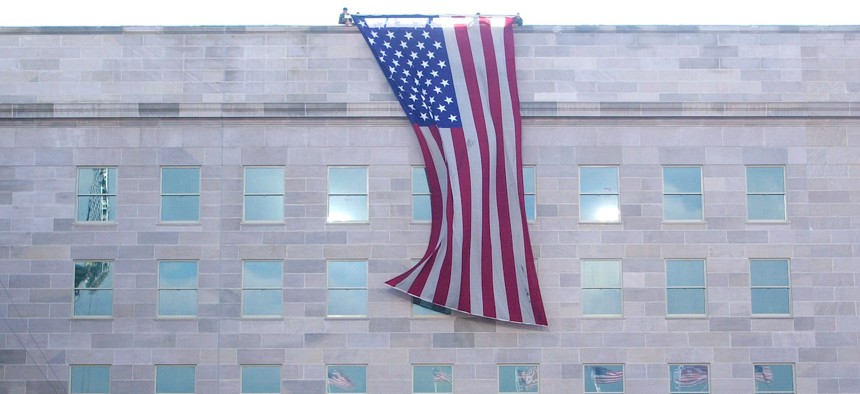
An American flag is unfurled on Sept. 11, 2002 in Arlington, Va., from the top of the Pentagon over the reconstructed section, which was damaged by American Airlines flight 77. President George W. Bush and Defense Secretary Donald Rumsfeld joined victims, families and workers in a remembrance ceremony on the first anniversary of the 9/11 terrorist attacks. Mike Theiler/Getty Images




What 9/11 can teach federal families about benefits
The federal workers’ compensation program can provide critical support after a work-related injury, illness or death, but families need to know what to document and which benefits to claim.

Every year, the anniversary of Sept. 11, 2001, brings back the same difficult truth: federal service is not always performed behind a desk, and risk does not always announce itself in advance. Sixty-nine federal employees were among those who died that day — including 62 at the Pentagon, three at the World Trade Center, three aboard Flight 93, one aboard Flight 77 at the Pentagon and one aboard Flight 175 at the World Trade Center. Many more reported for duty afterward to secure facilities, investigate the attacks, transport people, provide emergency assistance and help the country recover.
For their families, the lesson is not only one of remembrance. It is also a benefits lesson. If a civilian federal employee is injured, develops an occupational illness or dies because of federal employment, the Federal Employees’ Compensation Act may provide important protection.
FECA is the federal government’s workers’ compensation program for civilian employees, administered by the Labor Department’s Office of Workers’ Compensation Programs. It can pay for medical treatment, replace part of lost wages, provide compensation for permanent impairment and, in fatal cases, provide benefits to eligible survivors.
This is where many employees and families get into trouble: They know there are “benefits,” but they do not know which benefit applies, who administers it or what evidence is needed. A traumatic injury is generally tied to a specific incident during one workday or shift and is reported on Form CA-1. An occupational disease or illness develops over more than one workday or shift and is reported on Form CA-2. Wage-loss compensation is generally claimed separately, often with Form CA-7.
These distinctions are more than paperwork. They affect deadlines, agency responsibilities, medical documentation and how the claim is developed.
For survivors, FECA death benefits can be a critical source of financial protection. If the employee’s death was caused by a work-related injury or occupational illness, eligible dependents may receive recurring compensation based on the employee’s pay, subject to limits under the law. A surviving spouse may qualify. Eligible children may be included. In some situations, other dependent relatives may have rights as well.
FECA may also help with funeral and burial expenses and transportation of remains when applicable. But these benefits are not automatic just because the person worked for the federal government. The claim must show that the death was causally related to federal employment.
That means survivors need records. A surviving spouse or eligible children generally use Form CA-5 to claim compensation. Other dependent relatives may use Form CA-5b.
The file may need a death certificate, medical reports explaining the cause of death, proof of marriage or dependency, birth or adoption records, incident reports, position descriptions, exposure records and any prior FECA claim information. When the death follows an accepted work injury, the earlier claim file may be especially important. When the illness appears years later, the quality of the medical explanation and the factual history can make all the difference.
Sept. 11 also reminds us that not every compensable condition is visible on the day of the event. Some injuries are immediate, but others involve exposure, cumulative stress or occupational disease that may not be diagnosed until later.
Employees should not wait to document what happened. Write down where you were assigned, what you were exposed to, who was with you, what symptoms developed and what medical care you received. Survivors should ask whether an incident report was filed, whether there was a prior FECA claim and whether agency or medical records connect the condition to federal duty.
FECA is also only one part of the survivor-benefits picture. A family may also need to deal with the employing agency, the Office of Personnel Management, Federal Employees’ Group Life Insurance, the Thrift Savings Plan, Social Security and, in certain 9/11-related circumstances, other specialized programs.
These programs do not all use the same forms, deadlines or rules. Filing a FECA claim does not automatically file a retirement survivor annuity claim, a life insurance claim, a TSP beneficiary claim or a Social Security survivor claim.
Here is the practical advice I would give any federal employee: Do not leave your family to search for help as if they were on a scavenger hunt. Keep beneficiary designations current. Tell your spouse, adult child or trusted person where to find your personnel records, FECA correspondence, insurance information, TSP account information, medical records and emergency contacts.
If your work involves unusual hazards, deployments, emergency response, law enforcement, security operations, transportation, public health or disaster recovery, keep records that explain what you did and where you served.
A practical family checklist: Know the employing agency contact; know whether a FECA claim was ever filed; keep copies of medical, exposure and incident records; preserve marriage, birth, adoption and dependency documents; confirm beneficiary designations for life insurance and TSP; keep the death certificate and final medical records; ask promptly about FECA death benefits; and remember that a delayed illness, retirement or separation from service does not necessarily end the question of whether a condition was work-related.
Forms and resources to know: The Labor Department’s FECA program website and OWCP forms page are the official places to find current instructions, forms and claim resources.
- CA-1 for a traumatic injury that occurs during one workday or shift;
- CA-2 for an occupational disease or illness that develops over more than one workday or shift;
- CA-7 to claim wage-loss compensation;
- CA-5 when a surviving spouse or eligible child claims death compensation;
- CA-5b when another dependent relative files a survivor claim.
Employees and survivors can learn more about filing a claim and how to use the Labor Department’s ECOMP system to start claims, upload supporting documents and follow claim activity.
The anniversary of 9/11 is a time to remember the lives lost and the service given. It is also a reminder to prepare. FECA cannot remove grief, but it can provide medical support, income protection and survivor benefits when the requirements are met.
Families are in the best position when they know the benefit exists, understand that documentation matters and have the records needed to act quickly. In federal benefits, as in retirement planning, the best time to get organized is before there is an emergency.
An American flag is unfurled on Sept. 11, 2002 in Arlington, Va., from the top of the Pentagon over the reconstructed section, which was damaged by American Airlines flight 77. President George W. Bush and Defense Secretary Donald Rumsfeld joined victims, families and workers in a remembrance ceremony on the first anniversary of the 9/11 terrorist attacks.
NEXT STORY: GSA announces per diem increases for feds this fall