

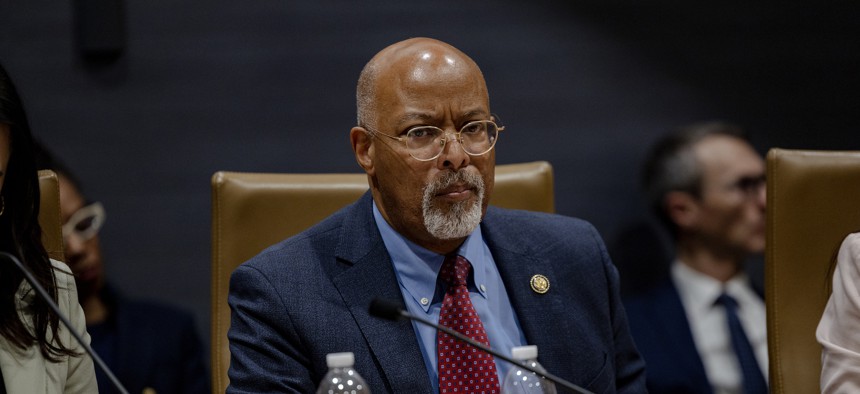
Rep. Glenn Ivey, D-Md., at a field hearing in Minnesota on Jan. 16. He expressed concerns on Thursday that a future president like Donald Trump would "run roughshod" over reforms Congress could implement. Jim Vondruska / Getty Images



‘My dream job has turned into a nightmare’: Ex-feds and public service experts testify to Congress on how to rebuild government post-Trump
Some recommendations that several Democratic lawmakers and advocates brought up included overturning Schedule Policy/Career, restoring collective bargaining rights for the federal workforce and increasing congressional oversight.

Updated at 11:55 a.m. ET Feb. 17
House Democrats examined the fallout from the Trump administration’s agency workforce cuts and potential congressional measures to rebuild the civil service and strengthen executive branch oversight during a Thursday roundtable with good government experts and former employees.
“If you just put it in place like before or leave it like it is, it's clear that someone like Donald Trump — who doesn't care about the law, doesn't care about ethics, doesn't care about norms or traditions — will just run roughshod over it,” said Rep. Glenn Ivey, D-Md.
Several speakers condemned the recent finalization of Schedule Policy/Career (formerly Schedule F), which would remove civil service job protections for tens of thousands of federal employees in “policy-related” positions.
Rob Shriver, former acting director of the Office of Personnel Management under President Joe Biden, argued that subjecting the federal workforce to increased political influence would deter people from wanting to work for agencies.
“Federal workers come to the job because they want to make a difference, and they want to be judged based on their merit and not based on their politics. That's been ingrained in our system since the 1880s, and this administration is now taking this back,” said Shriver, who is now a senior official at the Democracy Forward nonprofit. “We need to rebuild that trust, rebuild these guardrails and make sure that the American people understand that the people who work in the federal government are working for them.”
Trump officials have contended that Schedule P/C will not lead to federal employees being fired on the basis of their personal politics.
At the roundtable, former Rep. Barbara Comstock, R-Va., a Trump critic, suggested establishing bipartisan groups organized by issue area to advise Congress on oversight of agencies.
“You could gather people together and brainstorm with them to use their expertise,” she said. “Certainly we have a large pool of retired [feds] who have watched all of this and who want to help in a lot of ways. Some are already engaged.”
Krista Boyd, who was inspector general at the Office of Personnel Management before Trump fired her and is now a senior official at the nonprofit American Oversight, urged Congress to conduct more roundtables and investigations into the executive branch and strengthen the Freedom of Information Act.
She also argued that there should be consequences for any actions committed by the Trump administration that may be illegal. Specifically, she pointed to reports that officials improperly shared agency data.
“If that kind of behavior is allowed to stand without accountability, it will belittle additional reforms that are put in place,” she said.
Lawmakers and advocates also brought up familiar proposals, including halting reductions in force, restoring union representation in response to the president revoking collective bargaining rights for two-thirds of federal employees and increasing government pay so that it’s more comparable with the private sector.
Thursday’s roundtable took place in Fairfax County, Va., a suburb of Washington, D.C., where unemployment spiked following federal job cuts. Former civil servants also testified about how losing their careers has impacted them.
Kelly Jabar, who handled offboarding at the Food and Drug Administration before she was laid off, flagged several operational issues with how the Trump administration let her team go. She said that the termination notice did not state where to send government equipment and that colleagues received documents from the agency with the personal information of other people.
Jabar said that she struggled to get answers to any of her questions, including how long her health insurance would last, which was important to her as she was battling breast cancer.
“My dream job has turned into a nightmare,” she said. “I just wanted to heal, and this just keeps giving me more and more stress.”
Kenneth Bledsoe described his family’s chaotic evacuation from the Democratic Republic of the Congo after the dismantling of the U.S. Agency for International Development.
“There were explosions and gunfire, leaving under cover of night, going days without sleep, only a carry-on bag for each of us, crowded onto tiny boats with our fellow diplomats, their babies and their pets,” he said.
Jacob Cross discussed losing his job at the National Oceanic and Atmospheric Administration as part of the February 2025 mass firings of employees in their probationary periods, generally those who have been hired or promoted within the past year.
Cross said that he spent nearly a decade in the private sector specializing in tech, but it was his goal to work for the federal government. In recent months, the Trump administration has launched Tech Force to recruit tech employees.
Around the time of his firing, his wife found out she was pregnant. While Cross has since gotten a new job, he had to take a pay cut. The former fed compared his family’s situation to that of the government.
“While something may seem OK on the surface, the reality can be much different. My family navigated our hardships, and we are so lucky to have our daughter with us now. But because of the indiscriminate and cruel treatment we received as part of the DOGE firings, we took on debt, and my wife was forced to go back to work sooner,” he said. “My former program office is the same way. The dedicated civil servants that are still working there are ensuring the mission stays on track, but the innovations and growth that are necessary to make sure we stay on track for the future have been put on hold.”
Clarification: An earlier version of this story referred to the event as a hearing, as some Democratic members did. Under House rules, however, only the majority party can formally convene a hearing, so this event was not an official committee hearing.
Share your experience with us: Sean Michael Newhouse: snewhouse@govexec.com, Signal: seanthenewsboy.45
NEXT STORY: Watchdog flags gaps in Coast Guard’s handling of discrimination complaints