

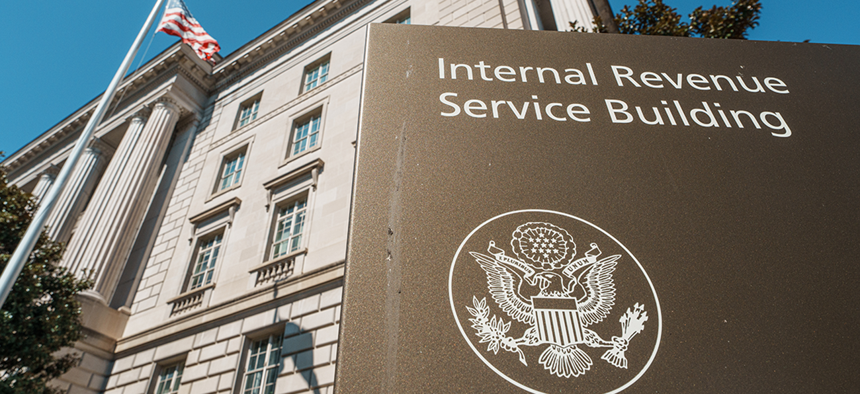
Top performance ratings can make federal workers eligible for financial and time-off awards. J. David Ake/Getty Images




IRS says it needs top performers, even if they don’t all get the performance ratings they deserve
An IRS division that reassigned employees to different parts of the agency to address backlogs is warning staff against “deliberately choosing mediocrity” in their day-to-day work if they get lower performance ratings this year.

The IRS is telling employees that it needs top performers who care about doing their jobs well, even if the agency is unable to give all of them adequate recognition for their accomplishments.
Federal agencies are currently reviewing how many employees can receive above-average scores on their annual performance reviews, after the Trump administration put a cap on top marks across the federal workforce.
The Office of Personnel Management in September directed agencies to limit top scores – an “outstanding” score of five, and an “exceeds fully successful” score of four – to no more than 40% of their General Schedule employees during this year’s performance review cycle.
IRS employees have been told by management that a three – which equates to “meets expectations” – is the default score many will receive. That preemptive messaging has led some IRS employees to question whether it is worth going above and beyond what’s expected of them.
An IRS division responsible for reassigning employees to different parts of the agency to address staffing shortages and backlogs caught wind of these complaints. In an email, it warned staff against “deliberately choosing mediocrity” in their day-to-day work.
In an email to employees last Friday, the IRS chief of internal consulting, a rebranded version of its chief operating officer, told employees that “changes to the performance rating process have generated concern, frustration, and, for some employees, disappointment.”
“Those reactions are understandable. Employees who work hard, take pride in their accomplishments, and routinely go beyond what is required naturally want that effort to be recognized,” IRS Chief of Internal Consulting Joseph Ziegler and his deputy, Elizabeth Vonhof, wrote in an email obtained by Government Executive.
Before serving in his current role, Ziegler was an IRS whistleblower who claimed the Biden administration gave preferential treatment to Hunter Biden, the former president’s son, during a tax investigation.
“I want to address one sentiment that has surfaced in some of the feedback received: ‘If I may not receive an Outstanding rating, why should I continue to perform at an outstanding level?’ I understand the frustration behind that question, but I hope we do not allow a rating label to define the quality of work we choose to perform or the professionals we choose to be,” Ziegler and Vonhof wrote. “A performance rating is important, but it should never be the sole reason we pursue excellence.”
Top performance ratings can make federal workers eligible for financial and time-off awards. Low scores could also make it easier for agencies to remove certain employees. OPM in July finalized a rule emphasizing recent performance reviews over tenure when carrying out reductions in force.
Ziegler and Vonhof told staff that the “IRS needs talented people who care about doing their jobs well” – even if they don’t necessarily get recognition for it. They added that a “fully successful” score “does not mean mediocre.”
“There is nothing mediocre about successfully performing meaningful work in service to IRS employees and the American public. At the same time, deliberately choosing mediocrity because a particular rating is not guaranteed is not the standard to which we should aspire as an organization or as professionals,” they wrote.
In February, IRS internal consulting put IT and human resources employees on 120-day details to work in taxpayer services. They were assigned entry-level roles answering inquiries from taxpayers and processing tax returns. Many of these temporary details to taxpayer services were extended for another 120 days in May. The National Treasury Employees Union estimates that about 1,500 IRS employees were placed on these details.
IRS employees who moved off taxpayer services details were told in late September that they would be reassigned to “ONE IRS Readiness” teams, with few details about what work they’d actually be doing in these new roles. Employees were shifted to these new assignments largely because they cleared a “huge” backlog of amended tax returns.
Employees placed on these details said it’s not clear how their performance will be evaluated this year, after being reshuffled to different parts of the agency. Impacted staff report currently report to internal consulting, but previously did work for taxpayer services. They originally worked in IT and human resources, but former IT staff have been explicitly told they cannot return to the agency’s tech shop. The IRS did not immediately respond to a request for comment.
“We should strive to do exceptional work because our work matters, because our colleagues and the public depend upon us, because we take pride in what we accomplish, and because excellence should be part of our professional identity, not something we turn on or off based upon the likelihood of receiving a particular rating,” Ziegler and Vonhof wrote.
One IRS employee said he was angry over what he saw as the agency trying to downplay staff concerns.
“If I do outstanding work, I want to be recognized for it outside of my own gratification. Otherwise, others will not believe my accomplishments were outstanding,” the IRS employee said. A second IRS employee said the email was “very disappointing.”
“These performance reviews are based on the jobs we were thrown into,” he said.
A third IRS employee said staff have been left in the dark over how performance ratings will be determined this year.
“No one really knows how and which employees were selected to be lowered. OPM gave some percentage recently and agencies had to calibrate to that percentage by a certain date last week,” the third IRS employee said.
Former IRS Chief Human Capital Officer Traci DiMartini, who was fired last year after challenging the acting IRS commissioner's decision to fire about 6,700 probationary employees for unspecified performance reasons, told Government Executive that the “tone of the email is insulting and also shows they have no clue how dedicated IRS employees are to the agency's mission and to supporting taxpayers.”
“One of the greatest privileges I had was leading the IRS HR office and it was quickly apparent that the IRS workforce is routinely mischaracterized by both political parties. The fact is the federal government has been doing pay for performance for decades," DiMartini said. "They routinely tie the bonus percentages to an employee's rating and that is why people are pissed off that this administration is unilaterally trying to find ways to downgrade performance.”
An IRS manager previously told Government Executive their program manager “didn’t want to see” any fives or fours – and that a “fully successful” score of three out of five “is what is expected across the board.”
Ziegler and Vonhof wrote that under OPM's new forced distribution model, “managers must continue to evaluate employees objectively against their established performance standards and document accomplishments accurately.”
“The standardized distribution does not eliminate the responsibility to assess performance fairly. It does, however, require greater differentiation when determining which accomplishments represent the organization's highest level of performance and recognition. That can require difficult conversations and difficult decisions, particularly among teams with many high performers.”
NTEU National President Doreen Greenwald said in a statement that taxpayers depend on experienced IRS employees to answer questions, process returns, and help resolve tax problems, and that “an arbitrary cap on the highest category of ratings undermines morale and makes it harder to retain the skilled employees who deliver those services.”
“IRS employees do not need a lecture about taking pride in their work. They demonstrate that commitment every day. Denying the ratings they earn sends the wrong message to a workforce the public relies on,” Greenwald said.
The IRS email states that internal consulting is in the “home stretch” of this year’s performance evaluation cycle, and is waiting to hear back about final ratings from the office of IRS Chief Executive Officer Frank Bisignano, IRS human resources and the Treasury Department.
The email states the percentage of employees allowed to receive top scores “may change in future years based on OPM/governmentwide guidance.”
“This represents a significant change in how performance ratings are administered, and change, particularly when it affects something as personal as how our contributions are recognized is not always easy," Ziegler and Vonhof wrote.
If you have a tip that can contribute to our reporting, Jory Heckman can be securely contacted at jheckman.29 on Signal.
NEXT STORY: SBA is moving field offices away from major cities, union says