

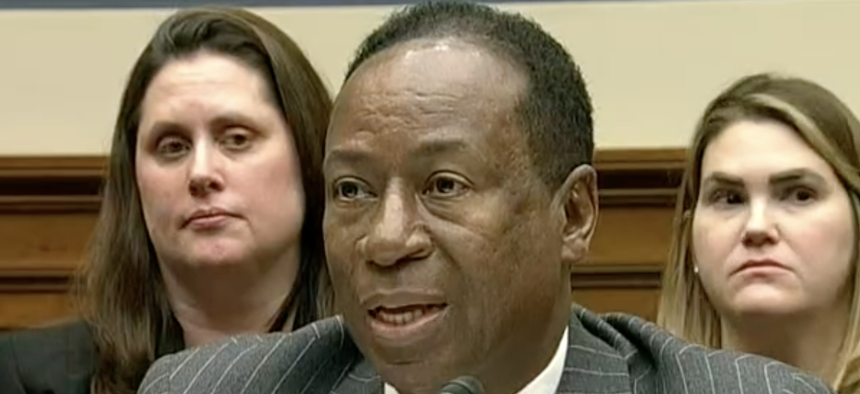
Labor inspector general Larry Turner testifies at a hearing on Dec. 7, 2021. C-SPAN / SCREENGRAB GOVEXEC




Inspector general fired by Trump talks leadership, OIG independence and his new memoir
Former Labor watchdog Larry Turner writes about confronting racism, working under “toxic” bosses and what he misses most about being in government.

Across his decades-long career in government, Larry Turner served in the Army, in senior positions at the Defense Department’s inspector general office and, ultimately, as the IG for the Labor Department. He was fired by the president, along with 16 other federal agency watchdogs, in January 2025.
Since his departure from government, Turner wrote a book recounting his abrupt firing as well as lessons in leadership that he’s learned throughout his life — tracing his path from being an introverted kid to heading a government oversight office.
In an interview with Government Executive, Turner discusses how IG staffers serve as a check on their boss, how he would strengthen the Trump administration’s anti-fraud initiatives and what he’d say to the president in order to change his mind about diversity, equity and inclusion programs.
Editor’s note: The following interview has been lightly edited for clarity and length.
Q. It's clear from reading the book that you really loved being an IG and being in the IG community — so much so that you coined the phrase, "It's a great day to be in the OIG.” So my first question for you is, what do you miss most about being an IG?
A. I actually miss the staff. Going through the military and going through the government and a couple years as a contractor, one of the things that I realized was my strength was leadership. When I say that, that sounds like a nice, corny thing to say. But after working for several different managers over my career, I know the importance of getting the best out of your staff and how you can get the best out of your staff.
When I would hire people or interview people for our jobs, I was really wanting to measure their passion about their work. We were a small OIG. We were about 350 employees. I would bring executives in and I would let them know that “Hey, unlike some places where you may be in this ivory tower, here you got to roll your sleeves up and actually go to work and manage people.”
I want people that are gonna get outside their office and go talk to the staff. That was how it was for me. That's why I love managing staff so much. When I left the government, all of a sudden, I found myself at home every day. I see my wife and talk to a few friends and colleagues on the phone, but I don’t have the daily interaction that I had with staff, which I just loved.
Q. In your book, you talk about the importance of IG independence. While IGs are supposed to be appointed “without regard to political affiliation,” most of the IGs who have been confirmed since the start of Trump's second term worked in the president's first or second administration. Your successor, Anthony D’Esposito, is a former GOP lawmaker who recently spoke at a Trump political rally. Considering all of this, do you feel you will be able to trust the findings of DOL OIG audits and investigations moving forward?
A. I would say with any OIG there's a possible perception that you may favor the administration or the secretary. People may question your findings. Was it independent? Was it nonpartisan? So that's the problem you run into, even if you were not trying to. Some of the criticism I see of some of the newer IGs, including my replacement, is because they, in some cases, have not stayed away from that. One of the things that you learn as an inspector general is that you have got to give the appearance of being independent and not influenced by the administration.
The other part about that is you don't know your staff’s political affiliation. I think our staff are just a slice of the American public, and so they are the ones that help you hold your feet to the fire. If they feel that you are siding with the administration, your employees could write a whistleblower complaint, somebody could go to the media or they could even turn you into the Council of the Inspectors General on Integrity and Efficiency.
(Editor’s note: CIGIE oversees investigations into senior watchdog officials. Last year, the Trump administration prevented the group from receiving funding for about a month-and-a-half, but backtracked following objections from some Senate Republicans.)
That's one of those things where we police ourselves up. That's why I think it's so important to provide that independence. IGs are intentional about that because you make sure that you avoid meetings with the secretary that may have a certain slant in terms of what the administration is doing. IGs try to stay away from that, and the secretaries know that because sometimes they won't invite us to certain meetings, or we will opt out and they understand and agree with that.
Q. Could you provide an example of a meeting that you purposefully skipped while you were an IG at Labor?
A. Once a week there were certain internal-level meetings that the secretary or the deputy secretary would have. When you get a new secretary, a time or two, you may attend those until you realize that this was really based on administrative guidance. So those were meetings where you felt like, “OK, I don't need to be at this meeting.” You would let the secretary or the deputy know that, and they would say, “Oh, not a problem Mr. IG. I understand that, and we don't want to compromise your position.”
Q. You write in your book about growing up in a segregated town, attending a segregated school and being one of the only Black officers at your first assignment in the Army. You write openly about racism you experienced in your personal and professional life. Something that stood out to me was when you had a new colonel, and he would only say good morning to white staff members and not Black ones. You also describe yourself as a supporter of diversity, equity and inclusion programs. In contrast, the Trump administration has sought to remove DEI from the federal government. If you had an opportunity to meet with the president, what would you say to him to try and convince him to change his anti-DEI stance?
A. I would say that if your goal is to hire the best people, then you have to open up the hiring process. If you only look at people that know you or that look like you, then you limit yourself. I am greedy. I want the best people working for me. Why would I want anything else than that?
If I were talking to the president, that's what I would tell him. If you really are serious about hiring the best people, then you have to open up the gates for everybody to apply. And from that application process, it'll give you a chance to look at more people. One of the reasons I pushed DEI was because I understood that there were a lot of qualified people that have been working all their lives to qualify for certain jobs. If you shut that down, then you don't give them a chance to compete.
I would like to be interviewing the top three or four people that are really good. You want your best choices. You don't want to have one person that stands out and two or three that are just really bad. That was the thing that I always impressed upon my managers and senior execs. At the end of the day, I considered success as getting the best employee available.
There were times that I had to have like a teach-and-train moment with my execs because they had a candidate or two that was African American, and they were afraid to hire somebody white because “I'm worried about stepping on the boss’ toes.” But they misunderstood what I was saying that, at the end of the day, it's about hiring the best people.
Sometimes that can mean you may have more white staff members. Sometimes you may have more Asians. Sometimes you may have more African Americans. But when you go through that process, and the top person that rises to the level is whatever race, it just happens that way. But I think it's unfair to anybody, and takes away from your credibility, when you just hire somebody that you know, or some friend, or somebody else’s friend or family member, or something like that.
Q. You were one of the first officials to warn about the prevalence of fraud in pandemic financial assistance programs, and the issue became personal for you when someone stole your identity to file a false unemployment claim. The Trump administration has prioritized combating fraud in federal programs. Given your experience, what suggestions would you give to the Trump administration to improve their anti-fraud initiatives?
A. Let your staff go after the top fraudsters. When you're going and looking for fraud, you want to be able to open up all gates. You can't pick a certain group to look at. If you're seriously interested in fraud, you want to go to those places where you can identify the fraudsters and prosecute them.
The other part about that, and this is why I feel the current administration has missed out a little bit, is that you gotta have the staff and resources to do that. My last two years as the IG, we were in a hiring freeze because we didn't have the budget. Under the Biden administration, they were trying to get us another $100 million. And even under the Trump administration, I was scheduled to testify like a week before I got fired because they were trying to get us additional resources.
I think it starts with resources, and you can't really be serious about fraud if you are continuing to reduce the staff or your auditors or investigators — the people that do the job. It's like you're talking out both sides of your mouth. On one hand, you're saying we want to really go after the fraud. But on the other hand, you're saying we're going to cut your staff by 50%. So which is it? You can't have it both ways.
(Editor’s note: The Partnership for Public Service nonprofit reported that, as of May 31, the average Cabinet OIG workforce is 19% smaller than it was in December 2024. Federal workforce data shows that Labor OIG has gone from 315 employees in 2024 to nearly 250 currently.)
The other part about it is you’ve got to want IGs who are aggressive in going after fraud. I think there's a feeling right now that that is not really the mandate that has been given to IGs and their staff. I think there is a sense right now that some staffers are concerned about their jobs being at risk by going after certain fraudulent groups. I think that's the biggest challenge.
Q. Can you be more specific about staffers feeling that their jobs are at risk if they go after certain groups or individuals?
A. When 17 IGs were illegally fired, including myself, that was a terrible message to send to the IG community. If you were getting rid of IGs that were ineffective or were not doing their job, you could justify that and say, “Hey, this is why we're getting rid of them.” I think that would have went a long way with people accepting that. But when you didn't do that, then it got people saying, “Okay. They did their jobs and they got released.” So now, if you work for the people who were fired, you're concerned about “Am I going to get in trouble? Am I going to lose my job because I'm going after someone that may be in a certain party or may be a part of the current administration? If I go after a friend of somebody's or somebody in a red state, am I going to put myself at risk?”
One of the hardest jobs for all IGs to deal with is that sometimes you will get a request from a congressional member. And that congressional member may want you to investigate the secretary or somebody on their staff. Most IGs, when they get that request, they know that the price of poker just went up because they also know that “If I don't find what that congressional member wants me to find, are they going to hold that against me? If I do find that the secretary did commit a violation, I'm going to have the secretary mad at me.”
At the end of the day, most IGs don't care about that. They just care about getting it right. IGs follow the facts wherever the facts may lead us. We're like referees. We're independent, we're impartial and we don't even get distracted by political affiliation or what a senator or a Congress member wrote. You don't even worry about that. You’re just worried about “We got tasked with going out here and investigating something. Let's make sure we do a thorough job, and make sure we check and double check to make sure that it’s correct.”
Q. While in your book you praise many of your previous supervisors, you also discuss a “toxic” boss you had while at the Defense Department inspector general office. This individual was ultimately fired, in part, for making false claims against you. What advice would you give to a federal employee or any worker who has a boss that is creating a hostile work environment?
A. One thing I always told my staff is one of the keys to being successful is learning how to work under anybody. The first time that you have a boss that's difficult, don't just throw your hands up and say “I'm out of here.” It's almost like a math problem. You try to figure it out, and this route doesn't work. You try several things, and at some point, you may get to where you’ve exhausted all methods and all means. At that point in time, then I would advise someone to start looking outside for a different opportunity.
When you're younger and you're going through a difficult boss, sometimes you get frustrated and you want to let it get personal. What I've always advised my staff is to, first of all, always remain professional and always stay positive. At the end of the day, if it gets negative, a lot of times you're at a disadvantage because you're dealing with somebody that writes your appraisal. You always really just got to stay professional, and I think that's the hardest thing for a lot of junior employees to do because they take it personally.
But at some point in time, you may get to a point where you need to say, “You know what? I've tried all these different methods and ways to make this work. I've met with my boss, tried to find out what I can do to improve or change their opinion of me.” And sometimes you may work for somebody that just don't like you. And when it happens, the best thing I think an employee can do is start looking elsewhere. Some people get so frustrated they quit and walk away before they have something else. I would never advise anybody to do that. I would always say stay the course until you can find something better.
Q. This is my final question. Is there a question I didn't ask you that you wished I had?
A. I decided to write the book because throughout my time in the government, as well as in the Army, my leadership style has been somewhat unconventional. What I mean by that is that work does not have to be drudgery. I actually believe that work can be fun, and one thing I like about the OIG community is that a lot of our folks really love what they do. It's about creating an environment where they can continue being productive, and they want to come to work and their passion comes through.
I've had several managers who were toxic, and so it was for that reason that I wanted to be a leader. Too often, I hear GS-15s and -14s say “I want a non-managerial job.” I've never felt that way. I want a job where I can control something more than having somebody control me. If I'm the IG or the deputy IG, I can ensure that we have a positive environment where people can be productive.
I wrote the book because I'm a people's person. Oftentimes, when I was the IG and deputy IG — and throughout my career, and even now since I've left the government — I'm always giving advice or mentoring or coaching. But what happened was, I'm only giving that advice to a handful of people now as opposed to when I was giving it to a whole agency. I thought one way to share some of that knowledge and the success that I've had in my government career and military career was to write a book and just share some of those things with folks who are trying to learn, who are trying to be more effective as leaders and trying to get into the government.
If you have a tip that can contribute to our reporting, Sean Michael Newhouse can be reached securely at seanthenewsboy.45 on Signal.
NEXT STORY: Shutdown threat possibly lifted as House passes stopgap spending bill