

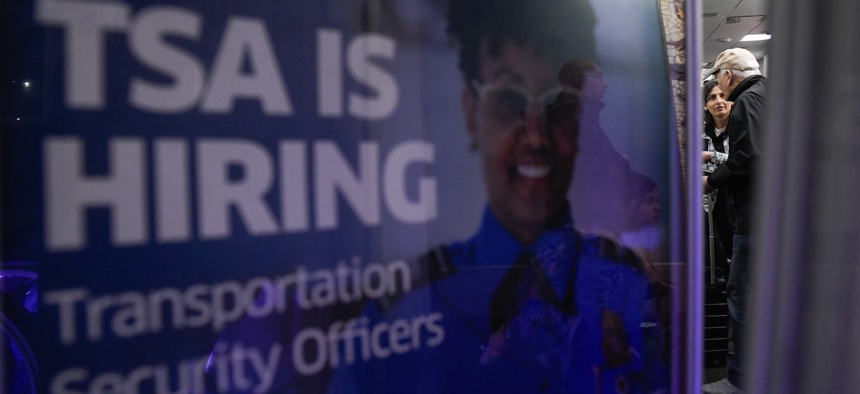
A poster promoting a career in TSA sits by a crowded TSA Checkpoint at the Philadelphia International Airport on March 28, 2026. Matthew Hatcher/Getty Images


TSA workforce, aviation leaders challenge Trump push to expand privatized airport screening
The proposal would require hundreds of small airports to join the Screening Partnership Program and shift thousands of TSA jobs.
Updated May 21 at 5 p.m.
Industry and government employee representatives alike pushed back on President Trump’s attempt to mandate the privatization of screening efforts at small airports on Wednesday, suggesting during congressional testimony the program should remain optional and could lead to worse outcomes.
The airline industry, the head of a major airport and the top official representing Transportation Security Administration employees all threw cold water on the president’s plan, which the White House proposed earlier this year. Trump is looking to dramatically scale up the Screening Partnership Program to include hundreds of participants, compared to the current roster of just more than 20 airports.
Former Gov. Chris Sununu, R-N.H., now the president of Airlines for America, said his members do not want to see airports have their choices taken away. The overwhelming majority of airports in the United States have since the Sept. 11 attacks used federal TSA screeners at their checkpoints, though the law creating the agency allowed them to opt in a partnership with the private sector.
“Ensuring SPP remains an option for airports and does not become a mandatory program is paramount to the U.S. aviation industry,” Sununu said, adding that while some of the airports that have elected to participate in the privatization program have done so successfully, “airports need the flexibility to make their own choices.”
Chris McLaughlin, CEO of Dallas Fort Worth International Airport, said TSA staff at his facility “do an amazing job” and he is therefore uninterested in joining the program.
“I think it's important for airports to have choices,” McLaughlin said. “I think there might be places where an SPP model could work for specific airports.”
Trump’s privatization plan would lead to job cuts of around 4,500 TSA employees. He proposed eliminating another nearly 5,000 jobs by reallocating resources that the agency said will lead to more efficiency, as well as by tasking states and localities to staff exit lanes. The budget proposed an additional $477 million for SPP to get more airports to enroll, though the White House said it would ultimately save $52 million.
“The budget begins the privatization of TSA’s airport screeners by requiring small airports to enroll in the Screening Partnership Program, under which TSA pays for private screeners at designated airports,” the White House said. “The airports that already use this program have demonstrated savings compared to federal screening operations.”
The president has also launched TSA Gold Plus, which would enable airports to leverage private sector investment in providing technology and staffing for screening while maintaining federal oversight. That differs from SPP, which uses federal dollars to contract with private screeners.
The administration has pointed to the two extended government shutdowns in fiscal 2026 that have forced TSA employees to go months on only the promise of back pay to justify the privatization push, suggesting non-government personnel maintained their pay throughout the funding lapses.
Everett Kelley, president of the American Federation of Government Employees, which represents TSA workers, said the pre-9/11 era demonstrated the pitfalls of privatized airport screening.
“The consequences of reverting to a contractor-driven model are not theoretical,” Kelley said. “We lived them before September 2001 and the historical record is unambiguous.”
Most Democrats on the House Homeland Security Committee that held Wednesday's hearing said forced privatization would be a mistake that would lead to worse outcomes for both travelers and TSA personnel. Workers at private companies would earn less than most TSA staff, they said, while losing their collective bargaining rights—a shift the administration is already seeking to implement at the agency.
“Airports recognize the downsides of privatization over the last 25 years,” said Rep. Lou Correa, D-Calif. “Airports have had the option to join SPP at any time, and only a small handful have done so.”
Republicans, meanwhile, expressed an openness to the plan, noting Democratically controlled cities have either implemented SPP (San Francisco) or are considering doing so (Seattle and Atlanta).
“I applaud the administration’s establishment of a new TSA Modernization office, reporting directly to the TSA administrator,” said Rep. Andrew Garbarino, R-N.Y., who chaired the hearing..” This new office directly answers this committee’s calls to modernize and reform the agency while increasing public-private partnerships in striving toward greater security outcomes.”
After the hearing, Garbarino clarified that private-public partnerships should be just one part of TSA's modernization, which should include new technology and streamlined screening for certain populations. He has supported bipartisan legislation to allow TSA to retain all of the fees it collects from travelers and to allow families with young children to receive expedited screenings.
"When it comes to optional programs like SPP, the most important thing stressed at this week’s hearing is that this is one of many avenues available to airports as they determine what frameworks work best for their needs," Garbarino said. "That was an important conversation to have across party lines, and I appreciated the testimony from all of our witnesses on how we can work together to protect the traveling public and our dedicated TSA workforce.”
Kelley suggested TSA employees should be applauded for their efforts while seeing their paychecks delayed, collective bargaining rights stripped and threats of thousands of job cuts.
“Despite all of this, they have continued to show up,” Kelley said. “They have continued to screen nearly three million passengers a day. They have maintained their unblemished record of keeping the flying public safe from terrorist violence.”
This story has been updated with additional comment.
If you have a tip that can contribute to our reporting, Eric Katz can be securely contacted at erickatz.28 on Signal.
NEXT STORY: Survey: Feds were less engaged, less satisfied and more burnt out in 2025