

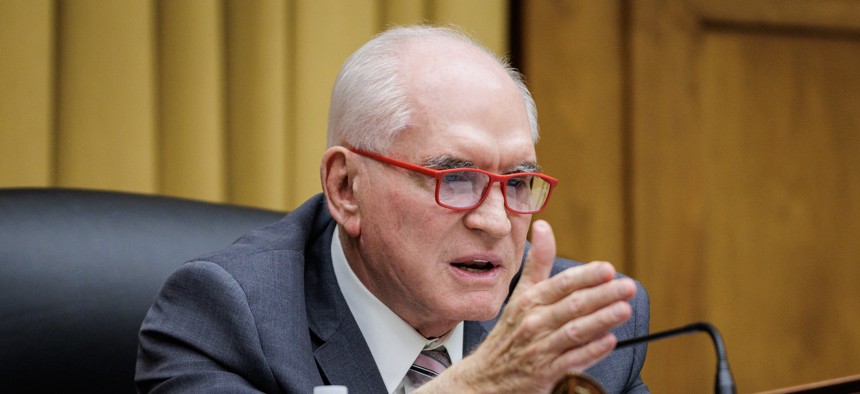
Rep. Mike Kelly, R-Pa., during a hearing on Dec. 5, 2024. He introduced legislation that would make changes to the IRS whistleblower program. Samuel Corum / Getty Images





IRS whistleblower program set for possible overhaul after bipartisan House vote
The measure would reshape how claims move through the system, how court reviews are handled and how payments are ultimately made. Over its history, the program has recovered about $7.5 billion.

The House on Monday passed, 346-10, a bipartisan bill that would make several reforms to an IRS whistleblower program that has recovered billions from noncompliant taxpayers.
“This is real money returned to the Treasury that would otherwise have been lost,” said Rep. Mike Kelly, R-Pa., the measure’s sponsor, during floor remarks. “In many cases, these are complex, high-dollar schemes that would not have been identified without insider information, proving that whistleblowers play an essential role in upholding the integrity of our tax code.”
The IRS Whistleblower Program Improvement Act (H.R. 7959) would:
- Modify the standard for reviewing whistleblower award determinations in the U.S. Tax Court in order to allow new evidence to be introduced during appeal.
- Permit whistleblowers to be anonymous before the Tax Court, unless there is a “societal interest” in disclosing their identity.
- Require interest on certain whistleblower payments if the IRS does not meet the deadline to inform the individual of an award recommendation, as part of an effort to ensure the tax agency distributes payments in a timely manner.
“Whistleblowers often face uncertainty and long delays. And in some cases, they face real personal and professional risk just for coming forward,” said Rep. Mike Thompson, D-Calif., a cosponsor of the bill, in a statement. “We need to be doing everything we can to fix those problems.”
Kelly and Thompson are the chair and ranking member of the House Ways and Means Subcommittee on Tax.
In 2025, the IRS reported that it has collected about $7.5 billion as a result of protected disclosures since 2007, leading to more than $1.3 billion in awards to whistleblowers. According to the tax agency, payments tend to be 15 to 30% of funds received due to the whistleblower’s information.
The National Whistleblower Center nonprofit backed the bipartisan measure, arguing it would “revitalize” the IRS whistleblower program after experiencing declining financial recoveries in recent years. The right-leaning National Taxpayers Union nonprofit also endorsed the legislation.
The bill is now headed to the Senate. Provisions that are identical to the House-passed measure are also in the bipartisan Taxpayer Assistance and Service Act (S. 3931), which was introduced in February but has not yet received any votes.
A spokesperson for Sen. Chuck Grassley, R-Iowa, who has previously introduced similar legislation regarding the IRS whistleblower program, said in a statement to Government Executive that he “welcomes” passage of the House bill and will work with the sponsors of the Senate measure “to enact these important reforms into law.”
The IRS recently completed its first tax season since the Trump administration’s staffing reductions across government. The tax agency also had to contend with implementing changes to the tax code mandated by the 2025 One Big Beautiful Bill Act as well as onboarding delays due to the fall 2025 government shutdown and federal hiring freeze.
If you have a tip that can contribute to our reporting, Sean Michael Newhouse can be reached securely at seanthenewsboy.45 on Signal.
NEXT STORY: McMahon distances herself from past Education layoffs, vows some rebuilding even amid elimination effort