

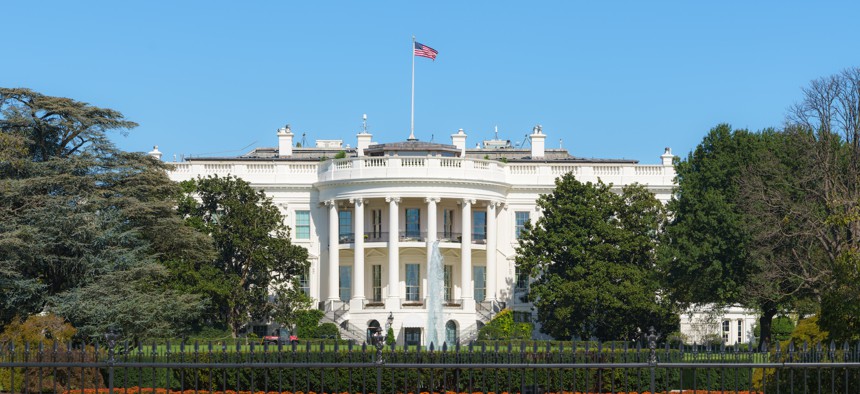
The Trump White House has made a number of changes to the Senior Executive Service. Prasit photo / Getty Images




As the number of political appointees surge and career SES ranks shrink, one nonprofit warns of ‘institutional consequences’
The Trump administration has sought to exert more political influence over the Senior Executive Service, which are the highest-ranking career civil servants.

The political appointee workforce in the federal government is at its largest size in decades while the number of career employees in the Senior Executive Service has decreased by nearly 30% since the start of the second Trump administration, according to a new report from the Partnership for Public Service.
“The concern is not that political appointees are inherently unqualified — many bring valuable expertise and leadership — but that agencies primarily led by officials selected for political loyalty rather than managerial competence can leave agencies without the expertise and experience needed to deliver results,” the nonpartisan good government group wrote.
The Partnership found that Trump, at the end of his first year, had installed more Schedule C appointees, which are made by the president for confidential or policy roles, than any other administration in the last 40 years. In total, there were about 2,570 Schedule C and non-career SES appointees serving at agencies in January 2026, which is approximately 800 more than President Joe Biden had at the same point in his term and roughly 1,000 more than at the one-year mark of Trump’s first administration.
Going forward, the Partnership expects that the number of political appointees under Trump will increase due to Schedule Policy/Career, which will convert tens of thousands of career feds into at-will employees, and Schedule G, an additional employment classification that the president established in 2025 for political appointees who do not require Senate confirmation.
Conversely, as the Trump administration has sought to downsize the civil service, the number of career SES has gone from nearly 8,130 at the end of Biden’s term to about 5,840 a year later, which is the lowest level since at least 1998.
As a result, political appointees currently hold 11.7% of filled SES positions, even though there is a 10% statutory cap on the percentage of such roles that can be allocated to non-career senior executives.
“The institutional consequences are substantial,” the Partnership wrote. “When the bridge between the career workforce and appointees is hollowed out, agencies lose institutional memory, technical capacity and independent professional judgment that prevents mismanagement, policy failures and political overreach.”
The Trump administration also has limited the number of senior executives who can receive top performance ratings, put more weight in reviews on whether the SES member is aligned with the president’s priorities and called on agencies to redesignate more of their senior positions as being open to political appointees.
Trump administration officials have argued that initiatives like Schedule P/C will not result in politically motivated hirings and firings and that they’re necessary to root out misconduct and poor performance among the civil service.
The Partnership proposed that Congress should cap the number of Schedule C appointees, bar the president from creating new job classifications (e.g. Schedule G) and require quarterly reporting on the number of political appointees.
If you have a tip that can contribute to our reporting, Sean Michael Newhouse can be reached securely at seanthenewsboy.45 on Signal.
NEXT STORY: New contract for background investigations raises concerns about scale and risk