

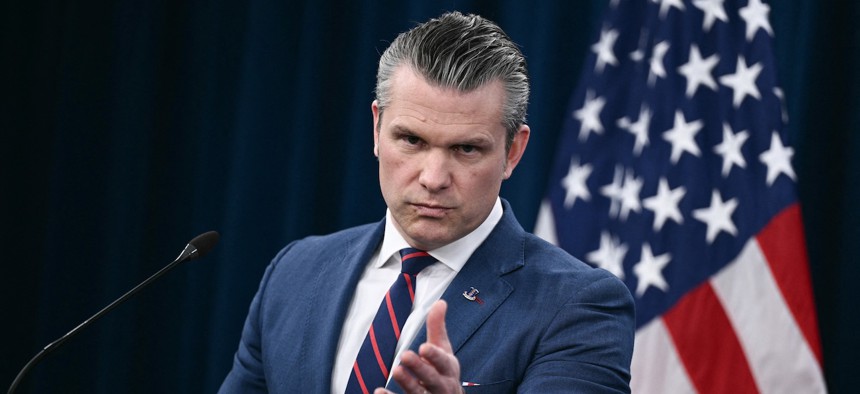
Defense Secretary Pete Hegseth sent a memo to DOD management telling them to encourage their staff to to volunteer for assignments to the Homeland Security Department. BRENDAN SMIALOWSKI/AFP via Getty Images





Hegseth ramps up pressure on Defense civilians to deploy for immigration enforcement
All supervisors must encourage employees to volunteer, secretary says, and requests will be accepted absent high-level intervention.

The Defense Department is reupping its request for civilian employees to deploy to the southwest border to assist with immigration enforcement operations, with supervisors now facing a stronger push to solicit their staff to sign up for the details.
The Pentagon first requested its civilian workers consider voluntarily accepting assignments to the Homeland Security Department last year to assist in the Trump administration’s immigration enforcement crackdown. Defense Secretary Pete Hegseth doubled down on that request in a message delivered to employees on Monday, adding new urgency to the appeal.
“I expect every supervisor to encourage their civilian employees to volunteer,” Hegseth said. “Leadership must continue to promote this detail program and educate their civilian employees on its importance.”
Detailed Defense employees are supporting Immigration and Customs Enforcement and Customs and Border Protection for up to 180 days, according to existing postings on the federal jobs board website. Duties include data entry, developing operational plans for raids and patrols, providing logistics support for moving officers and agents and their equipment and managing the flow of detained migrants. The Defense employees do not carry out law enforcement responsibilities.
DHS is currently shut down after its funding lapsed last month, though its law enforcement functions and employees remain largely unaffected. Neither it nor the Pentagon immediately responded to inquiries on the new directive.
One Army civilian said several supervisors sent Hegseth’s memorandum on Monday, without providing any additional context. A command-wide email did offer some additional information.
“DHS has a vital mission to safeguard and secure the homeland,” an Army official wrote in the email. “With the potential for increased numbers of migrants in the interior of the United States territory and across the southwest border, DHS needs volunteers to assist in its commitment to ensuring a safe and orderly immigration system.”
It was not immediately clear why the number of migrants entering the country could potentially increase—the Trump administration has consistently boasted that it has slashed the number of individuals illegally entering the country to record-low levels—though military operations in Venezuela could create disruptions there and President Trump has recently ramped up his threats to oust the current government of Cuba. Migrants arriving at the U.S.-Mexico border from those countries spiked in recent years, prior to Trump’s crackdown.
Hegseth encouraged “all who are interested” to volunteer for the detail, calling the work “vital to the national security of the United States.” All supervisors will approve the volunteer requests unless a deployment would conflict with mission-essential functions. Any disapproval must be signed off by a flag officer or Senior Executive Service employee, the secretary said.
The same Army civilian said there has not been any discussion of the detail opportunities since Hegseth first announced them last summer and the employee did not know of anyone who accepted such a role.
“We all think it’s absurd,” the civilian said. The timing of the new push seemed to be a “bad look,” the person added, given the war the U.S. is currently waging against Iran.
The memo is dated Feb. 19, more than a week before the U.S. and Israel began the war in Iran, though it was delivered to employees on Monday.
The detailing out of staff could create additional hardships for the department, which recently shed more than 60,000 employees, or 8% of its civilian workforce. In a January memo, Army Undersecretary David Fitzgerald said the service is still looking for ways to shed employees and is maintaining significant hiring restrictions so as to not “sacrifice this generational opportunity to fix ourselves and remove the bottlenecks that plague our daily operations.”
The Army has not yet “received meaningful optimization,” Fitzgerald said, despite many commands having realized “significant personnel reductions through [the deferred resignation program] and otherwise.”
Meghann Myers contributed to this report.
Share your news tips with us: Eric Katz: ekatz@govexec.com, Signal: erickatz.28
NEXT STORY: 5 guardrails federal agencies need before the next emergency loan program