

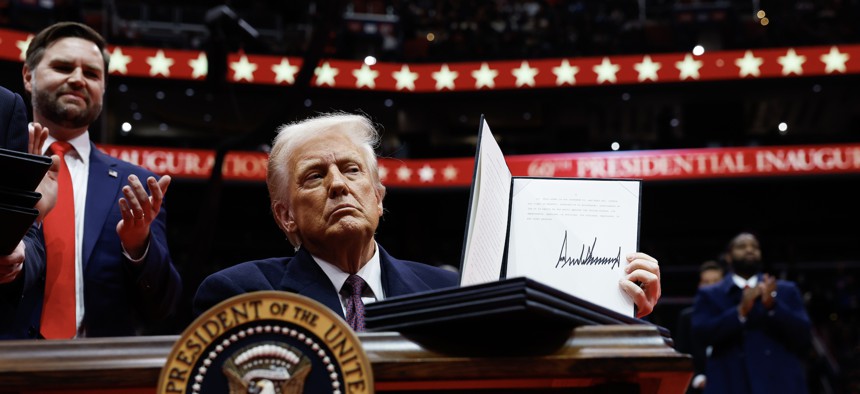
President Donald Trump holds up an executive order after signing it during an indoor inauguration parade at Capital One Arena on Jan. 20, 2025, in Washington, D.C. His administration has prioritized shrinking the federal workforce during his second term. Anna Moneymaker / Getty Images



‘Harder days ahead in 2026’: Good government group predicts increased political interference in the civil service in Trump’s second year
A new analysis from the Partnership for Public Service looks at the effects, so far, of the Trump administration’s reforms to the federal workforce and what they could portend.

On the first anniversary of President Donald Trump’s second inauguration, the Partnership for Public Service released a report assessing the impacts of his administration’s federal workforce reductions, concluding that they have decreased the effectiveness of government services, not achieved stated efficiency goals and were conducted with minimal transparency.
“As challenging as 2025 was, I think we can expect even harder days ahead in 2026,” warned Max Stier, the nonpartisan nonprofit’s president and CEO, during a virtual press briefing ahead of the report’s release.
The Partnership’s report characterizes the first year of Trump’s second term as “the most radical transformation of the federal government in over a half-century.”
Its authors argued that workforce cuts at agencies like the Cybersecurity and Infrastructure Security Agency, Federal Emergency Management Agency and Centers for Disease Control and Prevention have made the U.S. less prepared for a future 9/11 terrorist attack, Hurricane Katrina or COVID-19 pandemic.
“We live in a dangerous world, and I think we’re playing Russian roulette,” Stier said. “In so many ways, our government is about managing risk. We're creating more risk for ourselves as a nation through poor management and the changes in outlook of how our government is operating.”
The report also emphasized that:
- Reorganizations at the Social Security Administration have strained customer service functions.
- Reductions at the National Weather Service have hurt its ability to maintain 24/7 forecasting operations.
- A June 2025 study published in the Lancet medical journal estimated that 14 million people could die if cuts to foreign aid continued through 2030.
The Partnership contended that the Trump administration also has failed to improve government efficiency, even though that was the stated motivation behind these cost-cutting measures.
Notably, government spending increased between fiscal 2024 and 2025.
The report also criticized the Tech Force, a new initiative to recruit technologists for short-term stints in agencies. The Partnership argued that the program is duplicative of the U.S. Digital Service, which Trump transformed into the Department of Government Efficiency, and 18F, an internal government tech consultancy group that the administration eliminated.
“Those cuts required the marshalling of additional resources to create a new program,” according to the report. “Keeping the existing infrastructure of the previous programs may have been more efficient and cost-effective.”
Stier also pointed out that the percentage of federal employees younger than the age of 30 last year went from about 8.9% to 7.9%, according to a Partnership analysis of federal workforce data. In comparison, nearly 23% of the U.S. workforce is under 30.
“You saw a disproportionate number of young, tech-savvy federal employees being shown the door [even though] the federal government has had a history of insufficient generationally diverse talent,” he said.
The Partnership attributed this, in part, to the federal hiring freeze and mass firing of probationary employees, which generally affected those who had been hired or promoted within the past year.
While the Trump administration has described itself as the most transparent one ever, the Partnership noted that officials didn’t release data on governmentwide staff reductions until December. And the Office of Personnel Management in 2025 canceled an annual survey of federal employees’ engagement and morale, despite a law requiring it.
For its part, OPM in a New Year’s Eve blog post reported that its accomplishments in 2025 included creating a “leaner” federal workforce, managing the return to office for many government workers and leading the elimination of diversity, equity and inclusion programs.
Looking ahead, Stier and the Partnership are concerned that efforts like Schedule Policy/Career, which could remove civil service job protections from tens of thousands of federal employees, a new Schedule G for political appointees and essay questions on government job postings asking applicants to write about their favorite Trump policy will put added political influence on the civil service.
“We expect, and unfortunately fear, that the larder will be restocked, not with those that are expert, nonpartisan civil servants, but that there is a structure being put in place to hire loyalists,” Stier said. “The change of our federal government into one that is a loyalist workforce, as opposed to a professional one, is a process that we anticipate moving forward in 2026.”
NEXT STORY: How to institutionalize OPM reforms?