

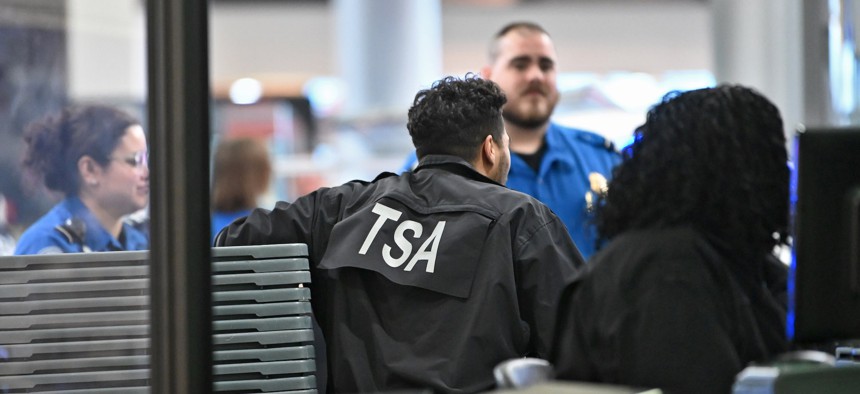
Transportation Security Administration workers at the security checkpoint at Albany International Airport on March 23. The agency said that requiring workers to stand at travel document check stations “reinforces both our security posture and our commitment to hospitality.” Lori Van Buren / Albany Times Union / Getty Images


TSA took away its officers’ chairs. The union isn’t sitting quietly
The Trump administration has taken several actions to weaken Transportation Security Administration employees’ collective bargaining rights.

The American Federation of Government Employees on Monday launched a public campaign to push back on a new Transportation Security Administration policy prohibiting officers from sitting while working at airport checkpoints.
“Our officers screen millions of people a day and they do it right, sitting or standing,” said Hydrick Thomas, president of AFGE TSA Council 100, in a statement. “Nobody who works a checkpoint asked for this. Nobody who flies asked for this. If TSA leadership truly believes standing makes people better at their jobs, I look forward to watching every manager in the building prove it for eight hours straight.”
According to an AFGE press release, TSA officials on Sept. 25 ordered that chairs be removed from travel document check stations because “[m]aintaining a standing posture helps reinforce professionalism, attentiveness and active engagement with passengers” and that the policy change “reinforces both our security posture and our commitment to hospitality.”
But union officials argued that there’s no data to support the assertion that a standing officer, versus a sitting one, improves security. They also reported that the agency has recently asked officers to sign a “Security Operations Pledge of Service and Security” in which employees agree to support “the well-being and morale of our colleagues.”
“That is a punch line,” said AFGE National President Everett Kelley in a statement. “Hospitality is not something you get by making working people stand at a podium until their feet go numb. Respect is how you keep good officers, and respect is how you keep travelers safe.”
TSA did not respond to a request for comment.
The TSA workforce has recently worked for periods without pay across two government shutdowns: the 43-day funding lapse in 2025 and the Homeland Security Department shutdown earlier this year. As a result, many officers quit or called out sick, which led to long lines at airport security checkpoints.
The Trump administration has sought to remove TSA workers’ collective bargaining rights, but a district judge in January blocked its most recent effort. DHS on Sept. 25, however, filed a notice of appeal. AFGE and the trade association for domestic airlines also have pushed back on the administration’s plans to expand the privatization of screening at small airports.
Administration officials contend that axing TSA union representation and increasing airport security privatization would generate cost savings.
Erich Wagner contributed to this report
If you have a tip that can contribute to our reporting, Sean Michael Newhouse can be reached securely at seanthenewsboy.45 on Signal.
NEXT STORY: Appeals court seemingly OKs VA’s contested union contract expiration