

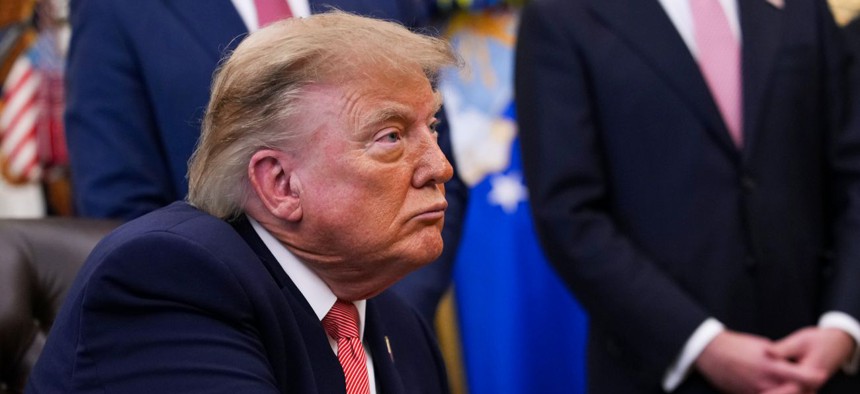
The Federal Mediation and Conciliation Service finalized regulations this week allowing it to cease appointing arbitrators in some cases, as part of the implementation of President Trump's executive orders banning collective bargaining for most federal workers. Photo by Andrew Harnik/Getty Images




Mediation agency finalizes rule allowing denial of arbitrator requests
Union officials said that though the final rule is an improvement over the Federal Mediation and Conciliation Service’s initial plan, it still improperly usurps arbitrators’ authority.

The Federal Mediation and Conciliation Service finalized new regulations this week implementing its controversial April policy change to decline to fulfill unions’ request for arbitrators to hear grievances filed against agencies where President Trump has purported to ban collective bargaining.
For decades, FMCS, which provides arbitrators and mediation services in both federal and private sector labor disputes alike, has served as a purely ministerial agency, issuing arbitrators—or panels of potential arbitrators—to parties within the federal government, whether a request was made jointly between the parties or unilaterally. Questions relating to whether a particular complaint is arbitrable had been left to the individual arbitrator to decide, with appeals of their decision going to the Federal Labor Relations Authority.
But earlier this year, FMCS abruptly halted the processing of arbitrator requests from some unions implicated in President Trump’s two executive orders that collectively strip the collective bargaining rights from two-thirds of the federal workforce.
The agency said it developed a new policy to no longer appoint arbitrators for grievances at agencies named in the two edicts in response to agencies like the Veterans Affairs Department, who told FMCS it refused to participate in arbitrations due to the executive orders. But since its implementation last spring, unions have argued that questions like whether grievances involving an agency named in Trump’s union EOs are still arbitrable should be for arbitrators and the FLRA to decide.
In final regulations, set for publication in the Federal Register Thursday, amending an interim final rule issued in August, FMCS continued to insist that the withholding or delay in appointing arbitrators in these cases do not weigh in on their underlying arbitrability.
“The threshold inquiry concerns a different question: whether FMCS, an agency of the executive branch, may lawfully take the administrative action requested of it,” FMCS wrote. “That question arises where a court has stayed or enjoined the arbitration or the obligation to arbitrate; where the president has excluded the responding agency from chapter 71 [of Title 5], the agreement has been terminated, and the agency has, as the president directed, terminated its participation in the proceeding; or where part 1404 [of FMCS regulations] requires joint authorization for the service requested. None of those is a question of whether the grievance is arbitrable under the parties’ agreement.”
In response to the five comments it received on the regulation, of which all were opposed, FMCS said it did make some revisions to better clarify that its inquiry into a disputed arbitration request is limited to whether it “may lawfully provide the requested service,” as well as that an agency’s lack of participation or contention that a particular grievance is meritless or otherwise not arbitrable does not “by itself” establish that FMCS should not issue an arbitrator in the case.
But Suzanne Summerlin, an independent labor attorney who penned comments opposed to the rule on behalf of the Federal Worker Alliance, a consortium of federal employee unions, said that while she appreciates the “improvements” to provide better guardrails for the new policy, FMCS’ rule still glosses over the fundamental conflict: that longstanding FLRA and Supreme Court precedent both state that parties to an expired or terminated collective bargaining agreement still must participate in grievances that arose prior to its cancellation.
“Many of these grievances that we’re talking about arose during a period of time before the EO was in effect and before agencies terminated their contracts,” she said. “The question is that once the EO happened, did that extinguish [the ongoing grievance] litigation, and the answer to that is no. This isn’t novel—contracts are routinely enforced after they expire over events that occurred during their effect. The problem with these regulations is that they treat a grievance over an employee suspension in 2024 the same as one filed yesterday.”
A lawsuit filed by four federal employee unions in the U.S. District Court for Washington, D.C., against FMCS seeking to roll back the policy change remains pending after the unions filed a motion for summary judgment in their favor last week.
And unions and agencies across government continue to wait for a decision by the U.S. Court of Appeals for the D.C. Circuit on whether unions can challenge the constitutionality of Trump’s union orders directly in federal court or if they must first channel them through administrative avenues, now 10 months since oral arguments were held last December.
Summerlin joked that between FMCS’ final rule and renewed reports that the FLRA has begun dismissing cases involving agencies named in Trump’s EOs for lack of jurisdiction, the administration is making unions’ argument for them.
“This is precisely what the unions have been arguing in the courts,” she said. “They’ve been saying that there’s no way that arbitrators, the FLRA and FMCS should be determining these rights when you’re talking about the president’s EO, because he has control over most of these agencies,” she said. “They’re no longer really independent after Trump v. Slaughter. And that’s key to the channeling question currently before the courts: it’s just impossible to get relief here.”
If you have a tip that can contribute to our reporting, Erich Wagner can be securely contacted at ewagner.47 on Signal.
NEXT STORY: OPM touts ‘hire-palooza’ event for early-career employees