

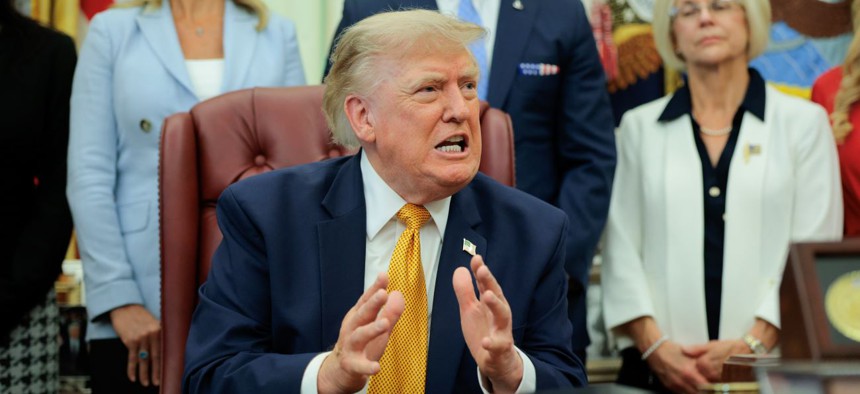
The Federal Mediation and Conciliation Service changed its regulations to no longer guarantee it will appoint arbitrators in some union grievance cases, following objection from some agencies tasked with implementing President Trump's anti-collective bargaining executive orders. Chip Somodevilla/Getty Images




Mediation agency changes how labor disputes move forward
The Federal Mediation and Conciliation Service says it is clarifying when it can decline to provide arbitrators, a change unions say exceeds its role.

The Federal Mediation and Conciliation Service this week promulgated new regulations to formalize a controversial April policy change that allows some agencies to effectively halt pending grievances that unions have filed against them.
FMCS’ primary role is to assign mediators to try to resolve disputes that arise during collective bargaining negotiations in both the private and public sectors, and to provide arbitrators to adjudicate alleged violations of union contracts at federal agencies as part of the grievance process.
But earlier this year, labor attorneys reported that the agency had abandoned its purely ministerial posture and begun asking “threshold” questions regarding the arbitrability of grievance prior to issuing an arbitrator or panel of arbitrators for the parties to choose from. By the end of April, FMCS settled on and released a new policy via memo: it would no longer appoint arbitrators for grievances at agencies implicated in President Trump’s two 2025 executive orders banning collective bargaining on national security grounds.
That policy conflicted with the agency’s own regulations, which state that arbitrator panel requests, “whether joint or unilateral, will be honored.” Federal sector labor law also stipulates that union contracts must allow for “either” party to invoke arbitration.
In May, the American Federation of Government Employees, International Federation of Professional and Technical Engineers, National Federation of Federal Employees and National Treasury Employees Union accusing FMCS of violating the Administrative Procedure Act by not following its own regulations.
But in an interim final rule published in the Federal Register Wednesday, FMCS formally changed its regulations to allow it to make “limited threshold determinations” regarding its authority to issue arbitrator panels. The rule, which FMCS said is necessary because some agencies have objected to its issuance of arbitrators due to the anti-union EOs, is effective immediately, though the agency is accepting comments on the change until Sept. 4.
“FMCS has determined that the current sentence stating that every joint or unilateral panel request ‘will be honored’ could be misread as requiring FMCS to provide panels even where doing so would be inconsistent with law, a court order or FMCS’ statutory or regulatory authority,” the agency wrote. “That was not the intended effect of the regulation. The proposed rule clarifies that FMCS retains authority to make limited threshold determinations concerning whether FMCS may lawfully provide the requested service.”
During the threshold question investigation process, FCMS said it may request information from the parties and decide to decline the panel request, hold it in abeyance or “take another administratively appropriate action.”
“FMCS’ action on such a threshold question does not adjudicate the parties’ underlying contractual, statutory or arbitrability dispute," the rule states. “These changes reflect the longstanding principle that arbitration is voluntary and correct confusing and potentially misleading language in FMCS’ current regulation.”
But Suzanne Summerlin, an independent attorney that represents unions in grievances and other matters, said FMCS is effectively usurping authority from both arbitrators, who are empowered to decide questions of arbitrability on their own, and the Federal Labor Relations Authority, which hears appeals of arbitration decisions.
“FMCS is a ministerial agency—they’re not supposed to be determining whether there’s a duty to arbitrate by an agency or a union,” she said. “[It’s] not a matter of consent as to whether there is a binding arbitration provision in your contract, it’s a matter of statute . . . The statute requires arbitration to happen and it is not by operation of consent of the parties.”
Robert Tobias, distinguished practitioner in residence at American University’s Key Executive Leadership Program and a former president of NTEU, said he struggled to understand the reasoning behind FMCS’ policy change in its regulations.
“I don’t see a rationale, I just don’t see one that make sense at all,” he said. “On the one hand, it’s argued that unions need to file administratively before they can go to court, but then they say, ‘We’re not going to let you exhaust your administrative remedies.’ There can be no rationale when you have the juxtaposition of those two points of view . . . I think it’s pretty hard to construct something when the language in the law is so clear.”
FMCS’ move comes amid a tide of recent arbitrators’ decisions in favor of unions on issues like the 2025 cancellation of telework and firing of probationary employees, some of which occurred with agency management in absentia.
“Unions—and my clients—have been winning those cases left and right,” Summerlin said. “I’ve had three cases go before arbitrators against the EPA with the agency in absentia. EPA, VA, all of those agencies are just not participating at all.”
If you have a tip that can contribute to our reporting, Erich Wagner can be securely contacted at ewagner.47 on Signal.
NEXT STORY: OPM finalizes rules expanding its power over RIFs, employee appeals