

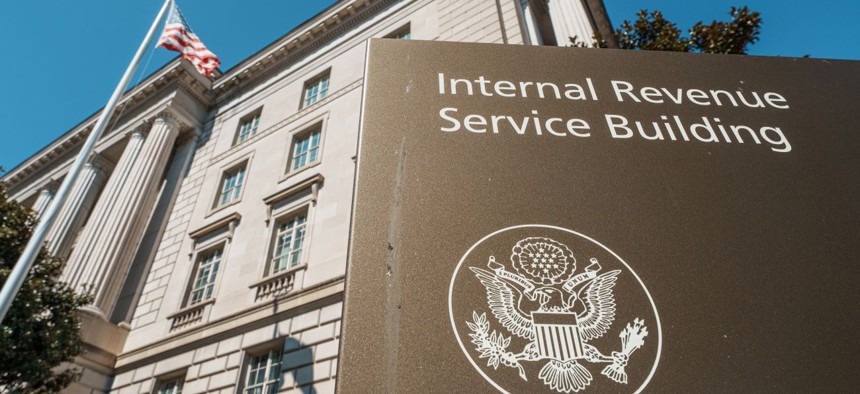
An independent arbitrator last week found that the IRS violated its union contract and committed unfair labor practices when it cancelled telework for most employees last year. J. David Ake/Getty Images




Arbitrator restores telework for IRS workers
The Internal Revenue Service withdrew from participating in the National Treasury Employees Union’s grievance against the agency for its 2025 return-to-office push in March, forcing independent arbitrator Christopher Shulman to conduct proceedings with management in absentia.

An independent arbitrator last week became the latest to order a federal agency to restore 2024-era telework agreements to its workforce, concluding that the Internal Revenue Service unlawfully repudiated its union contract when it effectively ended the workplace flexibility last year.
The National Treasury Employees Union first filed the grievance in March 2025, shortly after the IRS unilaterally cancelled telework and remote work agreements en masse, despite a collective bargaining agreement that required a “case-by-case” review of employees’ eligibility along with a detailed list of potential rationales for doing so. IRS rejected that grievance in May 2025, leading the union to request the help of an arbitrator.
But in late March, the agency told arbitrator Christopher Shulman that he was “no longer authorized to accept or adjudicate any grievances involving the IRS and NTEU,” and that management was withdrawing from all pending grievance proceedings. This corresponded both with a push by the Office of Personnel Management that month to encourage agencies to formally terminate their union contracts in accordance with President Trump’s 2025 executive orders banning unions at most federal agencies due to their purported national security work, as well as a push by some in the administration to prevent the Federal Mediation and Conciliation Service from assigning arbitrators in the first place.
Shulman and NTEU then conducted a hearing in May with the agency in absentia, citing an provision within the parties’ collective bargaining agreement allowing proceedings to continue with only one party’s consent.
Shulman bemoaned the uncertainty surrounding much of the federal collective bargaining apparatus, as a variety of lawsuits challenging the validity of Trump’s anti-union executive orders and their implementation continue to work their way through the courts.
“It is not hyperbole that most federal sector labor practitioners await a final judicial determination on this issue with bated breath,” he wrote. “If the EO’s exclusion of the agency from [the federal sector labor management statute’s’] ambit is ultimately upheld, then the agency’s termination of the parties’ collective bargaining agreements and subsequent withdrawal from the arbitration process will be deemed legal. If the IRS exclusion under executive order 14251 is not upheld, then the agency will likely have committed an unfair labor practice by terminating the collective bargaining agreement and withdrawing from this arbitration.”
But that is all moot, he said, because IRS terminated its telework and remote work agreements before the March 2025 executive order and the ultimate March 2026 contract termination.
“It is black letter law that expiration of a collective bargaining agreement does not terminate rights and obligations arising under the contract during its term,” Shulman wrote. “The obligation to arbitrate survives expiration where (as here) ‘the dispute arose during the life of the contract but arbitration proceedings had not begun before termination. The same would be true if arbitration processes began but were not completed, during the contract’s term.’”
Despite IRS’ lack of participation, Shulman approximated the agency’s argument, based upon its announcement that it would withdraw as well as its initial decision denying the union’s grievance. Like other agencies, IRS said it was compelled to implement its return-to-office mandate by Trump’s Jan. 20 memo instructing federal workers to return to agency offices full-time and OPM’s declaration that telework is a management right, making CBA provisions governing the workplace flexibility “unenforceable.”
But Shulman described OPM’s guidance to agencies as an “unqualified overstatement” of a Federal Labor Relations Authority caselaw.
“As noted by the union, telework and remote work arrangements do not address what work duties employees are to perform, which employees will perform the work, how they are to do so, or when,” he wrote. “Instead, these arrangements simply discuss where employees will perform assigned work. As such, FLRA and the courts have held these arrangements do not affect an agency’s rights to determine mission or to assign work.”
Shulman ruled that the agency must restore bargaining unit employees’ telework and remote work agreements, as well as rescind any adverse personnel actions stemming from the cancellation of the workplace flexibilities. IRS has 30 days appeal the decision to the FLRA.
In a statement Monday, NTEU National President Doreen Greenwald argued that telework and remote work are programs that are beneficial to employees, management and ultimately the public.
“Not only does telework save taxpayers money through reduced leasing costs, reduced energy expenses and increased productivity, it also boosts employee recruitment and retention, reduces traffic congestion and helps ease rising commuting costs,” she said. “NTEU is ready and determined to continue fighting to enforce our win on behalf of the employees we represent.”
If you have a tip that can contribute to our reporting, Erich Wagner can be securely contacted at ewagner.47 on Signal.
NEXT STORY: Pentagon closes cyber apprenticeship applications early after receiving over 15,000