

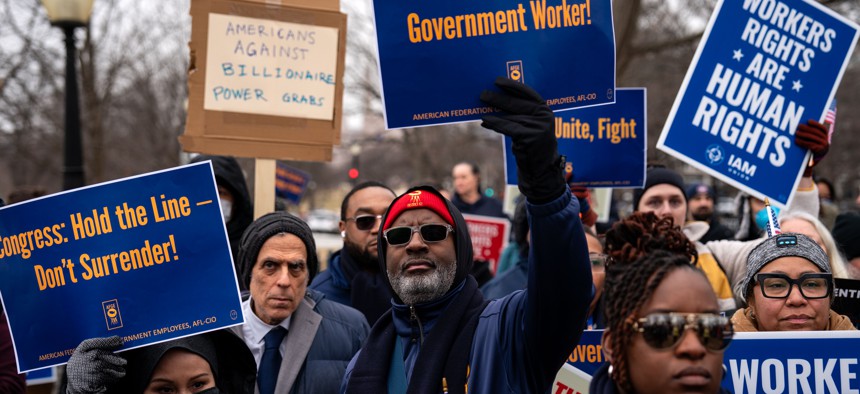
A coalition of federal employee unions said a new rule allowing the Federal Mediation and Conciliation Service to conduct 'threshold' investigations into the arbitrability of grievances violate federal sector labor law and the statute governing federal regulations. Kent Nishimura/Getty Images




Unions accuse mediation agency of ‘doublespeak’ in updated lawsuit
The Federal Mediation and Conciliation Service’s new policy allowing it to investigate the arbitrability of disputes if an agency objects to participating in them exceeds the “ministerial” agency’s authority, labor groups argue.

“Doublespeak,” “internally inconsistent,” and “inappropriate post-hoc justification.”
A coalition of federal employee unions had harsh words for regulations submitted last month that formalized a policy to block some labor groups from obtaining independent arbitrators to hash out disputes with management.
Earlier this year, the Federal Mediation and Conciliation Service abandoned more than four decades of precedent when it began asking parties about a grievance’s arbitrability prior to issuing a panel of arbitrators for a union and their agency to choose from. An April memo stated that it would no longer appoint arbitrators for grievances at agencies named in President Trump’s two 2025 executive orders banning collective bargaining on national security grounds.
Unions sued to block the new policy, arguing that it violated FMCS’ own regulations, which stated that it would honor requests for an arbitrator “whether joint or unilateral,” as well as federal statute, which stipulates that federal sector collective bargaining agreement must allow for “either” party to invoke arbitration.
But in July, FMCS published an interim final rule changing its regulations to allow itself to conduct investigations and make “limited threshold determinations” regarding its authority to issue arbitrator panels in federal sector grievance cases.
The unions filed an amended complaint last week in its case against FMCS, incorporating the new regulations into its argument. In addition to accusing the agency of reverse-engineering its regulations to allow the April directive, the unions said that FMCS is effectively inserting itself into Congress’ intended review scheme: arbitrators determine the arbitrability of a particular grievance, with appeals of those decisions going to the Federal Labor Relations Authority.
“Under the guise of clarifying its longstanding regulations, the [interim final rule] transforms FMCS from a facilitator of arbitration to a decision-making body, instituting a new ‘threshold inquiry’ to determine whether issuing a panel would violate ‘applicable law, a court order or FMCS’ statutory or regulatory authority,” the unions wrote. “Other than noting that FMCS ‘may request the parties’ agreement, a statutory provision, regulation, court order, written authorization or other information needed to determine whether FMCS may provide the requested service,’ no further details are given regarding the scope and extent of the new inquiry before providing an arbitration panel, nor whether or how a party could dispute the decision made.”
The unions argued that the new regulations’ imposition of a review process at FMCS contradicts the agency’s continued insistence that it does not decide the arbitrability of a dispute.
“FMCS’s own explanation or why this change is needed is internally inconsistent with its insistence that by conducting this inquiry, it is not deciding ‘the validity of any collective bargaining agreement, the merits of any grievance, the arbitrability of any dispute, or the parties’ rights or obligations under any agreement or law,’” they wrote. “FMCS does not—and cannot—explain how an inquiry that calls for examination of agreements, statutes and regulations to determine whether a party has a right to an arbitration panel aligns with regulatory provisions stating that FMCS is not determining arbitrability.”
A scheduling hearing in the case before the U.S. District Court for Washington, D.C., is slated for Sept. 23.
If you have a tip that can contribute to our reporting, Erich Wagner can be securely contacted at ewagner.47 on Signal.
NEXT STORY: IRS CEO’s call to end advanced leave should be ‘null and void,’ NTEU says in lawsuit