

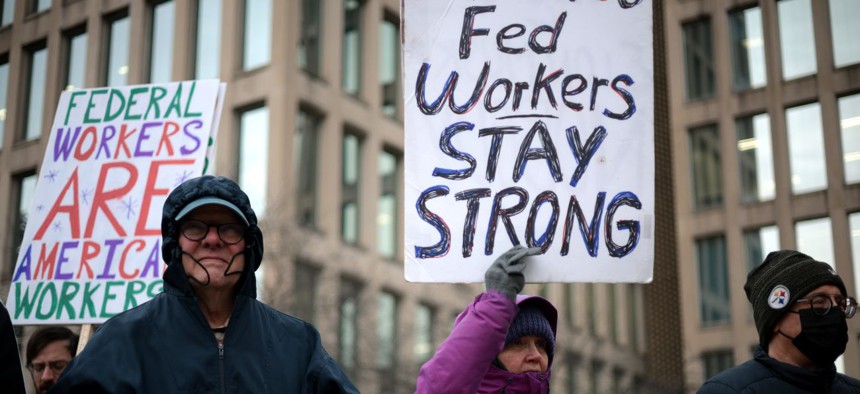
Federal employee unions this week sued the Office of Personnel Management over a pair of regulations upending the performance management and firing process across the federal government, alleging violations of the 1978 Civil Service Reform Act. Alex Wong/Getty Images




Unions: OPM’s suitability and performance management overhauls assert ‘plenary’ authority over federal firing
A coalition of labor groups sued the Trump administration Monday, arguing recent moves to centralize authority within the Office of Personnel Management and insert subjective criteria into employee evaluations amount to an end-run around the 1978 Civil Service Reform Act.

A coalition of unions that represent roughly half of all civilian federal employees sued the Trump administration Monday, seeking to halt a pair of recent regulatory changes that erode federal workers’ civil service protections and instill unprecedented power in the government’s dedicated HR agency.
The case, filed in the U.S. District Court for Northern California, centers on a pair of regulations finalized by the Office of Personnel Management this year: one requiring agencies to follow a forced distribution when conducting performance appraisals—effectively limiting how many employees receive top ratings—and another granting OPM the ability to fire employees across government for post-appointment conduct via suitability decisions, which previously only applied to job applicants, not incumbent employees.
The unions argued that the regulations at various points conflict with the 1978 Civil Service Reform Act, as well as violate the Administrative Procedure Act’s requirements that regulations be sufficiently reasoned and consider the reliance interests of stakeholders.
And they said the suitability rule, when considered in conjunction with separate regulations taking review of those and other personnel actions away from the Merit Systems Protection Board, effectively bypasses Congress’ intended bifurcation of the old Civil Service Commission into two agencies.
“Because an employee can only appeal a suitability action with OPM itself, the same agency (OPM): (1) establishes the use of suitability actions for removing employees, (2) takes such actions against employees, and (3) purports to determine whether its own actions were proper,” the lawsuit states. “In short, OPM has granted itself plenary and, in its view, unreviewable authority to fire employees across the government. It is hard to imagine a scheme that is more contrary to Congress’ design.”
In addition to the removal of appeals rights for feds fired under a suitability action, the labor groups called out the lack of transparency in who would effectuate those removals.
“There are no requirements or standards for determining who at OPM is authorized to make decisions regarding suitability actions, nor is that information public,” they wrote. “OPM’s website currently claims: “OPM’s Suitability Executive Agent Programs serves as the federal government’s suitability and fitness authority.’ OPM provides no further information regarding who comprises ‘SuitEA’ (which is not a subcomponent created or regulated by statute or regulation.”
The adoption of a “forced curve” on agency workforces through the new performance management process violates the Civil Service Reform Act’s requirement that performance appraisals must be based on objective criteria—ranking employees in relation to one another is inherently a subjective metric, the unions said.
“A small team with only high performers will need to rank some as less high performers,” the unions wrote. “Further, if two employees have the same objective performance rating and the new ‘distribution’ requires that they receive different summary levels, this is an invitation for favoritism based on subjective and impermissible factors. OPM has not shown that more dispersed evaluations are also more accurate and objective or that the use of objective criteria is no longer feasible.”
In a joint statement, union officials warned that these changes—if allowed to proceed—ultimately will erode agencies’ ability to serve the public.
“Congress built the civil service on a simple principle—that public servants are hired, judged and fired on merit, not on politics,” said Everett Kelley, national president of the American Federation of Government Employees. “OPM does not have the authority to write those protections out of the law, and no statute gives it the sweeping power it has claimed here.”
“These rules proposed by the Trump Administration are yet another illegal continuation of their attacks on federal workers and the apolitical civil service, as they seek to eliminate long-held worker due process rights while implementing a ‘fox guarding the henhouse’ employee appeal process,” said International Federation of Professional and Technical Engineers President Matt Biggs. “These actions are un-American.”
If you have a tip that can contribute to our reporting, Erich Wagner can be securely contacted at ewagner.47 on Signal.
NEXT STORY: Unions accuse mediation agency of ‘doublespeak’ in updated lawsuit