

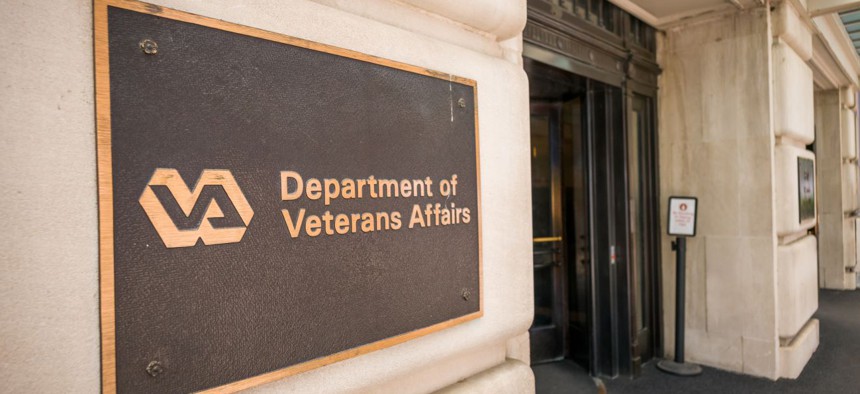
The Veterans Affairs Department and the American Federation of Government Employees are at loggerheads again over whether the VA may end its collective bargaining agreement with the union that represents more than 300,000 of its workers. J. David Ake/Getty Images




VA’s third attempt to scrap union contract heads back to court
The Veterans Affairs Department says it is following the terms of an expiring agreement. AFGE argues VA is ignoring a requirement to keep the contract in place during negotiations.

A union representing more than 300,000 Veterans Affairs Department employees is asking a federal judge to block the department’s third attempt to cancel its collective bargaining agreements, this time after talks over a new agreement broke down..
Since President Trump issued an executive order in March 2025 banning collective bargaining at most federal agencies on national security grounds, the VA has twice tried to end its union contracts, first in August 2025 and again last March. Both efforts were blocked via preliminary injunctions imposed by U.S. District Judge Melissa Dubose, a Biden appointee, who found that the department violated employees’ First Amendment rights. The VA’s second attempt prompted Dubose to warn the department it could face contempt proceedings. A federal appeals court upheld most of Dubose’s rulings in May.
The latest dispute centers on whether VA can allow the current agreement to expire while they are still negotiating a new one.
The American Federation of Government Employees on Tuesday filed its second motion asking U.S. District Judge Melissa Dubose to enforce her prior court orders after management said it would terminate the contract upon its scheduled expiration date of Aug. 8. The VA, for its part, argued that it is simply letting the deal expire.
Though her injunction preserves the CBA only for “the remainder of the agreed-upon term,” the union said the VA issued a notice following the appeals court’s ruling in May seeking to begin negotiations for a new term. That action triggers a clause within the CBA—common across government—automatically extending the contract until the parties can reach a new deal.
“[AFGE’s National VA Council] promptly acknowledged VA’s letter in writing,” the union wrote. “The VA and NVAC began negotiating by focusing on preliminary matters, such as the arrangements for ground rules negotiations, including through letters written by NVAC to the VA dated June 5, June 12, June 17, June 26, June 30 and July 8.”
AFGE said that as part of those talks, management said the new deal would only cover the roughly 3,000 VA police officers, firefighters and security guards, in line with the executive order’s exception for such positions. But on July 24, management accused the union of refusing to meet for negotiations within 30 days of its request to begin negotiations, and said it would actually terminate the agreement for all bargaining unit workers.
But the VA, in a filing seeking reconsideration of an order that the department respond to the union’s motion within three days, said its actions were foreseeable and that any claims regarding the 3,000 employees exempt from the executive order must be channeled through the Federal Labor Relations Authority.
“Plaintiffs assert that the VA is seeking to ‘terminate’ the agreement come August 8, 2026,” attorneys for the department wrote. “The master agreement, however, expires August 8, 2026 by its own terms. And plaintiffs do not dispute that the VA informed them as early as May 19, 2026 (and again on July 15, 2026) what the VA’s position was on continued CBA coverage for employees who are not exempt from executive order 14,251. The rush to judgment on plaintiffs’ motion to enforce is a crisis of their own making, when they have been aware of this issue since May.”
The outcome could determine whether thousands of VA employees keep the workplace rules and protections negotiated in their current contract as the Trump administration moves to scale back collective bargaining across the federal government.
If you have a tip that can contribute to our reporting, Erich Wagner can be securely contacted at ewagner.47 on Signal.
NEXT STORY: Staffing cuts are leaving federal statistical agencies stretched thin