

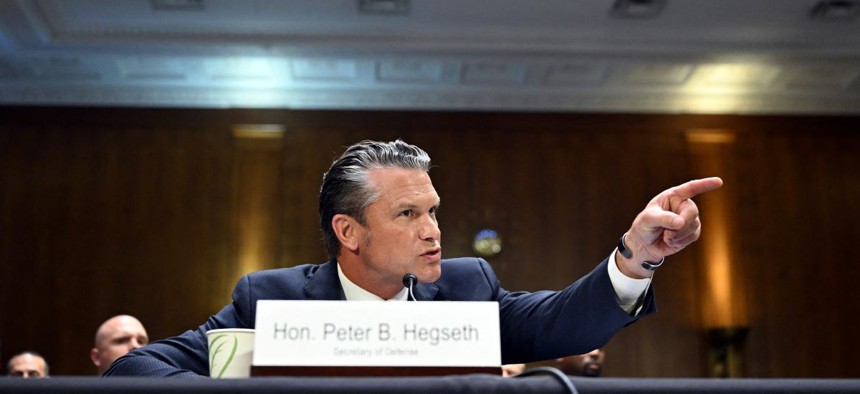
Two federal employee unions urged a federal judge this week to issue a preliminary injunction unwinding Defense Secretary Pete Hegseth's April directive to terminate their collective bargaining agreements. Alex WROBLEWSKI / AFP via Getty Images




Unions ask for injunction restoring collective bargaining at Defense
The latest filing from a pair of federal employee unions highlights the ways in which the Pentagon strayed from the Trump administration’s own guidance for implementing the president’s executive order banning collective bargaining at most agencies on national security grounds.

A pair of federal employee unions on Monday urged a federal judge to issue a preliminary injunction restoring their collective bargaining agreements with the Defense Department, arguing that Secretary Pete Hegseth failed to follow the Trump administration’s own process for implementing two executive orders banning organized labor at most federal agencies.
Earlier this month, the American Federation of Government Employees and National Federation of Federal Employees sued the Pentagon over the April termination of their collective bargaining agreements, a move that the Defense Department said was aimed at complying with President Trump’s March 2025 executive order barring collective bargaining for two-thirds of the federal workforce on national security grounds.
The lawsuit, which was filed in the U.S. District Court for Maryland, focuses not on the legality of Trump’s edict, but rather whether Hegseth fulfilled his obligation to conduct “reasoned decision-making” under the Administrative Procedure Act when he ordered CBAs be terminated with just 24 hours’ notice.
“The Hegseth memorandum did not point to any facts showing that any of plaintiffs’ CBAs, much less all of them, were inconsistent with national security,” the unions wrote. “DOD agencies had voluntarily agreed to these CBAs. Nor did the Hegseth memorandum consider the obvious alternatives to immediate mass termination of all CBAs, such as refraining from terminating CBAs until litigation about [the executive order] runs its course, allowing CBAs to expire pursuant to their own terms, or identifying only those specific parts of CBAs that the secretary determined to be inconsistent with national security . . . The Hegseth memorandum was the opposite of the reasoned decision-making that the APA requires before final agency action.”
The unions said that the Defense Department did not even follow a template for terminating union contracts issued by the Office of Personnel Management in February, seemingly designed to address the APA’s requirements for agencies to explain policy changes and consider the reliance interests of stakeholders. Instead, Hegseth wrote simply that the actions were “required” in order to comply with Trump’s order.
“The OPM termination template reinforces that CBA terminations are discretionary and must comply with the APA’s requirements for reasoned decision-making,” the unions wrote. “The OPM template indicates that agencies should specify that, after the issuance of the EO, the agency ‘considered whether to terminate any CBA, in whole or part, as it pertains to those bargaining unit employees who fall within the EO’s scope.’”
Since the contracts’ termination in April, management officials have told union members that their union “does not exist any longer,” and some employees have been required to sign documents attesting that they lack union representation. Employees in disciplinary proceedings are denied access to union representation, managers are unilaterally changing employees’ work schedules with little notice, and the labor groups’ membership is on the decline.
“Plaintiffs face an existential threat because workers are afraid to engage in any union activity or are confused about their right to do so,” they wrote. “DOD is telling plaintiffs’ members and prospective members that they are ineligible to join unions and that their unions ‘do not exist.’ Plaintiffs cannot successfully retain or recruit members under such circumstances, and union membership is declining. These harms are irreparable.”
Since its initial filing earlier this month, AFGE and NFFE’s case has been assigned to U.S. District Judge Stephanie Gallagher, a jurist who was nominated to the federal bench by both presidents Obama and Trump.
If you have a tip that can contribute to our reporting, Erich Wagner can be securely contacted at ewagner.47 on Signal.
NEXT STORY: OPM shrinks its workforce by a third, seeks further staffing cuts