

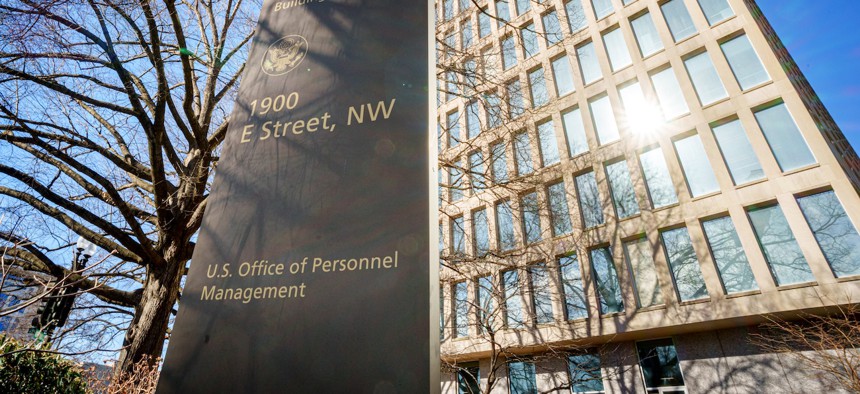
The regulations would require additional training for managers and supervisors on performance and misconduct issues. J. David Ake/Getty Images




Trump wants to scrap a key framework for federal employee discipline
Officials said the Douglas factors, 12 criteria federal agencies have used for 45 years to devise and justify discipline for misconduct, are too restrictive and “mechanistic.” Practitioners disagree.

The Trump administration last week proposed new regulations that would nullify a decades-old legal framework agencies use to mete out and justify federal employee discipline in favor of what critics say will be a vaguer and less fair standard.
In a proposed rule published in the Federal Register, the Office of Personnel Management and Merit Systems Protection Board jointly called for “retiring” the Douglas factors, a list of 12 criteria agencies are expected to employ when they consider disciplinary measures, developed in a 1981 MSPB case shortly after the implementation of the 1978 Civil Service Reform Act. They include, among other things, the severity of the offense, an employee’s past performance and conduct and their potential for rehabilitation.
But OPM and MSPB argued that rubric had grown too restrictive, and that agencies had taken a “mechanical” approach to apply each factor to a given disciplinary case, disincentivizing managers from pursuing adverse actions against their employees.
“In proposing this departure from the 12-factor Douglas test, MSPB acknowledges that Douglas has long been a cornerstone of federal employment law,” the agencies wrote. “However, over the ensuing decades, agencies and, occasionally, MSPB, have applied Douglas in a rigid, mechanistic way that the original decision never contemplated or prescribed. For the reasons set forth in this proposed rule, and in conjunction with OPM’s streamlining of performance management policy, the board proposes to correct this rigid application and reaffirm the board’s commitment to adjudicating disciplinary action appeals under a more flexible standard in conformance with its statutory authority.”
Raymond Limon, who served as a Democratically appointed member of MSPB from 2021 until February 2025, said that while he agrees that the Douglas factors are designed to be “illustrative” rather than rigid, the administration’s description of how they are applied doesn’t jibe with his experience adjudicating employees’ appeals, particularly given agencies better than 80% success rate before the board.
“It’s possible that some agencies on their own have created a more formalistic approach requiring supervisors to complete it like a checklist and address every issue,” he said. “But to me, if they’re doing that, that’s because they’ve developed a poor policy or don’t understand the law correctly . . . I feel like the proposed regulation assumes that Douglas is the disease, but it may simply be the stethoscope.”
OPM and MSPB’s new standard—to simply consider the “totality of circumstances” when considering a disciplinary measure—is vaguer and ripe for abuse, said Michael Fallings, managing partner at Tully Rinckey PLLC, a firm specializing in federal employment law.
“’Totality’ is just a vague way of saying that we’re going to consider factors, but what they’re trying to say is, ‘We don’t have to consider certain factors that may some times be in favor of the employee,’” Fallings said. “What we’ve seen [in my practice] over the past year are employees proposed for removal for one instance of misconduct and no prior discipline. We’ve seen some where the alleged event occurred years ago, with no prior discipline and good performance since then. It’s a way to say, ‘We’ll consider the circumstances, but we don’t have to.’”
The regulations would require additional training for managers and supervisors on performance and misconduct issues, something long requested by good government groups. And it formally reintroduce a number of policies from Trump’s first term aimed at making it easier to fire poor performers, including reducing the length of performance improvement plans to 30 days, banning settlement agreements that remove documentation of poor performance or misconduct from an employee’s record, and barring the use of union official time to help an employee pursue adverse action appeals.
The that the administration’s latest proposal was jointly offered by OPM and MSPB undermines a key tenet of the Civil Service Reform Act, Limon argued.
“The MSPB was designed by Congress to be an oversight body over OPM and that also to be an independent institution,” he said. “That’s why the Civil Service Reform Act was created: to split up the Civil Service Commission. The policy wing became OPM, and MSPB would do the commission’s adjudication work. Good fences make good neighbors, but they’re collapsing that.”
If you have a tip that can contribute to our reporting, Erich Wagner can be securely contacted at ewagner.47 on Signal.
NEXT STORY: OPM proposes ‘decentralized’ FEVS with fewer questions and less transparency