


Visual Generation/Getty Images





Performance prioritized over seniority in proposed RIF rule, OSC says
COMMENTARY | The Office of Special Counsel says proposed reduction-in-force changes would give more weight to employee performance and offers its own perspective on how agencies might apply the new rules.
The U.S. Office of Special Counsel is charged with safeguarding the integrity of the federal merit system. This responsibility includes promoting fair employment practices, protecting whistleblowers who expose waste and wrongdoing, and ensuring that the government’s workforce is built on competence rather than cronyism or outdated rules. In this spirit, I welcome the Office of Personnel Management’s proposed rule to reform reduction-in-force procedures. The rule is a long-overdue corrective. It prioritizes performance over mere longevity in determining which employees agencies retain during downsizing.
The current RIF system, rooted in mid-20th-century practices and tracing back to protections in the Veterans’ Preference Act of 1944, served an important purpose at the time: shielding veterans and providing stability through objective seniority-based rules. However, it evolved in ways that prioritized length of service over actual job performance, often at odds with the merit ideals. Under current rules, tenure and length of service take precedence over performance. Consider a dedicated employee who consistently exceeds expectations, innovates to improve processes, uncovers operational inefficiencies, or reports misconduct through proper channels. That employee could lose their position in a RIF simply because a less effective colleague has accumulated more years of service. This outcome is not hypothetical. It reflects the reality of existing regulations, which often demoralize high performers and prevent agencies from maintaining the expertise needed to fulfill their missions effectively.
The proposed rule changes this approach fundamentally. It elevates performance ratings as the primary factor for retention decisions within each tenure group. Tenure and veterans’ preference follow. Agencies would assign numerical credit based on an employee’s three most recent ratings of record over the prior four years: seven points for an outstanding rating, five for exceeds fully successful, three for fully successful, and zero for lower levels. Veterans’ preference points would then augment this score. Ties would break by tenure subgroup and then by service computation date.
This structure aligns with statutory requirements in 5 U.S. Code § 3502(a), which directs that regulations for releasing employees in a RIF must give due effect to tenure, veterans’ preference, length of service, and efficiency or performance ratings. Inserting merit into the RIF process was part of the design of the Civil Service Reform Act (CSRA) in 1978, which codified merit principles into statute and emphasized efficiency and accountability in the civil service. As laid out in the CSRA merit system principles at 5 U.S. Code § 2301(b)(6): “Employees should be retained on the basis of the adequacy of their performance, inadequate performance should be corrected, and employees should be separated who cannot or will not improve their performance to meet required standards.” This had never been fully implemented in OPM RIF regulations until now.
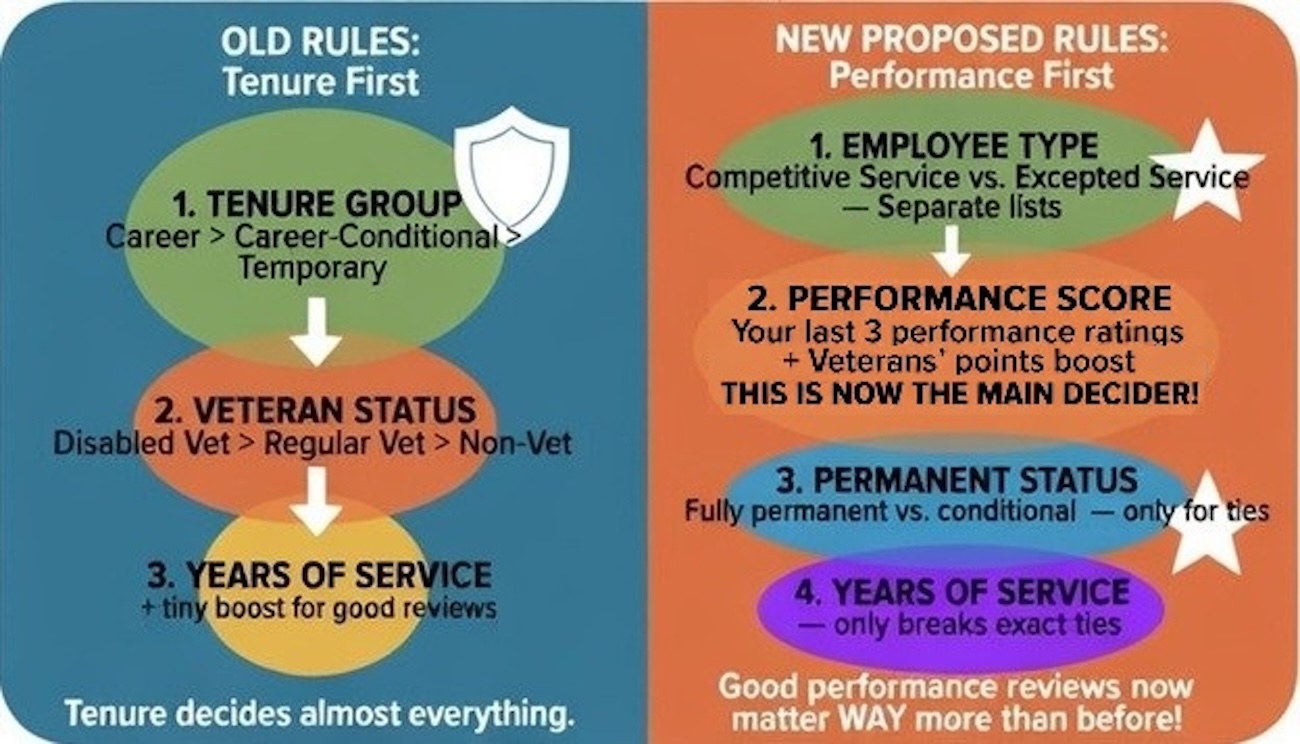
The potential benefits of this shift are clear and substantial. During periods of downsizing, agencies retain employees who deliver the strongest results, preserving critical institutional knowledge and specialized skills essential for mission success. Post-RIF productivity increases as high performers remain in place. A culture emerges where sustained excellence receives appropriate recognition and reward. Moreover, by prioritizing performance, the rule enables agencies to more freely expand and contract the workforce in response to shifting priorities, technological advancements, and changing mission needs. The federal government’s historic lack of agility in dynamic environments has long been a critical weakness.
Whistleblowers, whom the OSC protects vigorously, receive meaningful indirect protection under the proposed rule. By prioritizing merit over seniority, the new system makes it significantly more difficult for supervisors to use RIF actions as cover for retaliation. High-performing employees who raise legitimate concerns now receive stronger protection against arbitrary separation based solely on tenure. In contrast, the predictability of the traditional seniority-based system too often enables ill-intentioned supervisors to target employees selectively. Streamlining the overall RIF process further reduces administrative burdens. Agencies spend less time on complex retention registers and more on public service. Taxpayers benefit from lower costs and greater efficiency.
The reform corrects a longstanding historical imbalance while still recognizing the legitimate purposes of seniority. Seniority rewards loyalty and longevity, preserves institutional knowledge that performance metrics may not fully capture, and provides an objective standard that is less vulnerable to subjective bias. The proposed rule does not eliminate seniority; it retains it as a key secondary factor and tiebreaker, striking an effective balance between merit and experience.
Nevertheless, the rule’s success depends entirely upon careful execution. A key historical barrier to RIF reform has been widespread ratings compression in federal performance appraisals, where the vast majority of employees receive high ratings with limited differentiation. According to OPM’s analysis in its February 2026 proposed rule on performance appraisals, for the performance cycles of fiscal years 2022 to 2024, approximately 64.4 percent of non-SES/SP employees on a five-level summary rating system received an “outstanding” or “exceeds fully successful” rating, while only 0.5 percent were rated below “fully successful.” This compression has limited meaningful differentiation, meaning that without reforms to appraisal rigor, a performance-based RIF could frequently default to secondary factors like tenure due to clustered high scores.
In addition to encouraging meaningful distinctions between performance levels, it is critical that fairness and impartiality form the core of performance review standards. Otherwise, RIF reform could become what its critics fear. Performance appraisals carry inherent risks if supervisors apply them subjectively or inconsistently. Ratings might reflect personal favoritism, discrimination based on protected characteristics, or political considerations rather than objective contributions. Those worries deserve serious attention.
Supervisors need mandatory, recurring training on conducting objective evaluations. Agencies need clear, job-specific metrics that tie directly to position duties and organizational goals. Employees must have access to transparent feedback throughout the appraisal cycle. Robust appeal processes should resolve disputes quickly and impartially. OSC will continue to investigate any prohibited personnel practices, including retaliation against whistleblowers or discriminatory application of ratings. Fortunately, OPM’s recent emphasis on overhauling the federal employee performance review system demonstrates that the agency’s leaders understand this challenge and are willing and able to meet it.
The proposed RIF rule marks a necessary step toward a more agile and merit-driven civil service. Implementation must proceed with unwavering dedication to fairness and transparency. When done correctly, the change upholds the merit system’s fundamental promise: a government staffed by capable professionals who serve the public effectively. Federal employees deserve nothing less. The citizens they serve demand no less.
Charles Baldis is senior counsel and designee to Acting Special Counsel Jamieson Greer.