

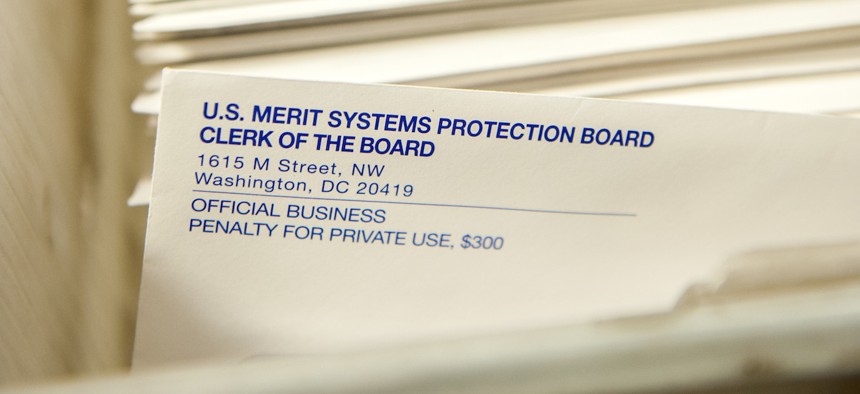
Katherine Frey/The Washington Post via Getty Images



MSPB relinquishes jurisdiction over some federal worker appeals
The agency tasked with adjudicating appeals of federal employee firings upended decades of precedent in ruling that agencies may challenge its jurisdiction on constitutional grounds.

The Merit Systems Protection Board last week issued a sweeping new decision that could upend how—and if—some federal workers appeal their termination, ruling that the attorney general has constitutional authority to fire immigration judges at-will.
The case stemmed from the 2025 firings of two immigration judges—Megan Jackler and Brandon Jaroch—in which the Justice Department cited Article II of the Constitution as the sole basis for their removal. An administrative law judge overturned both employees’ removals, at which point both Justice and the Office of Personnel Management appealed those decisions to the full MSPB.
Though most of the MSPB’s analysis hinged upon whether immigration judges are considered ”inferior officers,” for whom removal protections were ruled unconstitutional under the Seila Law v. Securities and Exchange Commission Supreme Court decision, it also creates a new avenue by which agencies can assert constitutional authority to argue that the board lacks jurisdiction to review certain firings.
“The agency does not contend that Article II of the Constitution renders [Title 5] section 7513 removal protections invalid as a matter of law or in all circumstances,” the MSPB’s two Republican members wrote. “The agency argues only that the removal protection provisions cannot be constitutionally applied to the appellants, whom the agency argues are inferior officers under the Constitution, because doing so would impinge on the president’s authority under Article II of the Constitution to manage the executive branch. The agency’s argument hinges on the nature of the appellants’ positions (an issue we address below) and does not apply to the broad swath of section 7513-protected employees who are not inferior officers.”
But Kevin Owen, a partner at Gilbert Employment Law, a firm that specializes in federal employment issues, said that potentially overturns decades of precedent protecting against parties making “facially constitutional” challenges against the MSPB or the 1978 Civil Service Reform Act that established it.
“It’s a complete 180, that’s really what it is,” Owen said of the decision. “The board had consistently taken the position that it doesn’t have the authority to entertain facial attacks on the constitutionality of the statute. And now they’re, within four or five paragraphs, saying that it does? . . . I think it’s because now the board wants to open the door for future facial attacks on the CSRA under the Constitution.”
The MSPB warned, though, that simply invoking Article II of the Constitution would be a skeleton key for avoiding the board’s review.
“Our holding in this case does not mean that an agency can deprive the board of jurisdiction over an adverse action merely by invoking Article II authority,” it wrote. “However, if we find that a particular employee is subject to at-will Article II removal, we must dismiss their appeal for lack of jurisdiction.”
The board found that immigration judges are inferior officers under the Constitution because of limited avenues for appeals of their decisions and a purported ability to influence policy. But that cuts against initiatives during both of Trump’s presidential terms to simultaneously limit their autonomy and bar them from speaking publicly.
On Monday, attorneys for the two immigration judges announced that they had already filed an appeal of the MSPB’s decision to the U.S. Court of Appeals for the Federal Circuit.
“The board’s decision is dead wrong and contradicts more than a century of binding Supreme Court precedent, dating to the 1800s,” said Nathaniel Zelinsky, senior counsel with the Washington Litigation Group. “This is a massive power grab on the part of the president. If the Trump administration prevails, the federal government will quickly regress into a corrupt patronage system without any legal protections for the millions of civil servants who honorably serve the American people every day.”
Share your experience with us: Erich Wagner: ewagner@govexec.com; Signal: ewagner.47
NEXT STORY: New bills would extend whistleblower protections to more feds