

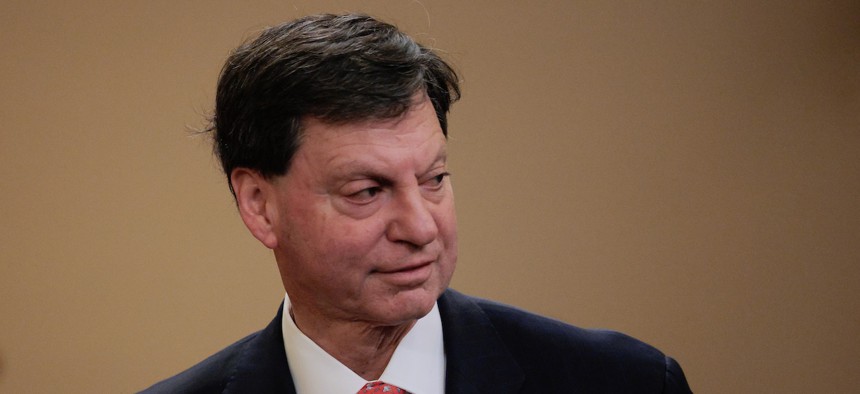
Frank Bisignano told members of the House Ways and Means Committee on Wednesday that IRS had improved performance despite staffing cuts. Chip Somodevilla/Getty Images





After shedding 25,000 employees, IRS chief says his agency now has perfect staffing level
The tax agency’s CEO criticized his predecessors for staffing up without justification, though he noted he has not conducted workforce analysis either.

The Internal Revenue Service now has the ideal number of employees, the agency’s de facto leader told lawmakers on Wednesday, who suggested his organization was operating more productively despite shedding more than 25,000 employees last year.
IRS grew to more than 100,000 employees under President Biden without evidence to support that increase, Frank Bisignano told members of the House Ways and Means Committee, though he noted that there still has not been any empirical assessment to confirm the current staffing level of around 75,000 employees is appropriate. Still, he maintained IRS’ current size is the correct one, noting it has improved its efficiency by leveraging artificial intelligence and other technologies.
“I've yet to find one piece of paper that explained why that was the right number,” Bisignano said of IRS’ workforce under Biden. “So I understand that we have less people, but I'm not sure that there's anything that ever said what the right staffing level was, ever.”
Later, when asked what his assessments of the proper IRS staffing levels had borne out, the agency’s first-ever CEO said, “I feel good about the number of employees I have right now.”
In 2025, IRS moved aggressively to push out employees—many of whom were newly hired under Biden after the Inflation Reduction Act injected an unprecedented sum of cash into the agency—through a series of voluntary incentives and involuntary dismissals. It has since more than erased the previous administration’s hiring surge, which was designed to boost customer service and increase audits of wealthy individuals and corporations.
The reductions caused the agency’s inspector general and its Taxpayer Advocate Service to sound the alarm that it was ill-prepared for the current tax filing season. While Bisignano boasted that IRS has hired 2,200 employees to support the agency during its busiest time of the year, the IG recently noted the division tasked with processing original and amended tax returns has hired just 50 employees in anticipation of the 2026 filing season, or 2% of its authorized level. IRS offices processing tax returns and providing telephonic and in-person customer service, as well as other duties related to filing season, lost 8,300 workers under President Trump, or 17% of their staff, the IG found.
Bisignano said that his agency has improved performance despite the cuts, pointing to data the agency has not yet made public to note callers are waiting less than 10 minutes to get through. IRS is in the process of transforming its performance metrics by merging existing customer service data with automated responses and online queries, while lowering its service standard from 85% of calls answered to just 70%.
The improvement, he added, came as the agency was implementing new provisions of tax law included in the One Big Beautiful Bill Act that Trump signed into law last year.
“Remember, there was a lot of pundits out there saying IRS is going to fail,” Bisignano said. “There's a large implementation, there's the Trump accounts, there's less staffing and they have old technology. We’re 40% through the tax season, and we hear in every corner that it’s going well.”
Republican committee members praised Bisignano for the changes and said their offices are receiving fewer requests for tax assistance from constituents than ever. Democratic members, meanwhile, criticized Bisignano’s approach and said their constituents are reporting extended wait times and increased tax issues.
“It seems that that's a recipe for pretty overworked staff, including yourself, based on your roles,” Rep. Jimmy Panetta, D-Calif., said of the staffing cuts and Bisignano, who also serves as head of the Social Security Administration, “but also what I'm seeing and hearing from my constituents, a lot of long lines for assistance, rushed and some very slow work.”
Rep. Richard Neal, D-Mass., the committee’s ranking member, referenced Government Executive’s reporting that IRS is moving employees from human resources and IT to assist in taxpayer service roles during filing season.
“Now, the administration is papering over self-inflicted failures by putting bodies in chairs with no experience processing returns or in customer service,” Neal said.
Bisignano boasted that he has restructured IRS to remove layers of management and ensure “more functions report directly to me.” He added that AI will make things easier for taxpayers and employees alike, noting it will assist in, for example, getting answers to customer service representatives more quickly. Eventually, he said, it will help increase the tax compliance rate.
“I believe AI will be part of speeding up everything we're doing,” he said. “It will change the way our workforce works in a better way.”
Last week, IRS severed ties with the union that represents most of its employees, a move that followed a directive from a Trump executive order. Bisignano downplayed the impact of the change, saying federal employees are already guaranteed sufficient compensation and collective bargaining is therefore irrelevant. While most federal workers do not negotiate over pay and benefits, their unions bargain over a slew of other issues and provide representational services.
“Federal employees under statute, under law, have greater benefits than any union in the world can provide for their people,” Bisignano said. “So they're losing nothing.”
Share your experience with us: Eric Katz: ekatz@govexec.com, Signal: erickatz.28
NEXT STORY: Report: Nearly 95k science employees left government as Trump downsized agency workforces