

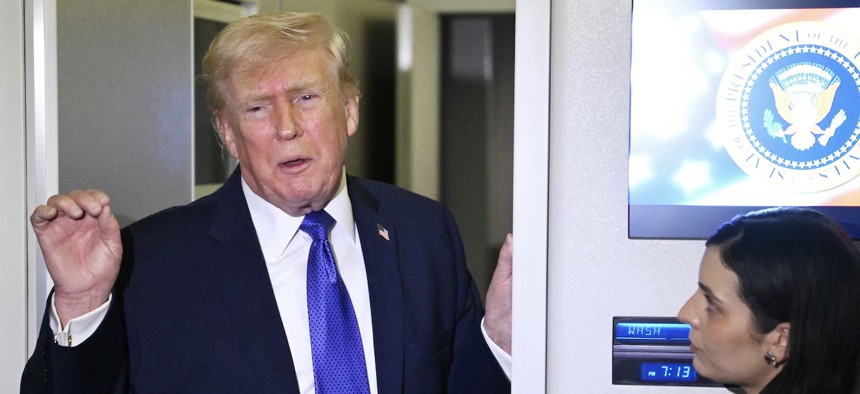
Last September, President Trump nominated Charlton Allen to serve as general counsel for the Federal Labor Relations Authority. Mandel NGAN / AFP via Getty Images





Unions oppose a Trump labor nominee over lack of experience, hostility toward bargaining
Conservative lawyer Charlton Allen has no prior experience in labor-management relations, but said he opposed collective bargaining rights for state workers in North Carolina as a political candidate in 2012.

A coalition of more than 30 federal employee unions last week urged senators to reject President Trump’s nominee to a top position enforcing federal sector labor law over his lack of experience in the field and past antipathy toward collective bargaining rights.
Last September, Trump nominated Charlton Allen to serve as general counsel for the Federal Labor Relations Authority. Per Allen’s website, he is a conservative lawyer, political consultant and occasional pundit, who served for seven years as a North Carolina industrial commissioner.
The FLRA general counsel is responsible for investigating and prosecuting alleged unfair labor practices and other disputes between federal agencies and their labor unions. In the year since President Trump returned to office, a backlog of 300 cases has developed, which cannot proceed to the FLRA for consideration without a Senate-confirmed general counsel.
In a letter to the top Republican and Democrat on the Senate Homeland Security and Homeland Security Committee, under whose jurisdiction Allen’s nomination falls, the Federal Workers Alliance formally lodged concerns that Allen is a “political gadfly” with “no experience, qualifications or even prior interest in labor relations.” The group said they scoured Allen’s 2024 podcast and various opinion columns but found no mention of the issues he would be expected to engage with if confirmed.
“These podcasts and articles cover the widest variety of political topics, except, notably, anything about labor relations, which reveals his lack of expertise or even interest in this field,” the unions wrote. “But each of his publications and podcasts should certainly be reviewed before the committee conducts a hearing on his nomination.”
Though the public record on Allen’s views on collective bargaining is scant, it is not empty. In 2012, when he ran unsuccessfully for a seat in the North Carolina state legislature, he submitted a candidate questionnaire to the conservative organization CIVITAS, in which he said that the state should allow union representation for “no public employees.” He also described minimum wage laws as an “unfair intrusion into the labor market, [which] hurt the employment opportunities for low-skilled labor.”
And as a student at the University of North Carolina Chapel Hill in the early 1990s, he ran a student publication that routinely attacked Muslims, gay people and immigrants, and wrote in an article that the case against a candidate for student body president is that “He’s Jewish.”
“As general counsel of the FLRA, Mr. Allen would supervise the staff of attorneys, investigators and support personnel in his immediate office as well as in the four regional offices of the FLRA,” the unions wrote. “Regrettably, there are serious questions about his suitability for these supervisory responsibilities that must be answered before his confirmation hearing . . . While he may be entitled to his misguided belief that public employees should not have the right to collectively bargain, he should not be confirmed to a position whose sole responsibility is to enforce those rights.”
The committee has yet to set a date for Allen's confirmation hearing.
Share your news tips with us: Erich Wagner: ewagner@govexec.com; Signal: ewagner.47
NEXT STORY: OPM instructs agencies to terminate union contracts potentially in violation of court orders