

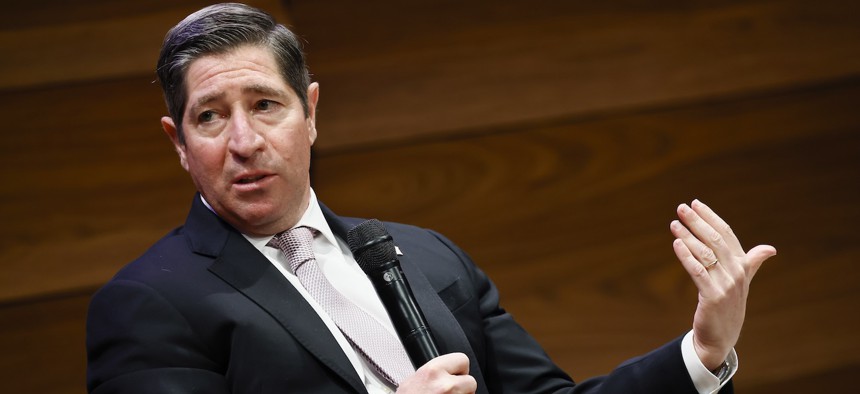
On Thursday, OPM Director Scott Kupor told reporters that Schedule F was “not about political appointments or terminations.” Paul Morigi/Getty Images





Trump admin moves to finalize return of Schedule F
Officials estimate that around 50,000 federal workers will be stripped of their civil service protections beginning in around a month, as unions, employee associations and good government groups decry their positions’ politicization.

The Office of Personnel Management is set to finalize regulations implementing President Trump’s plan to strip tens of thousands of federal employees of their civil service protections.
First developed during Trump’s first term and revived last year, Schedule F—now renamed Schedule Policy/Career—is a new job classification within the government’s excepted service for “policy-related” positions. Employees in positions targeted for conversion would become effectively at-will employees.
A final rule formally implementing the policy is set for publication in the Federal Register Friday. Its provisions, first reported by Government Executive last November, include stripping Schedule Policy/Career employees of the removal protections in Title 5 of the U.S. Code and of their right to appeal adverse personnel actions. Whistleblower complaints from converted employees would no longer go to the U.S. Office of Special Counsel, instead being referred internally to the employing agency’s general counsel for review.
Administration officials estimated that as many as 50,000 federal employees could be targeted by the new policy after it takes effect March 8. Agencies have filed initial submissions of what jobs should be converted to Schedule Policy/Career, which will culminate in Trump’s issuance of a new executive order facilitating those conversions.
Speaking with reporters Thursday, OPM Director Scott Kupor insisted that hiring and firing would continue to be based purely based on merit, despite the new lack of oversight and administrative review over said actions.
“This is not about political appointments or terminations,” Kupor said. “There is no involvement of the political process in the hiring or firing of these individuals. Everybody will be hiring under the merit hiring principles, they’ll be reviewed under the merit hiring principles. People’s party affiliations or, as I said, anything that they, you know, think or say, is not relevant.”
OPM last year issued a new Merit Hiring Plan that requires greater input from political appointees during the federal hiring process and solicits federal jobseekers to write essays about their favorite Trump administration policy or executive order.
OPM officials cited Government Executive’s reporting as evidence that Schedule Policy/Career is needed to crack down on dissenting voices still in government.
“We have a boatload of empirical data that there is misconduct and policy resistance among career civil servants,” an official said. “Just in the formulation of this rule, a confidential draft was leaked to the media. We know that that happens, we're inundated every day in the federal government with misconduct and poor performance by civil servants. It’s a crisis.”
The official stressed that the new internal investigators of whistleblower complaints would be “unbiased,” though officials could not guarantee how individual general counsel might appoint them, except that they cannot be “directly involved” with the complaint.
"It was Congress' decision to exclude people who had been excepted from the competitive service by reason of their policy influencing role from OSC procedures,” they said. “But, so, we are doing, we are filling that gap . . . which to be honest is really the best we could do once the president has made the determination that these employees are policy-influencing.”
Backlash to Schedule Policy/Career among groups that represent federal workers or advocate for better government performance was swift. Fully 94% of the more than 40,000 comments submitted on the proposed rule were opposed to the policy.
The Partnership for Public Service, which last week released a new report concluding that at-will employment in state governments by and large did not improve performance but did correspond with greater instances personnel decisions driven by politics and other improper motives, blasted the measure as a step back toward the political spoils system of the 19th century.
“No matter what the administration says, today’s action has nothing to do with restoring merit in federal employment” said President and CEO Max Stier. “This new designation can be used to remove expert career federal employees who place the law and service to the public ahead of blind loyalty and replace them with political supporters who will unquestioningly do the president’s bidding.”
And Everett Kelley, national president of the American Federation of Government Employees, promised an “imminent” court challenge to the rule, in coordination with other employee groups.
“When people see turmoil and controversy in Washington, they don’t ask for more politics in government, they ask for competence and professionalism,” he said. “OPM is doing the opposite. They’re rebranding career public servants as ‘policy’ employees, silencing whistleblowers, and replacing competent professionals with political flunkies without any neutral, independent protections against politicization and arbitrary use of power.”
National Active and Retired Federal Employees Association National President William Shackelford called the move a threat to the “integrity of our democracy.”
“Expansion of political cronyism increases the risk that executive actions will be decided by the size of political contributions rather than the faithful execution of the law,” Shackelford said. “That increases the risk of politically motivated enforcement of laws, threatening individual liberty; politically determined tariff exceptions and contract and grant awards, threatening greater corruption and waste of taxpayer dollars; and politically selective provision of services, threatening failure of government operations for disfavored groups or localities.”
Share your news tips with us: Erich Wagner: ewagner@govexec.com; Signal: ewagner.47