

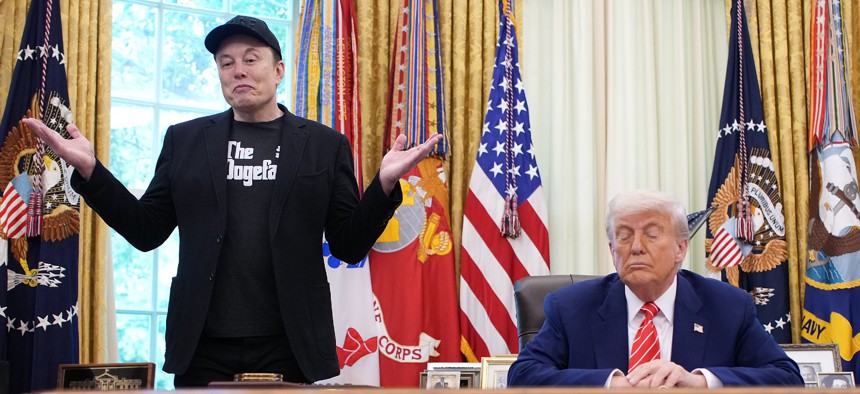
Elon Musk speaks alongside President Donald Trump to reporters in the Oval Office of the White House on May 30, 2025. The Trump administration and Musk's DOGE reduced the federal civilian workforce by 9% in 2025, according to OPM. Kevin Dietsch / Getty Images




The tail wagging the dog: Snapshots of the public service a year into the second Trump administration
COMMENTARY | One year in, DOGE and the Trump administration have had profound effects on the federal civil service, but looking at the numbers, it's not always where one expects.

In the months leading up to the 2024 election, Elon Musk honed his pitch for a Department of Government Efficiency. The DOGE acronym was no accident. Musk was taken in by the tremendous success of the Dogecoin, the virtual currency that began as a joke in 2013 but quickly became wildly popular, although its founders continue to use an adorable dog as its online mascot. The dog, in fact, became so popular that it’s got its own Dogecoin swag store.
Musk had been taken by Dogecoin for years. So when he got his chance with the Trump transition, he couldn’t resist finding a way to use DOGE as an acronym for his campaign against government.
But after all the headlines and turmoil, just what has DOGE and the administration’s other strategies to slash federal employment produced? The Office of Personnel Management has just released an enormous tranche of data—not nearly as detailed and useful as FedScope, which it replaced, but useful nevertheless for creating snapshots of the changes in the federal workforce since Trump’s inauguration. (The old FedScope has vaporized, although data can be extracted through a very complex series of steps.)
The snapshots nevertheless tell a fascinating story of how the DOGE tail has wagged the federal dog.
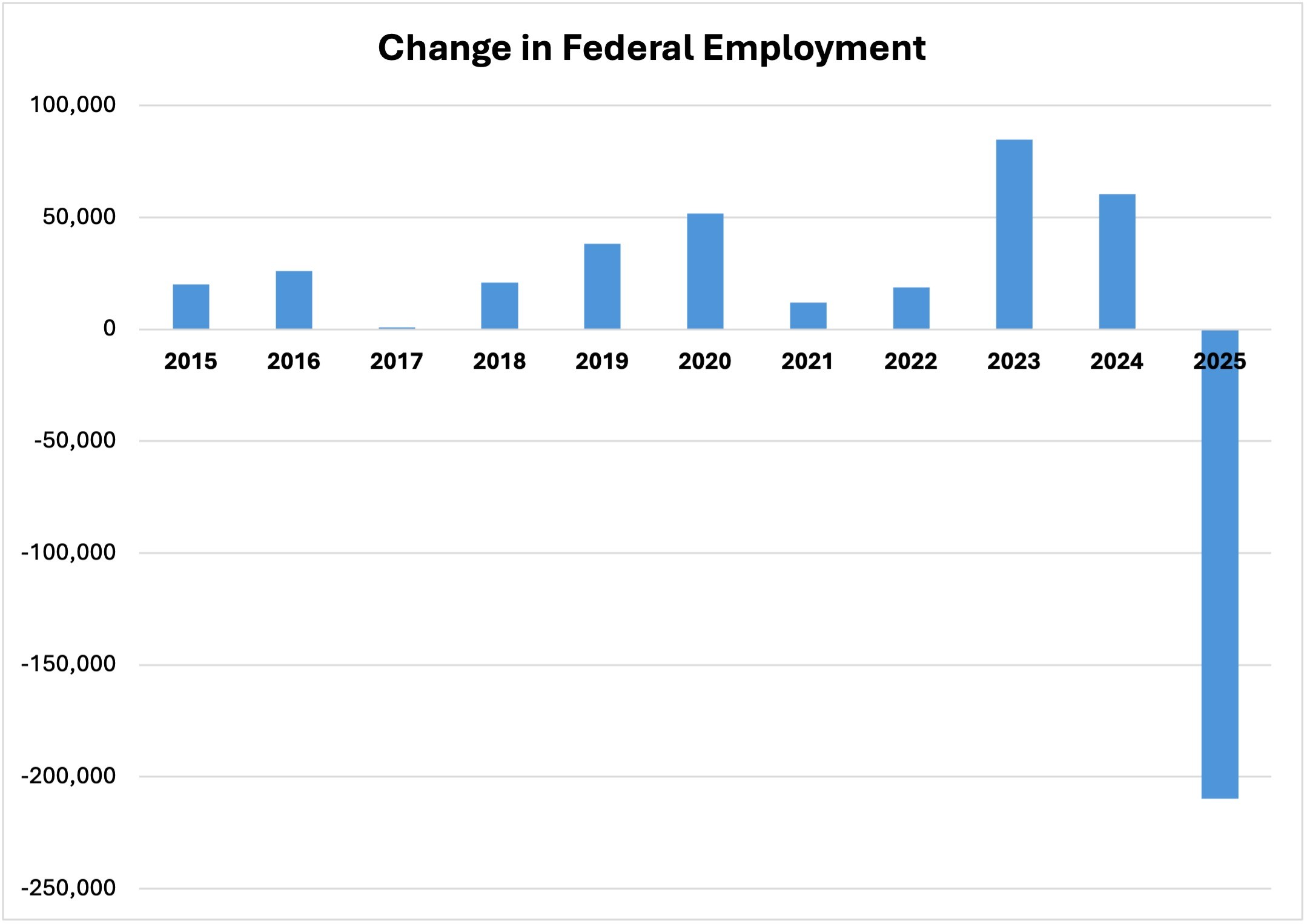
The administration eliminated 9% of the federal workforce
The Trump administration reduced the federal civilian workforce by 209,775 employees, a 9% cut. This size of the workforce isn’t unprecedented, however. It’s almost exactly the same now as in 1994 and 1973, although of course both the country’s population and the budget were much smaller.
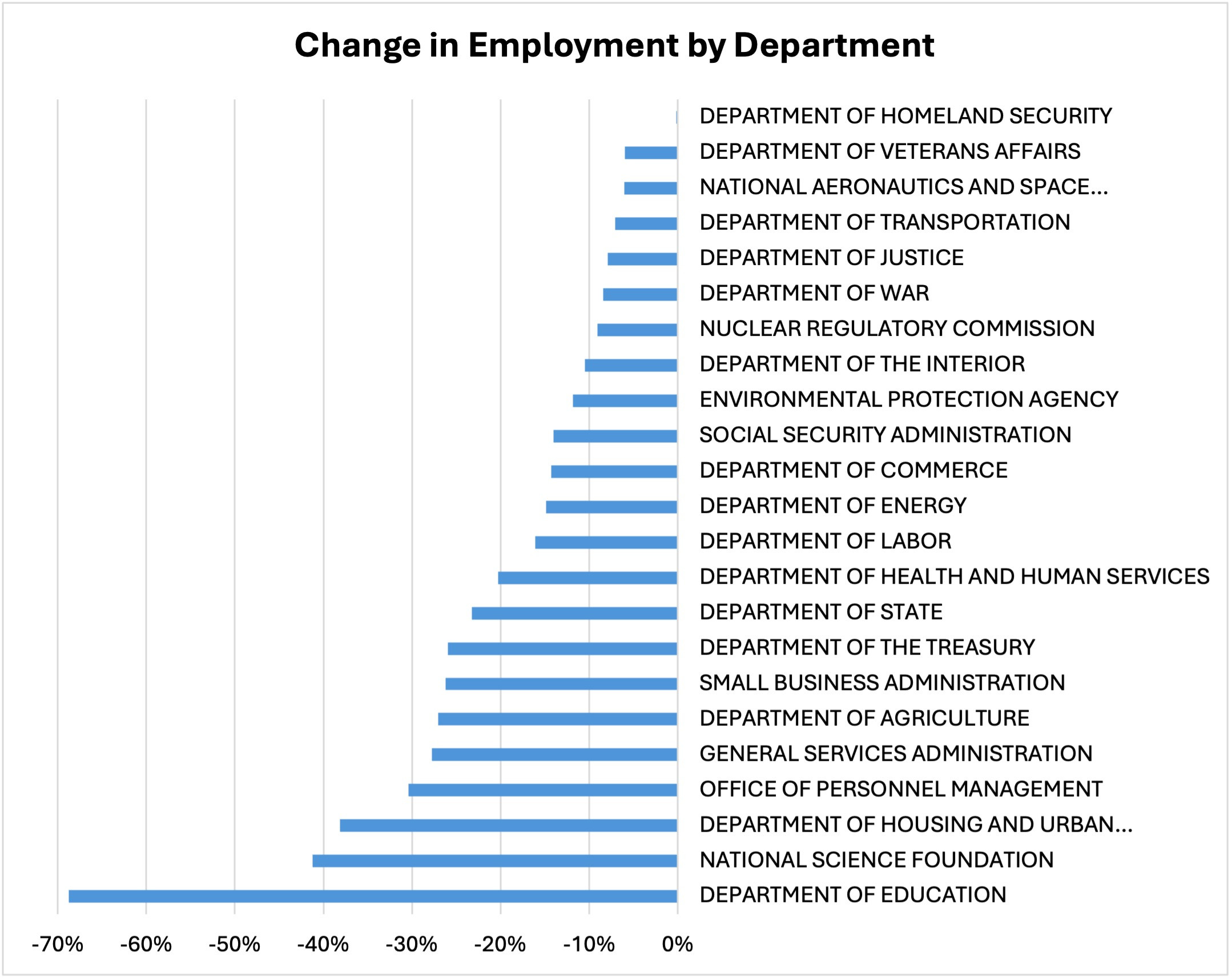
Every department is smaller now than before Trump’s inauguration
All cabinet departments suffered cuts, ranging from a very small cut in the Department of Homeland Security to a 69% cut in the Department of Education. The Department of Housing and Urban Development and the National Science Foundation come next, with reductions of about 40% each.
There were enormous changes in the Department of Homeland Security
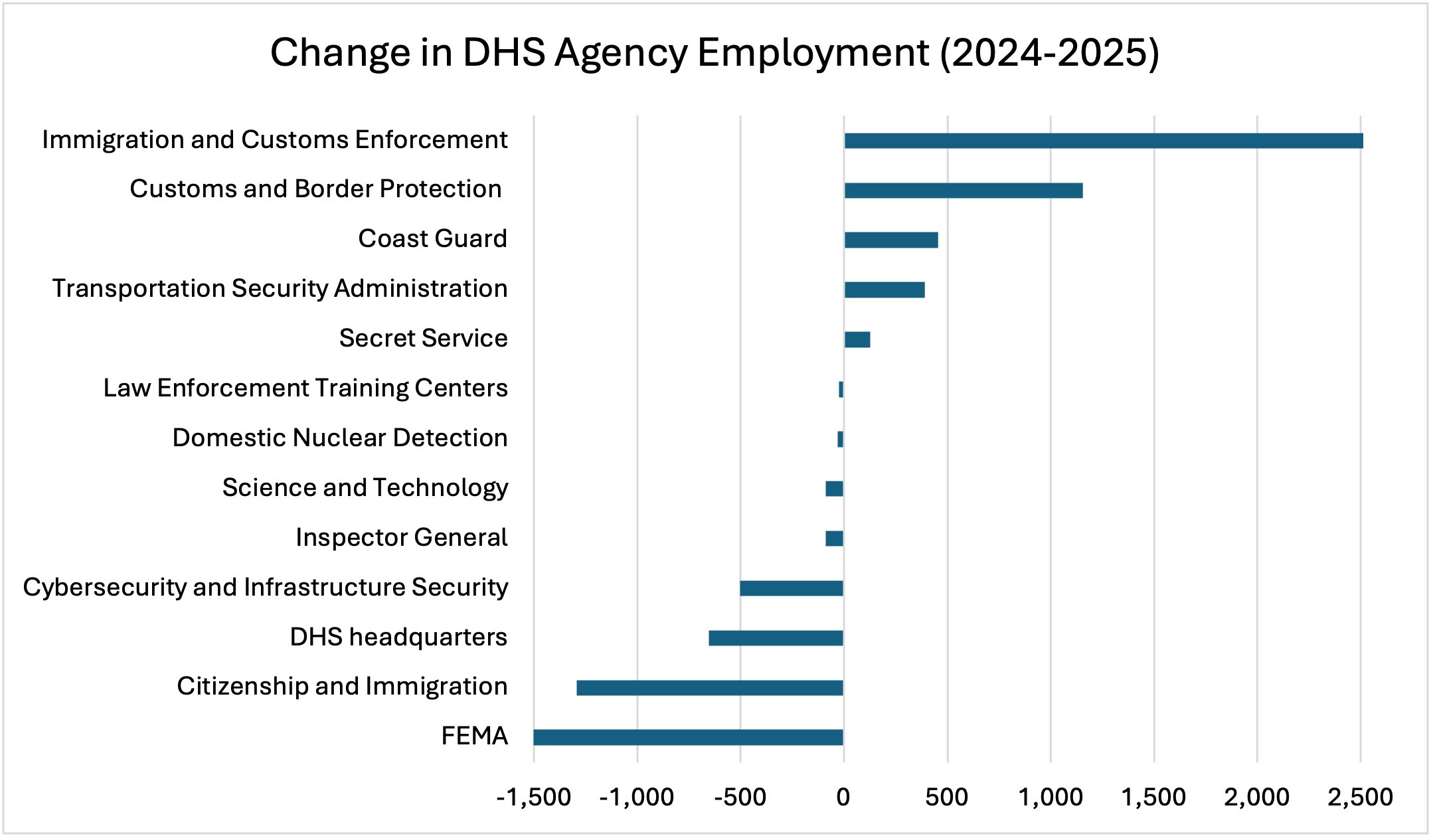
Perhaps no department had wider changes than DHS. Immigration and Customs Enforcement and Customs and Border Protection got big increases in the number of employees. The Federal Emergency Management Agency suffered big cuts. And as Customs and Border Protection grew, U.S. Citizenship and Immigration Services, the branch of DHS charged with managing legal immigration, shrank.
The geographical distribution of federal employees has changed slightly but significantly
For most members of the public, a huge surprise has always been that most federal employees work outside the Washington area. That's even more so now. In fiscal year 2024, 85.9 percent of all feds worked outside the Washington area. Today, it's 86.6 percent—that is, the share of federal employees working outside Washington has increased, which is in sync with the Trump administration's commitment to reducing the power of Washington civil service professionals.
Most states saw relatively little change in total federal employment, but there have been some big winners and losers. The losers are an unusual collection of both red and blue states, with red-state losers (Wyoming, Montana and Kansas) typically smaller and more dependent on relatively small operations like the Veterans Affairs Department and national parks. The nine winners likewise are a disparate collection: six states that went for Kamala Harris (Hawaii, Connecticut, California, Minnesota, New Mexico and Virginia), and three states that went for Trump (North Carolina, Florida and Texas). Programmatic changes drove these patterns, but there’s no evidence overall of political targeting—except at the Washington area.
Employees in lower General Schedule grades took the biggest hits
One of Trump’s most powerful themes was that he was going to “drain the swamp.” The implication of the pledge was that federal employees in policy-related positions would take the biggest cuts; they, presumably, were in the strongest position to block the administration’s policies.
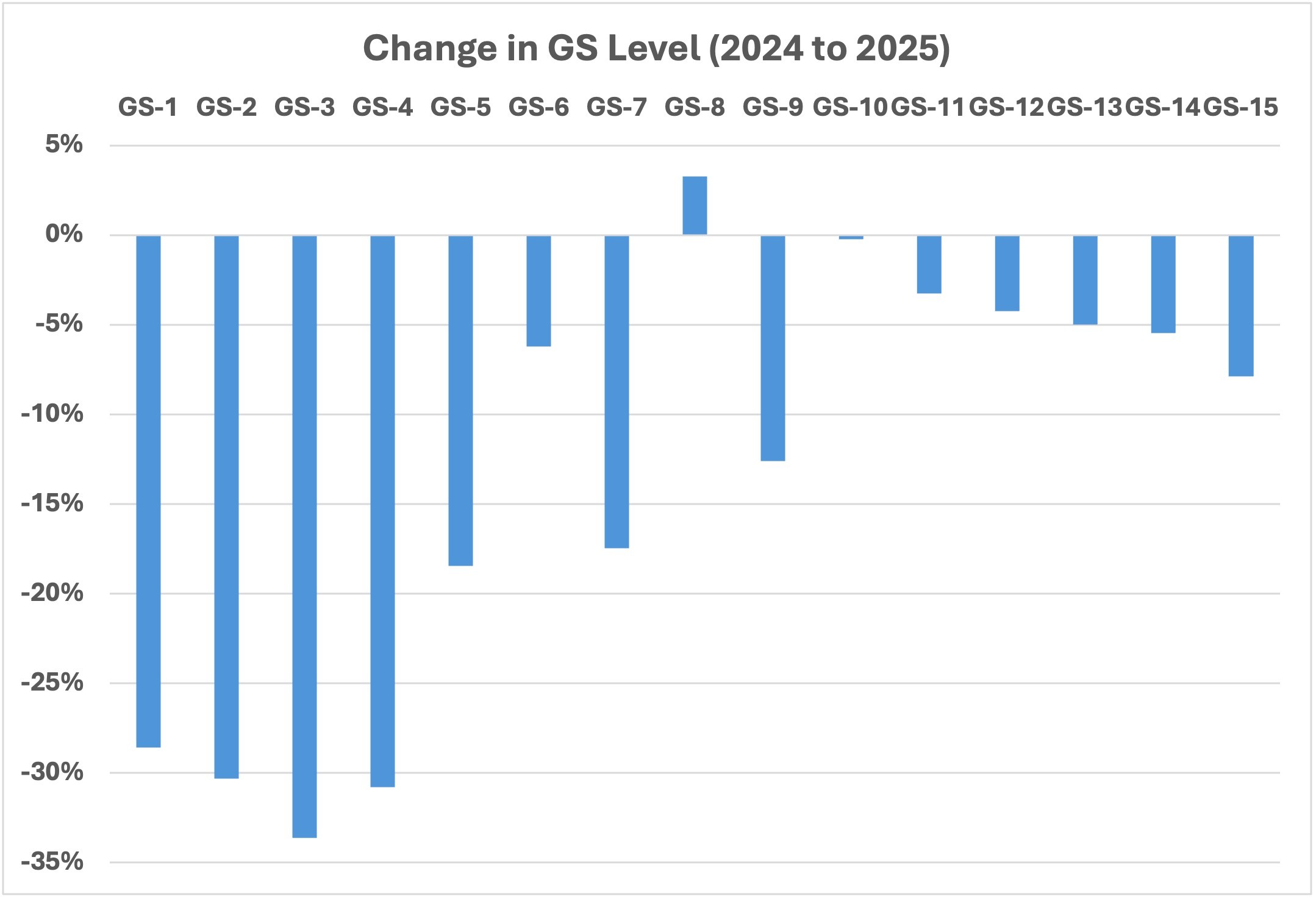
In fact, however, the largest cuts, in terms of percentage of the workforce, came at lower levels of the General Schedule. There were also significant cuts at the GS-7 and GS-9 levels, presumably as part of the administration’s strategy of firing probationary employees.
The Senior Executive Service was a major target
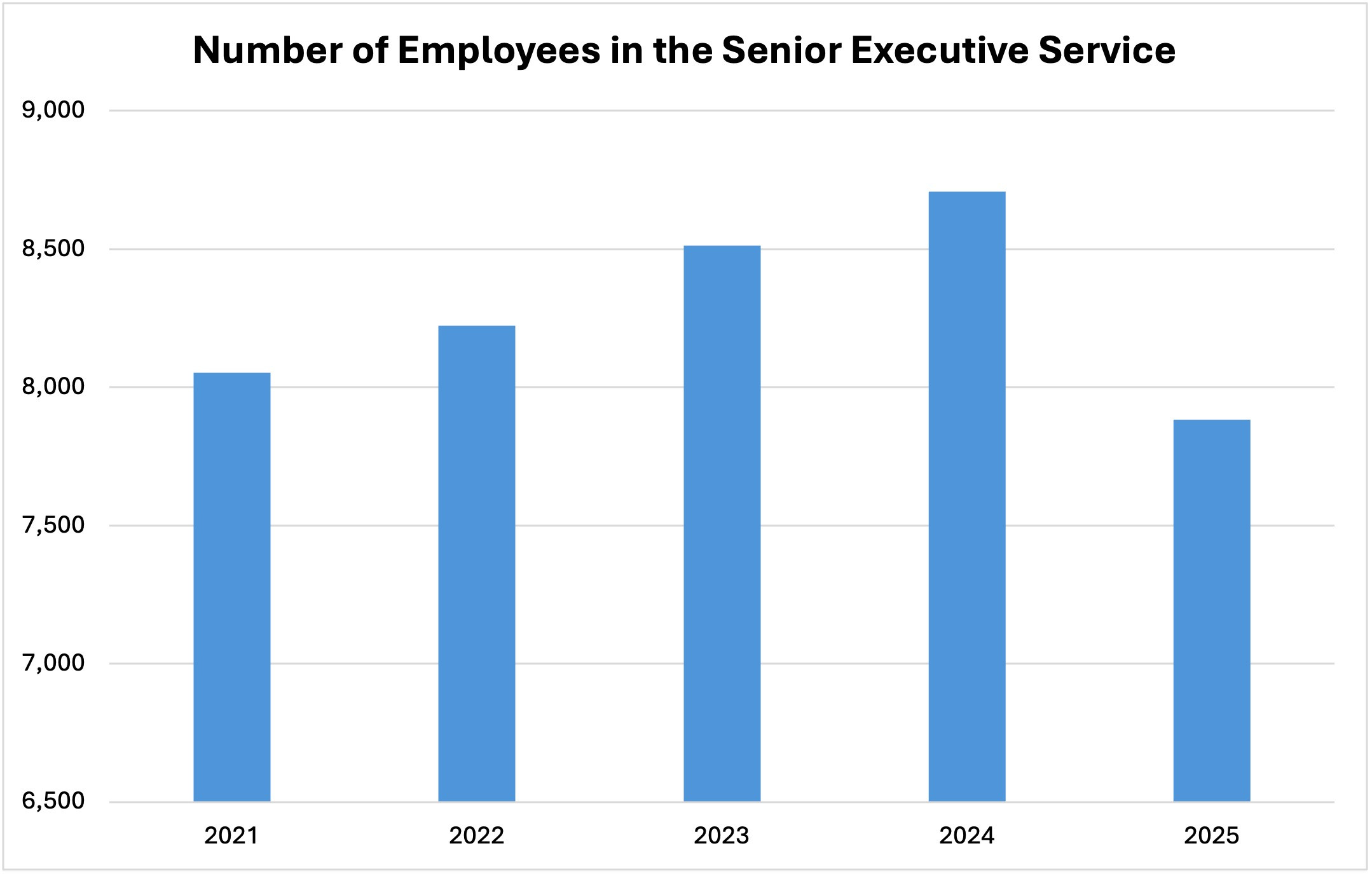
In terms of “draining the swamp,” however, the SES was a major target. These senior executives are among government’s most experienced employees, and they serve as a critical shock absorber between political appointees and the career service. There are now 9.4% fewer members of the SES than in 2024.
Public employee unions also took a hit
The share of federal employees in a bargaining unit dropped from 56.2% in November 2024 to 37.9% in November 2025.
Employee performance ratings dropped
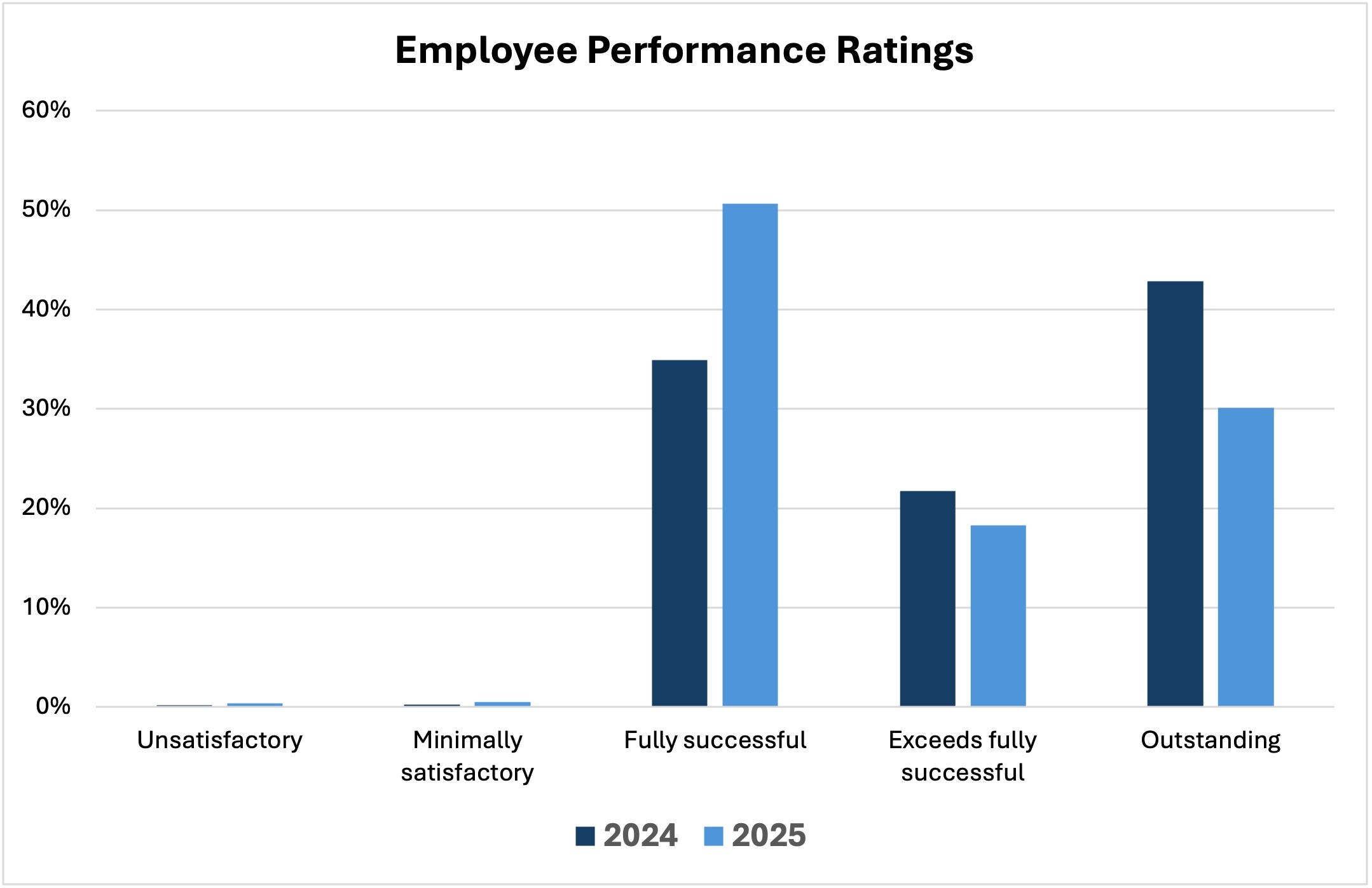
There’s been criticism of the federal employee rating system for many years, especially because critics have believed far too many employees get the highest ratings. The administration took a big step in reversing that in 2025. The number of employees rated in 2025 was just 29% of the number in 2024. But of those employees rated, the share receiving “outstanding” and “exceeds fully successful” dropped from 64% in 2024 to 48% in 2025.
Looking for a federal job?
Not a great time, needless to say. The number of job announcements in 2025 dropped 43%, compared with 2024. But if you are looking around, the Department of Defense is the best bet, followed by the VA and the Department of Justice (especially since, as always, DOD and the VA have the largest number of employees).
Your best chances for finding a federal job are in California and Texas, followed by Virginia. The odds are slimmest in Vermont, Iowa, Kentucky, Arkansas, West Virginia, Delaware, New Jersey, Rhode Island and Connecticut.
Donald F. Kettl is Professor Emeritus and Former Dean at the University of Maryland School of Public Policy. He is a Fellow of the National Academy of Public Administration.
CORRECTION: An earlier version of this article listed Minnesota as a red state that increased its federal employment. Kamala Harris won the state in 2024.
CLARIFICATION: An earlier version of this story referred