

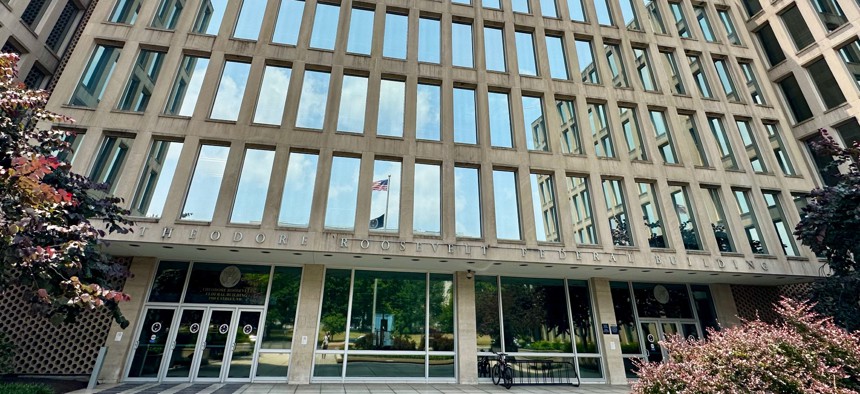
In a regulatory proposal set for publication Tuesday, OPM similarly proposed taking over MSPB’s handling of appeals that derive from an agency’s reduction in force. Douglas Rissing / Getty Images





OPM seeks to consolidate power over employee appeals in new regulations
Under a pair of regulatory proposals published this week, the federal government’s dedicated HR agency seeks to wrest appeals of suitability and reduction in force decisions from the Merit Systems Protection Board.

The Office of Personnel Management this week proposed two new sets of regulations that would grant itself the authority to adjudicate the appeals of some federal workers’ firings, wresting control from the Merit Systems Protection Board.
In proposed regulations published in the Federal Register Monday, OPM proposed taking over adjudication of suitability appeals, which refer to decisions on whether someone is appropriate for federal employment. Last year, President Trump signed an executive order instructing OPM to take over suitability decisions, which previously were handled by each individual agency.
In its proposal, OPM said it would ensure that the staff who make suitability determinations and those who adjudicate appeals of those decisions would be kept separate.
“Today, OPM’s suitability functions take place in an office that is split into two separate program areas,” the rule states. “This structure ensures that today, adjudicative staff involved in making suitability determinations and taking suitability actions are kept separate and distinct from another group of senior suitability adjudicative staff responsible for supporting OPM on appeals of suitability actions to the MSPB, with both sides reporting through separate supervisory chains of command. Under the proposed OPM appeal process, OPM will retain this structure to maintain decisional and supervisory independence between staff that make suitability determinations and take suitability actions from those that decide appeals of suitability determinations and actions.”
And in a regulatory proposal set for publication Tuesday, OPM similarly proposed taking over MSPB’s handling of appeals that derive from an agency’s reduction in force. The agency is preparing an additional proposal seeking to drastically streamline the RIF process, including by changing the criteria upon which agencies choose which employees to retain or lay off and stripping some job types from rules aimed at protecting employees rights during a RIF.
Across the two proposals, OPM lamented what it described as “cumbersome” and time-consuming processes associated with MSPB appeals. When an employee appeals a personnel action before the MSPB, they are entitled to a hearing; under OPM’s plans, that would be up to the discretion of whoever adjudicates the appeal. The agency also faulted Congress for MSPB’s frequent lack of a quorum, at one point going five years—four of which were during Trump’s first term—without the requisite two members needed to address a then-3,500 case backlog.
“During the 2017 to 2022 period when MSPB lacked a quorum, OPM had 14 appeals of its suitability actions impacted, where the individuals and agencies involved in the actions waited an average of five years and seven months between the time OPM took its suitability action and the date the board rendered a decision,” OPM wrote. “This situation leaves individuals and agencies in limbo for far too long. MSPB itself cannot rectify this recurring problem, as the cause of the lack of a quorum stems from the Senate’s failure to confirm nominees to the MSPB in a timely manner. The executive branch lacks any meaningful control over this process, and therefore prudent governance requires the executive to minimize disruption to personnel operations caused by loss of a quorum at MSPB.”
Michael Fallings, a managing partner at Tully Rinckey, a law firm that works primarily with federal employees, warned that OPM’s proposed streamlined appeal process is “vastly different” from what workers experience at MSPB. He said the proposals, coupled with the Trump administration’s adoption of a final rule re-implementing Schedule F, all work together to make it easier to remove federal employees and narrowing their avenues for recourse. Employees in “policy-related” jobs that are converted to the newly renamed Schedule Policy/Career would lose their right to whistleblower protection by the independent Office of Special Counsel, as those cases would now go to agencies’ in-house general counsel’s office.
“I’m concerned because it is more restrictive of employees’ rights,” he said. “The administration’s stated goal is to really streamline the process as far as removing employees is concerned, which in actuality is just an opportunity the administration is taking to remove and reduce the workforce in a less litigious fashion. I think the administration knows that employees will appeal if given the opportunity to do so, and that some of those appeals are justifiable, so they are trying to lessen the number of successful appeals and the ability for employees to fight these actions.”
American Federation of Government Employees National President Everett Kelley called the moves to sideline MSPB an effort to “illegally deny federal workers their right to appeal.”
“Eliminating independent review of federal RIF actions would not only make it harder for employees to challenge their proposed terminations, but would essentially give the administration free rein to terminate huge swaths of the federal workforce without meaningful independent oversight,” Kelley said. “This is all part of a deliberate attempt to dismantle the nonpartisan civil service. On their own, and taken together, these actions unlawfully concentrate removal authority in OPM and directly undermine the statutory framework Congress established to ensure an independent, professional and nonpartisan civil service.”
And Don Kettl, a professor emeritus at the University of Maryland and former dean of its School of Public Policy, said the various initiatives aimed at increasing OPM’s power over personnel decisions and reducing the influence of oversight bodies like MSPB, the Federal Labor Relations Authority and Office of Special Counsel are part of an effort to topple the 1978 Civil Service Reform Act.
“What the administration is trying to do is to eliminate any kind of independent brake on its policies or decisions,” he said. “[They’re] clearly trying to unwind as much of the CSRA as they possibly can, and that has to do with the role of the Senior Executive Service, the independent power of the SES, the appointment right and appeal rights of civil service employees . . . It’s all part of a much broader framework to unwind the CSRA bit by bit, regulation by regulation, without having to go to Congress to ask for legislation.”
Share your experience with us: Erich Wagner: ewagner@govexec.com; Signal: ewagner.47
NEXT STORY: How to attract tech workers to civil service? Give them credit!