

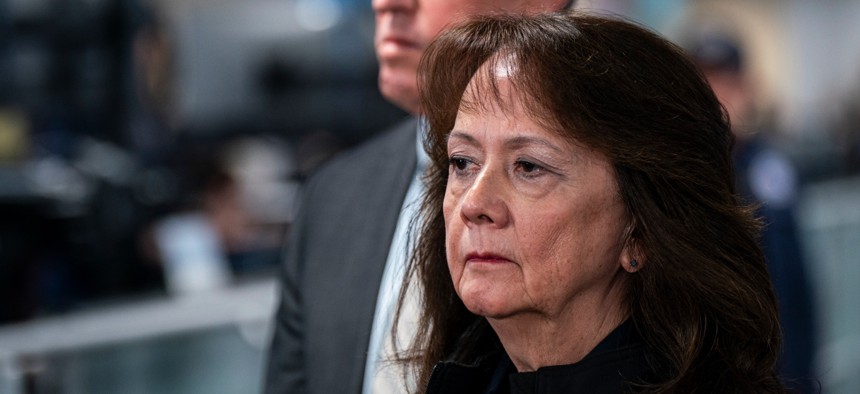
FEMA Administrator Karen Evans listens during a press conference in the National Response Coordination Center at FEMA headquarters on Jan. 24, 2026 in Washington, D.C. Evans testified last week that the agency's CORE workforce had grown too large, which former officials dispute. Al Drago / Getty Images




Officials warn disaster response at risk as former and current FEMA leaders clash in court over mass staff cuts
Recent FEMA execs say the current leadership does not understand how the agency actually works.

Updated Feb. 27 at 1:01 p.m.
Current and former leadership at the Federal Emergency Management Agency are engrossed in a back-and-forth dispute in federal court over the impact of the disaster response office shedding staff en masse, with some officials saying the Trump administration is putting FEMA’s core functions at risk.
The legal clash is playing out as part of a lawsuit in which a federal employee union and local governments are seeking to block an alleged plan by the FEMA to halve its workforce. Current FEMA employees and former executives in written testimony to the court praised the agency’s Cadre of On-Call Response and Recovery staffers, who work under two-to-four year contracts that are typically renewed but have been systematically dismissed at the end of their agreements starting late last year. CORE employees are often the first to deploy following a disaster and, according to the lawsuit, some of the terminated workers were in the middle of hurricane relief deployments.
FEMA has so far slashed more than 1,000 CORE employees since 2024, or about 10% of that workforce. FEMA also employs about 4,000 reservists, who serve on a part-time basis and only activate during disasters, and around 5,000 permanent, full-time staff.
Karen Evans, who is currently serving as the FEMA administrator, said in her declaration before the court last week that the CORE workforce, like the agency’s overall mission, had grown too large. She noted that during the Biden administration, CORE staff deployed to assist in housing migrant children. Evans has served in her current role since December and is the third official President Trump has tapped to temporarily lead FEMA.
MaryAnn Tierney, who served at FEMA for 15 years, including as the acting deputy administrator through June, said on Wednesday in response to Evans that the acting administrator is out of her depth and misrepresenting the facts on the ground.
“Ms. Evans' declaration does not accurately reflect the operational realities of FEMA disaster response and recovery, nor does it adequately address the functional consequences of the current non-renewal practices on FEMA's existing statutory obligations,” Tierney said. “I believe the assertions in Ms. Evans' declaration materially understate the operational harm resulting from the January 2026 CORE non-renewals.”
Evans has only been in her role at FEMA since December, Tierney said, and she therefore relies only on theoretical understandings of how FEMA operates rather than “first-hand experience managing large-scale disaster operations, surge staffing or long-term recovery.”
Historically, Tierney added, non-renewals of COREs resulted from specific analysis of issues such as recovery backlog, housing inventory and grant management obligations. In this case, by contrast, she said the decisions were centralized and made all at once as part of an attrition effort.
Evans in her declaration sought to tamp down the impact of the non-renewals, suggesting that FEMA can easily ramp up staffing as required by disaster needs. Tierney disputed that account, arguing instead that a large cadre of the full-time CORE employees are necessary to supplement the part-time reservists who FEMA activates when a disaster strikes. Newly hired employees cannot quickly replace separated CORE staff, she added, as they need to clear background checks, get onboarded, receive training and certification and have on-the-job experience before they can deploy to disasters.
“Surge capacity cannot be created instantaneously,” Tierney said, who warned that without CORE staff FEMA “cannot execute its mission.”
Functions at risk of suffering include the processing of individual disaster assistance applications, managing public assistance grants, conducting damage assessments, serving in field leadership and logistics roles and operating of temporary housing units.
“In practice, CORE employees are not peripheral or supplemental,” Tierney said. “They constitute the operational backbone of FEMA's response and recovery workforce. During my 15 years at FEMA, there was no major disaster in which CORE employees were not indispensable from initial response through recovery closeout.”
Evans also suggested the non-renewals were standard, noting FEMA declined to bring back 349 CORE staff in 2025. FEMA did not renew 159 CORE employees last month, though those figures were mitigated when the agency paused the apparent blanket non-renewal approach due to severe snowstorms. She added there is no blanket policy and non-renewals occur where there are performance or overstaffing issues.
Earlier this month, Michael Coen, who served as FEMA’s chief of staff during the Obama administration, also extolled the benefits of the CORE workforce. In addition to immediate deployments, he said, CORE staff overwhelmingly serve in longer-term roles at disaster sites to provide assistance in the months and years that follow.
“CORE employees perform critical functions all across the agency, and mass non-renewal of CORE employees would have a devastating impact on FEMA’s disaster response and recovery capabilities,” Coen said.
Victoria Barton, FEMA's associate administrator for external affairs, disputed the critical filings and said Evans laid out a "clear-eyed review of agency operations." She criticized Coen and Tierney—the latter of whom served as acting deputy administrator under Trump—for contributing to "inflating the workforce beyond sustainable levels," and said they are no longer attuned to the situation on the ground. Barton noted that Evans has more than 30 years of federal service, with most of that experience coming in the technology space.
"She has brought a level of scrutiny and accountability [to FEMA] that was previously lacking," Barton said. "FEMA finally has leadership who is closely examining operations and asking the tough questions that previous entrenched bureaucrats either overlooked or, quite frankly, buried or hid for their own gain. The federal government is not a jobs program."
Several former FEMA workers impacted by the new policy also issued written testimony to the court, noting they worked in areas such as providing disaster assistance to states, training employees or developing applications upon which agency programs run. They expressed complete surprise by their contracts not being renewed. Darrell Burton, a current full-time, permanent FEMA employee, told the court that the CORE non-renewals has made it impossible to find any instructors to train FEMA staff in western states on wildfire response.
Local disaster managers throughout the country also offered their testimonies, saying they would be ill-suited to handle existing or future disasters without the support of FEMA and its CORE staff.
Plaintiffs in the lawsuit have argued that staffing cuts by FEMA and the Homeland Security Department, its parent agency, are unlawful because of statutory mandates for officials to maintain capacity for disaster response and recovery and requirements in the Post-Katrina Emergency Management Reform Act that prohibit DHS from significantly modifying FEMA’s mission. Tierney and Coen said DHS did not make staffing decisions at FEMA during their time at the agency, though Evans said the department has final say over all staffing decisions.
This story has been updated with additional comment.