

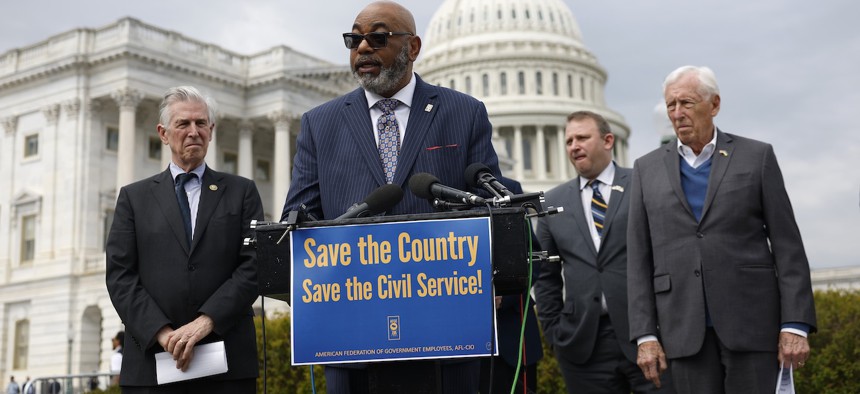
American Federation of Government Employees National President Everett Kelley speaks alongside Rep. Don Beyer, D-Va., at a press conference on federal workforce rights outside the U.S. Capitol on March 28, 2025. Lawmakers and union leaders spoke out against President Donald Trump's executive order ending collective bargaining with federal labor unions. Kevin Dietsch/Getty Images




Appeals court declines to block Trump’s anti-union EOs
The lone Democratic appointee on a Ninth Circuit three-judge panel suggested that he and his colleagues may reach a different conclusion with the benefit of a “fully developed factual record.”

A federal appeals court on Thursday declined to enforce a temporary decision blocking the Trump administration from stripping two-thirds of the federal workforce of their collective bargaining rights, dimming though not extinguishing the American Federation of Government Employees’ legal challenges against a pair of anti-union executive orders.
A three-judge panel on the Ninth Circuit Court of Appeals ruled unanimously that it could not uphold a preliminary injunction that would have blocked the Trump administration from implementing a pair of 2025 executive orders that cite a seldom-used provision of the 1978 Civil Service Reform Act to ban collective bargaining at most federal agencies, under the auspices of national security. That injunction had itself been put on hold by the appellate judges since last August.
AFGE has argued that the president’s invocation of national security concerns in the executive orders is a mere pretext to retaliate against unions for their actions speaking out against and challenging Trump’s policies in court. But the three-judge panel in its first ruling found that the administration likely would have taken the same action absent the union’s First Amendment activity, a decision they reiterated in Thursday’s ruling.
“The [Office of Personnel Management] guidance on EO 14251 buttresses [our prior] conclusion because it highlights how collective bargaining has assertedly undermined the president’s ability to oversee the federal workforce, which is essential ‘to take care that the law is faithfully executed and to protect America’s national security,’” wrote U.S. Circuit Judge Daniel Bress, a Trump appointee. “In short, because EO 14251 has ‘a legitimate grounding in national security concerns, quite apart from any’ retaliatory animus, the government on the existing record has shown that the president would have taken the same actions in the absence of the asserted retaliatory intent.”
But the ruling was not all bad news for unions seeking to challenge their ouster from the federal workplace. The panel unanimously agreed with AFGE’s analysis that federal courts had jurisdiction to hear its complaint immediately. The Trump administration has argued across the various lawsuits challenging the executive orders that labor groups must first pursue their claims before the Federal Labor Relations Authority, despite the fact that the edicts in question remove their bargaining units from that quasi-judicial agency’s jurisdiction.
“Although it is true that Congress ‘intended the [federal sector labor-management relations statute] statutory scheme to be exclusive with respect to claims within its scope,’ AFGE’s challenges are best viewed as outside the statute’s scope because EO 14251 has excluded the employees of the listed agencies from coverage under Chapter 71 (i.e., the FSLMRS),” Bress wrote. “In issuing the executive order, the president pursuant to § 7103(b)(1) determined “that Chapter 71 of title 5, U.S. Code, cannot be applied to these agencies and agency subdivisions in a manner consistent with national security requirements and considerations.’”
And in a concurring opinion, U.S. Circuit Judge John Owens, an Obama appointee, stressed that the panel could reach a different conclusion on whether the executive orders are retaliatory with the benefit of a more fulsome factual record to review. Specifically, he said that the judges were hamstrung by a lack of consideration of a legal test established in the 1977 Supreme Court Mt. Healthy City School District Board of Education v. Doyle at the district court level.
“Here, the district court did not address the applicability of Mt. Healthy . . . to the question at hand,” Owens wrote. “And based on the preliminary record before us now, I agree that the government likely would prevail on this issue, meaning that the plaintiffs have failed their significant burden. But ‘because our review of a preliminary injunction is limited to the law applied by the district court and because the fully developed factual record may be materially different from that initially before the district court, our disposition of appeals from most preliminary injunctions may provide little guidance as to the appropriate disposition on the merits.”
In a statement Thursday, AFGE National President Everett Kelley vowed to continue pursuing its claims at the district court level, and said his union is weighing whether to seek en banc review of the case by the entire Ninth Circuit bench.
“This case is not over,” he said. “The merits of this case are still very much alive. Importantly, the Ninth Circuit agreed with AFGE on a critical issue. The court held that federal district courts have jurisdiction to hear this challenge. That is a precedent-setting victory.”
Share your news tips with us: Erich Wagner: ewagner@govexec.com; Signal: ewagner.47
NEXT STORY: Fate of CFPB employees hang in the balance as judges consider agency's future