

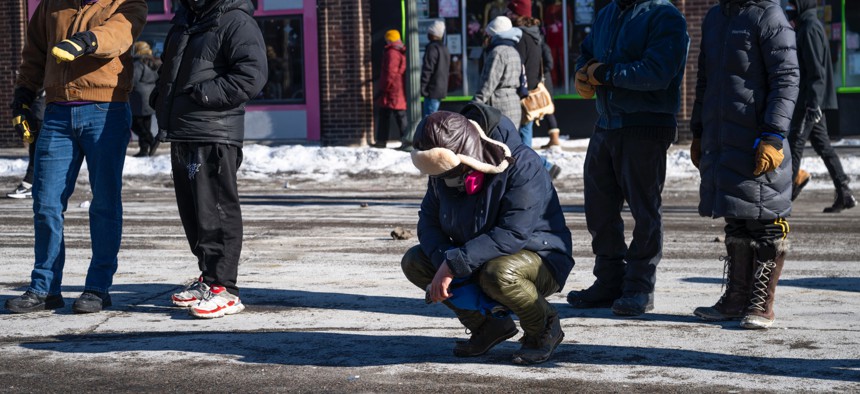
A person kneels near the site where 37-year-old Alex Pretti was allegedly shot and killed by federal agents on Jan. 24, 2026 in Minneapolis, Minnesota. Federal agents allegedly shot and killed Pretti, a south Minneapolis resident, amid a scuffle to arrest him. Stephen Maturen / Getty Images





Man fatally shot by Border Patrol agents was a federal employee at VA
The intensive care unit nurse was 37. His death could have widespread implications for federal operations.

Federal agents on Saturday fatally shot a man protesting immigration enforcement activities in Minneapolis. The man was later revealed to be an employee of the Veterans Affairs Department, working as an intensive care unit nurse at the medical center in the city where he was killed.
Alex Jeffrey Pretti, 37, was taken to the ground by several federal agents before one of them shot him. Pretti gathered with other protestors as Border Patrol was conducting what it called a targeted operation to detain an individual it said was in the country illegally.
Trump administration officials accused Pretti of approaching Border Patrol agents with a weapon and resisting efforts to disarm him. They said, without evidence, that Pretti was looking to “massacre law enforcement.” Analysis of videos of the incident by media organizations such as The New York Times found the evidence contradicted that version of events, as Pretti approached the with only his phone and his firearm was holstered and concealed until after the agents had forcefully brought him to the ground.
As a VA nurse, Pretti was a member of the American Federation of Government Employees chapter at the Minneapolis VA Medical Center. AFGE President Everett Kelley said Pretti "dedicated his life to serving American veterans."
“Our union is heartbroken,” Kelley said. “An AFGE member is dead. And a family’s life has been forever changed.”
Kelley blamed President Trump’s policies for creating the environment in which Pretti’s death occurred, though he encouraged his members to demonstrate restraint.
“I urge everyone to remain disciplined and measured in public, even as we are rightly angry,” Kelley said. “Still, we must do what we can to maintain peace and calm.”
The Trump administration was quick to denounce Pretti despite his work for the administration and with veterans, with Homeland Security Department Secretary Kristi Noem quickly labeling him a domestic terrorist. VA did not respond to a request for comment. Records indicate Pretti worked for VA since at least 2016.
Pretti’s death marked the third shooting by federal law enforcement in Minnesota in recent weeks. Earlier this month, an Immigration and Customs Enforcement agent shot and killed Renee Good, who was protesting the agency’s enforcement activities from her vehicle. Officers shot another man who was fleeing his attempted arrest.
Doug Massey, president of the AFGE chapter that represents employees in VA's headquarters, said the pain of Pretti's death would be widespread.
“Alex…was known by colleagues, friends, and family as a compassionate caregiver who was deeply committed to helping others,” Massey said. “His senseless death is a profound loss to his loved ones, his patients, and our union family.”
The shooting could have further implications for federal employees: Senate Minority Leader Chuck Schumer, D-N.Y., said in response to the shooting that his party would not agree to a six-bill funding package next week if it contains DHS appropriations. Half of the 12-annual must pass spending bills for fiscal 2026 have already cleared Congress, but the remaining six are still pending before the Senate. The House already approved them.
In addition to DHS, those measures would fund the departments of Defense, Labor, Health and Human Services, Education, Transportation, Housing and Urban Development, State and Treasury, as well as other related agencies. They are currently operating under a stopgap continuing resolution that is set to expire Jan. 30. Lawmakers could opt to fund just those agencies and negotiate separately over DHS, though such an approach would require new votes in both the House and Senate.
Share your news tips with us: Eric Katz: ekatz@govexec.com, Signal: erickatz.28
NEXT STORY: Laid off HHS employees win judge approval to seek class action suit